Yasawa Blue Ridge Sanctuary
A resort design for an undeveloped Yasawa island: villas along the ridgelines, a spa hidden in the green slopes, and the steep ground left wild.
NARARA · YASAWA GROUP · FIJI
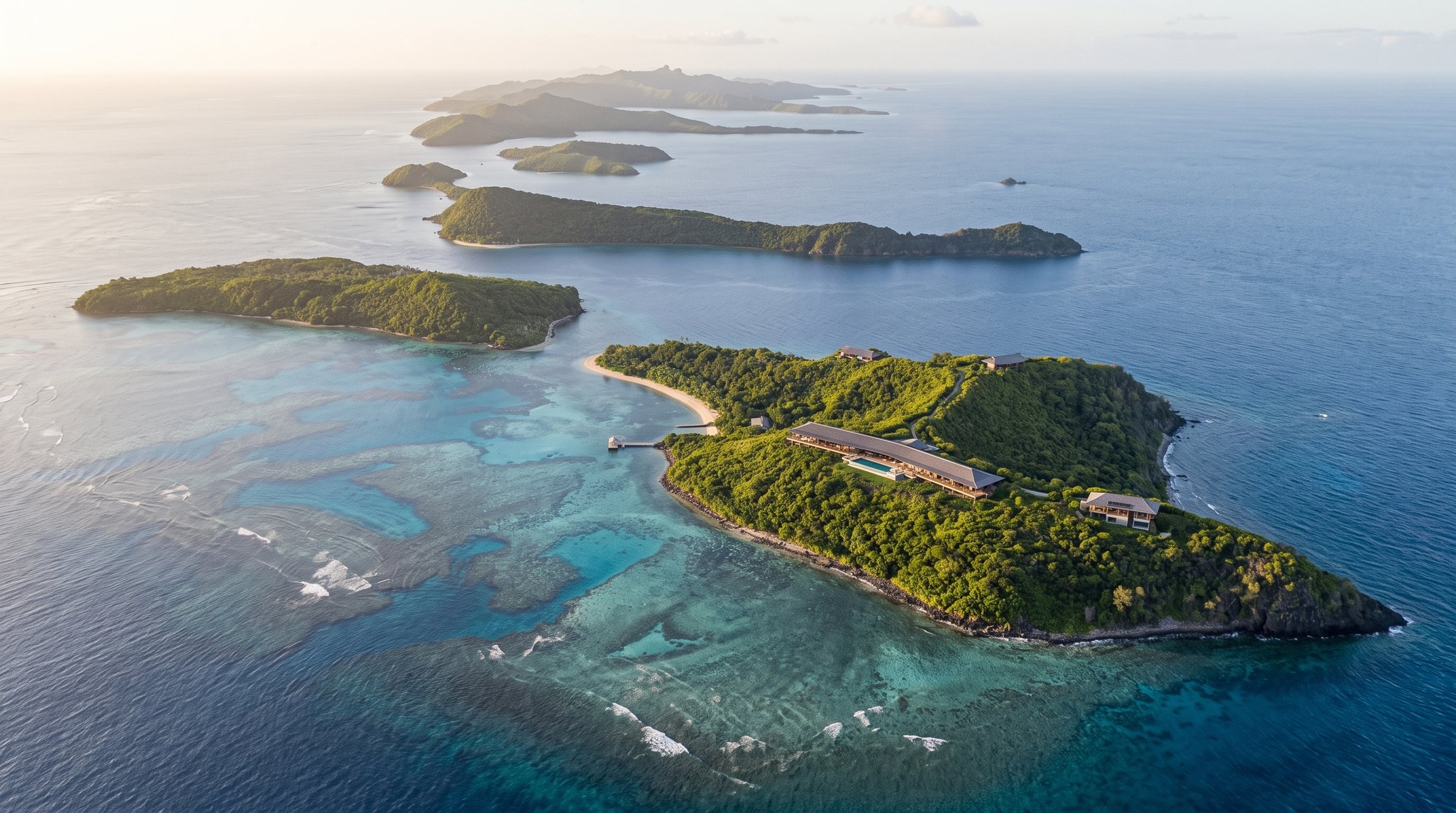
The best sites on Narara are not on the beach. They are above it.
Narara sits in Fiji's Yasawa Island Group: roughly 112 acres of forested slopes and white-sand beach, publicly listed and described as undeveloped. Most concepts for islands like this begin at the waterline and stay there. This design begins higher. The ridges are the island's strongest asset: elevation gives privacy, breeze, drainage and views in two directions, and it keeps buildings off the active beach and dune systems that Fijian coastal rules exist to protect. The guest sequence follows the terrain: a tender landing on a beach kept deliberately modest, a slow climb through vegetation, then a long pavilion on the ridgeline. Steeper slopes stay undeveloped. The sanctuary earns its name from two conditions meeting: blue water below, green ridge above.
| Location | Narara Island, Yasawa Island Group, Fiji |
|---|---|
| Site | Approx. 112 acres; undeveloped, with white-sand beaches and forested ridges |
| Programme | 20–35 keys and 6–10 private villas; wellness focus, private buyout option, phased delivery |
| Identity | Ridge-based sanctuary; blue water below, green ridge above |
| Status / Context | Appears publicly listed as available; foreshore lease and EIA screening would govern any works |
| Stage | In-house resort design — architecture, structure, MEP, BIM |
One spine, from water to ridge.
§03 — Masterplan strategyA single walking and buggy spine climbs from the arrival beach to the Ridge House and the villas beyond.
Everything on Narara hangs off one route. A small jetty or tender landing keeps the arrival modest; no marina, no dredging. The spine ascends through vegetation to the central pavilion, then distributes villas along elevated sites. A spa hides in the green slopes. Back-of-house and utilities sit in a screened lower valley. Steeper terrain is left alone, crossed only by walking trails. The masterplan protects the drainage, the vegetation and the silhouette that make the island worth building on.
Arrival Beach
A small jetty or tender landing on a beach left substantially as found. The arrival is deliberately understated: no marina, no dredging, no seawall. Works seaward of the high-water mark would wait on foreshore lease review.
Ridge Spine
A single walking and buggy route climbs from the beach to the Ridge House and onwards to the villas. One spine simplifies services, limits clearing and turns the ascent itself into part of the guest experience.
Ridge Villas
Villas occupy elevated sites chosen for privacy, breeze and double-aspect views. Elevation keeps buildings clear of the active dune systems and gives every key its own horizon, with the beach reserved for arrival and swimming.
Hidden Spa
A wellness sequence embedded in vegetation on the green slopes: treatment pavilions, water courts and outdoor bathing reached on foot. The spa is discovered along the climb, its rooms shaded by the canopy that conceals them.
Protected Ground
Steeper slopes remain undeveloped, used lightly as walking trails. Back-of-house, utilities and storage sit in a discreet lower valley, screened by landscape, so the working island never intrudes on the sanctuary above it.
The Ridge House.
§04 — The iconic pieceA long, horizontal pavilion on the natural ridgeline, framing blue water on both sides.
The Ridge House is the island's public heart: arrival lounge, restaurant, bar, library, yoga deck, wellness reception and a small infinity pool under one deep, shaded roof. Set along the crest, it frames views in two directions and uses the ridge as a natural ventilation and orientation device. Guests reach it on foot after the climb from the beach, which is precisely the point. Its presence comes from position and restraint.
Structurally it is straightforward: a repetitive engineered-timber frame on stone plinths, low-rise, with cyclone-rated roof anchorage and tie-downs throughout. The linear plan suits prefabrication and staged delivery to a remote site, and every element remains inspectable and repairable — the discipline outer-island Fiji demands.
Architecture, engineering, ecology.
§05 — The technical layersRefined Fijian tropical modernism
Deep roofs, shaded verandas, timber and local stone, woven screens and lime plaster. The language is low-rise and low-impact, tuned to natural ventilation and the ridge condition. Nothing on the skyline shouts; the architecture defers to the terrain that organises it.
Cyclone discipline in timber
Engineered timber frames on stone bases, cyclone-rated roof systems with anchorage and tie-downs, and marine-grade fixings specified for salt-laden air. Modular villa structures standardise the engineering while allowing each unit to adapt to its own slope and orientation.
Autonomous and screened
The island generates its own power through solar and battery plant, treats its own water and wastewater, and routes services along the single spine to limit trenching in steep terrain. Vegetation and natural drainage are protected as infrastructure in their own right.
Terrain-led coordination
Topographic masterplanning in a coordinated BIM environment: terrain models drive villa placement, service routing and cut-and-fill control on steep ground. Standardised villa families with local adaptation keep documentation lean and the phasing legible from concept onward.
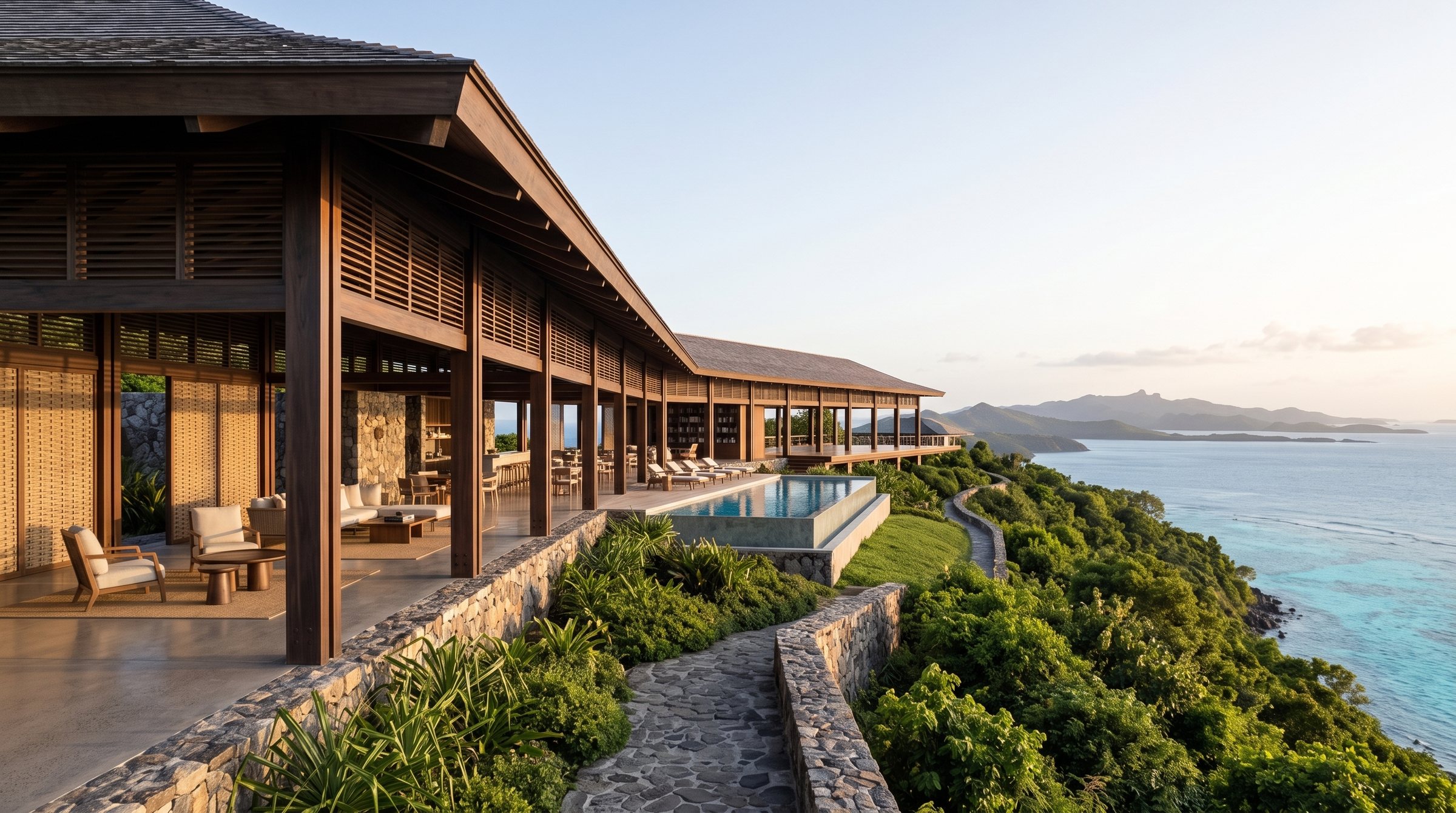
Luxury here is two conditions meeting: blue water and green ridge.
Steep terrain, cyclone exposure and outer-island logistics make Narara a compact test of the studio's central claim: that topography, structure and services can generate the architecture. Narara Island is privately owned and appears publicly listed for sale; this is an independent concept with no affiliation with any owner, broker or Fijian authority. Any real project would require title verification, EIA screening, foreshore lease review and local licensed consultants.
If a project here became live, we would work as the technical partner alongside the licensed local consultants who carry statutory responsibility in the jurisdiction — the architect of record, structural checkers, MEP and utilities engineers, and the environmental, coastal and fire specialists the approvals require. Our role is design, structural engineering, MEP coordination, BIM and construction-oriented documentation.