Alidhoo Art & Wellness Island
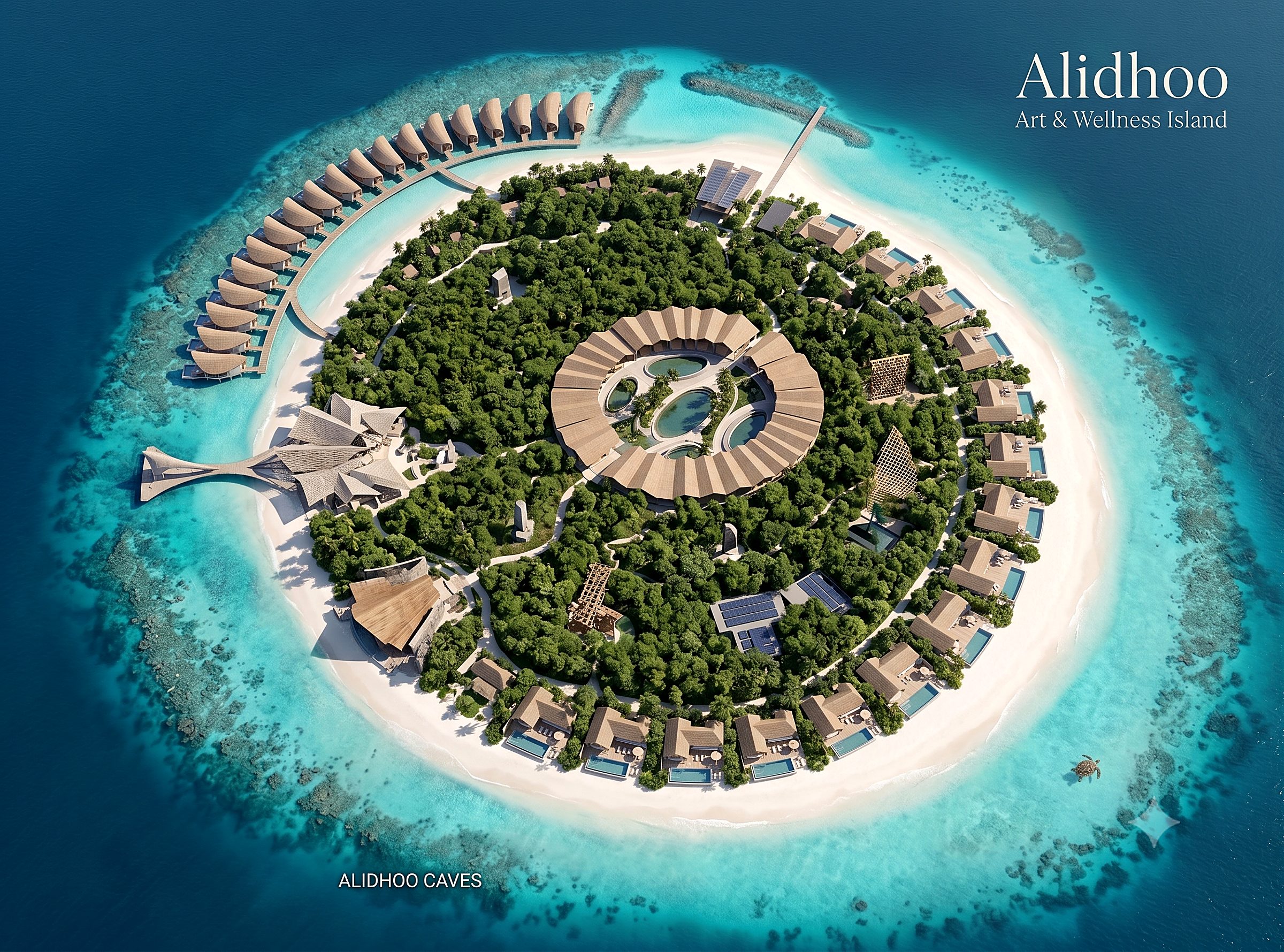
A round island in the far north, planned as a single work: not a resort decorated with art, but a resort conceived as one. Fifty keys, a sculpture route instead of corridors, and a circular wellness ring hidden in the green.
The furthest island in our Maldives series — and the one where architecture is asked to do the most.
Alidhoo sits in Haa Alifu Atoll, at the remote northern end of the Maldives, inside its own reef ring and near the underwater caves that dive boats know it for. Distance is the brief. Guests who travel this far north stay longer, move slower and expect more than a beach — so the island is planned as a continuous curated experience: buildings, pathways, courtyards and water spaces conceived as architectural pieces with clear function and honest structure. The circle of the island sets the plan; everything else follows its geometry.
| Location | Alidhoo, Haa Alifu (North Thiladhunmathi) Atoll, far-northern Maldives |
|---|---|
| Setting | Round reef-ring island · house reef and the dive caves that carry its name |
| Programme | 50 keys — 32 beach villas · 18 Wave Villas on the lagoon arc · The Art & Wellness Ring · sculpture route · arrival gallery |
| Identity | Art and wellness — long stays, slow travel, an open-air collection |
| Status | Public purpose — resorts |
| Stage | Concept design — architecture, structure, MEP, BIM |
The collection, in motion.
Around the ring and along the Wave Villas — the island read as one continuous piece, from arrival gallery to the quiet centre.
A museum you sleep in.
§03 — Masterplan strategyThe plan is concentric: a beach ring of villas, a forest, and one circle of wellbeing at the centre.
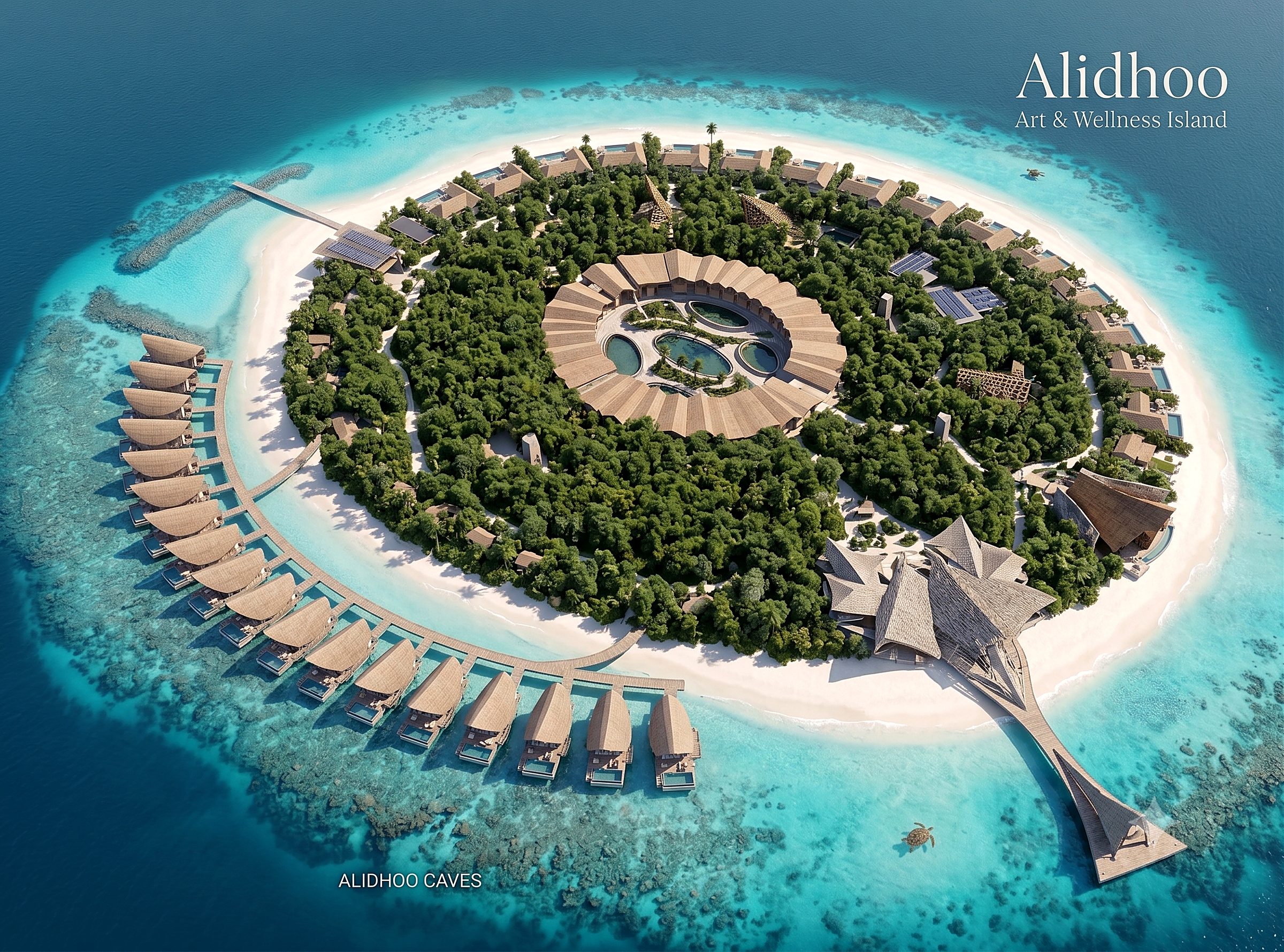
Fifty keys are read from the plan itself — 32 beach villas on the outer ring, behind the vegetation line and each with its own garden and pool, and 18 Wave Villas carried over the lagoon on a single curved arc. Between the two rings, the interior stays forest: the sculpture route threads through it, connecting arrival, dining, spa and shore without a straight line anywhere on the island.
The Ring at the centre
The Art & Wellness Ring sits in the densest vegetation, invisible from the beach — treatment rooms, hydrotherapy pools, meditation courts, yoga decks and shaded galleries arranged around quiet water gardens.
The Wave Villas
Eighteen overwater villas on one soft arc, their curved rooflines following the rhythm of the water — deep overhangs, timber ribs, private pools and direct lagoon access. An arc, because the lagoon has no corners.
The sculpture route
Stone pieces, timber lattices, suspended shade structures, water mirrors and low light works — placed along the paths, not in a lobby. The route is the circulation diagram; the art is the wayfinding.
The beach ring
Thirty-two villas around the island's perimeter, spaced by vegetation, each opening to its own stretch of sand. The arrival gallery — a folded-roof pavilion at the head of a flared pier — is the first piece in the collection.
The working island
Solar fields sized into the plan from day one, with desalination, wastewater treatment and service routes grouped and screened. Sustainability is carried as infrastructure here, not as messaging.
The Art & Wellness Ring.
§04 — The iconic pieceA circle in the forest — geometry doing the work that walls usually do.
The Ring is a single circular pavilion hidden at the centre of the island, its radial roof segments opening onto an inner court of organic pools and planted gardens. The circle is not ornamental: it creates privacy without fences, microclimate without machinery, and a natural sequence for the wellbeing rituals it holds — spa treatment rooms, hydrotherapy, sound therapy, meditation courts and galleries, each turned inward to water and light.
Guests move through it the way they move through the island — in a slow curve, from shade to light to water. Structurally it is a repeated radial bay in timber and stone, sized for barge logistics and buildable by the trades a remote atoll actually has.
Function first — then the sculpture.
§05 — Architecture · engineering · ecologyTechnical minimalism, warm materials
Timber, stone, muted concrete, woven screens and bronze-toned metal — a palette that reads as one collection across villas, pavilions and installations. Every sculptural move carries a function: shade, privacy, orientation or structure.
Curves built from straight logic
The Wave Villas' curved roofs resolve into repeated prefabricated ribs; the Ring is one radial bay, repeated. Corrosion-aware detailing throughout, and overwater structures coordinated with the marine and geotechnical specialists who own the lagoon works.
The far north kept dark and quiet
Passive shading and cross-ventilation first; then solar with battery storage, desalination with energy recovery, treated wastewater reused for irrigation. Low-light design protects the reef at night — and keeps the island's own artworks lit softly, not the sky.
A collection needs a catalogue
Fifty keys, one ring, eighteen curved roofs and a route of installations — coordinated in a federated BIM model with Tekla detailing, so each piece arrives on the barge as drawings that fit together the first time.
One island, one work.
From the air the plan reads like a drawing — the ring at the centre, the arc on the water, and the route stitching them together.
Not a resort decorated with art. A resort conceived as one.
Alidhoo is why this design exists: when architecture is asked to be the attraction, the technical layers have to be beyond reproach — geometry that builds, structures that repeat, infrastructure that disappears. This is an in-house concept design for a real island.
If Alidhoo — or any Maldives island — became a live project, we would work as the technical partner alongside the Maldives-registered consultants who carry local responsibility: the architect of record, structural checkers, MEP and utilities engineers, and the EIA, coastal and marine specialists responsible for foundations, lagoon works and environmental approvals. Our role is design, structural engineering, MEP coordination, BIM and construction-oriented documentation.