Berinmadhoo Northern Quiet Retreat
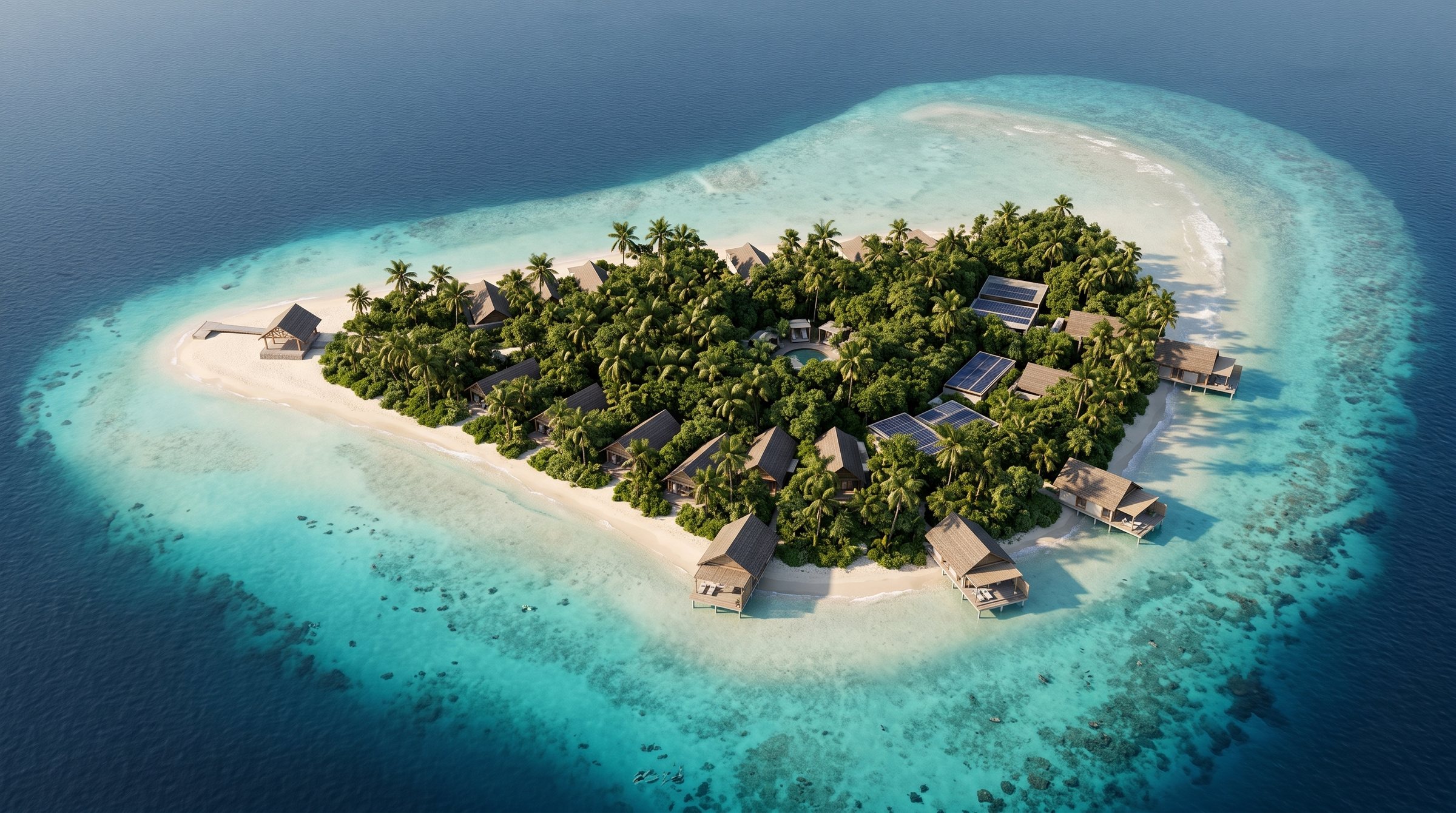
A compact northern island in Haa Alifu Atoll, held at resort scale rather than spectacle scale: 18 to 24 keys, one calm arrival line, villas tucked behind the vegetation, and service infrastructure kept small enough for the island to stay the main event.
Berinmadhoo is not a resort machine. It is a small northern island whose best design move is restraint.
The official island registry lists Berinmadhoo as a 15.40-hectare proposed island under the Ministry of Tourism, near Hanimaadhoo International Airport. The Ministry of Tourism's new developments list also identifies Berinmadhoo in Haa Alifu Atoll as a resort development. This design uses that real island context and the satellite geometry as the brief: compact footprint, quiet arrival, no oversized overwater fan, and no architecture that fights the island outline.
| Location | Berinmadhoo, Haa Alifu Atoll, Maldives |
|---|---|
| Coordinates | 7°02′50″N 72°58′16″E |
| Island | 15.40 ha · compact vegetated island · broad reef shelf and shallow lagoon edges |
| Access | Northern Maldives context, with Hanimaadhoo International Airport listed as the nearest airport |
| Programme | 18 to 24 keys — beach villas · limited reef-sensitive decks · arrival pavilion · wellness court · discreet service/solar compound |
| Density | Low-density design, roughly 1.2 to 1.6 keys per hectare |
| Status | Listed for resort development / under Ministry of Tourism |
| Stage | Resort design — architecture, structure, MEP, BIM |
Quiet is a layout decision.
§02 — Masterplan strategyThe plan stays inside the island's scale: one arrival, one soft guest heart, short service routes and no decorative sprawl into the reef.
Berinmadhoo is treated as a northern retreat for guests who want distance, calm and privacy. The masterplan keeps the main buildings on already legible high ground and uses the vegetation line as the first privacy layer. Beach villas sit as small, repeatable pavilions; overwater elements are limited and placed only where the reef survey would allow them in a real project.
Arrival on one line
A single jetty meets a low arrival pavilion, small enough to feel private and clear enough to orient the whole stay from the first step onto the island.
Villas behind the trees
Beach villas use the retained vegetation as privacy and shade. The count stays low so each key has its own piece of beach, wind and view.
Wellness in the quiet interior
A small spa and garden court sit inside the island rather than on the loudest edge, turning the dense green centre into an amenity.
Reef-sensitive water rooms
Lagoon rooms are treated as optional and few. In a live project they would follow coral, seagrass, current and bathymetry mapping, not a marketing diagram.
A discreet working edge
Back-of-house, desalination, wastewater, stores and photovoltaic roofs are grouped in one screened technical zone with short service paths and no guest crossover.
The Northern Room.
§03 — The iconic pieceA resort this small does not need a monument. It needs one memorable room where arrival, shade and water meet.
The Northern Room is the arrival pavilion, lounge and first restaurant under one long, low roof. It is not a grand object; it is a calibrated piece of shade set at the head of the jetty, with the lagoon in front and the island canopy behind. Its structure is deliberately repeatable: prefabricated timber and steel bays, corrosion-aware fixings, deep overhangs and a stone plinth that takes the weather.
For Berinmadhoo, identity comes from restraint. The roof gives the island a recognisable threshold without turning the shoreline into a stage set.
Low density, high discipline.
§04 — Architecture · engineering · ecologySmall buildings, exact shade
Low villas, deep verandas and muted materials. Nothing taller than the palms, nothing brighter than the beach, and no gesture that requires the island to pretend it is larger than it is.
A kit that can arrive by sea
Repeatable timber-and-steel frames, corrosion-aware connections and simple spans sized for remote transport and assembly. The fewer the special pieces, the more precise the island can be.
Passive first, plant second
Orientation, shade and cross-ventilation reduce load before mechanical systems appear. Solar roofs, battery storage, desalination with energy recovery and treated wastewater reuse would be coordinated with local utilities and environmental consultants.
A small island rewards certainty
A federated BIM model keeps architectural, structural and MEP decisions in one place, with Tekla detailing for prefabricated elements and quantities known before they leave the mainland.
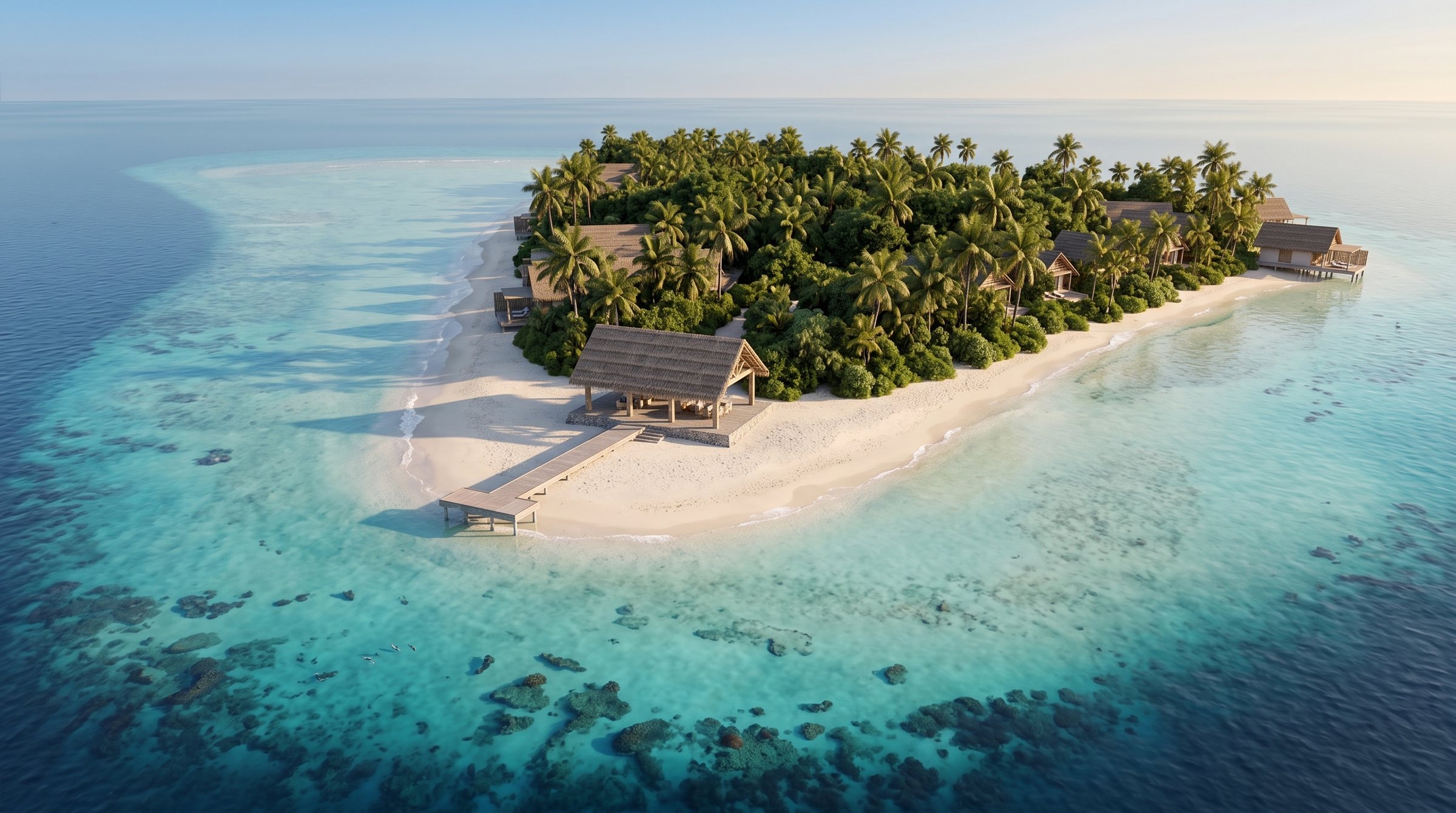
The same retreat, closer to the water.
The second image keeps the same island and resort logic, but reads the arrival and villas from a lower aerial angle.
A small island is not a smaller version of a large resort. It is its own discipline.
Berinmadhoo is included because it is real, listed in official Maldives tourism sources, and different from the other islands in the series: northern, compact and better served by quiet precision than by visual excess. This page presents our in-house resort design for the island — architecture, structure and BIM.
If Berinmadhoo — or any Maldives island — became a live project, the first steps would be formal ownership/lease verification, survey, bathymetry, geotechnical work, environmental baseline studies and an EIA process led by the locally authorised team. We would work as the technical partner alongside Maldives-registered architects, engineers, structural checkers, EIA consultants, coastal/marine specialists, fire consultants and utilities consultants.