Xeronisi North Aegean Architectural Hotel
An island hotel of 60–100 keys organised along one shaded architectural spine: arrival, lobby, dining, pool and spa on a single line, villas at the edges, and the engineering resolved from the first drawing.
XERONISI · NORTH AEGEAN
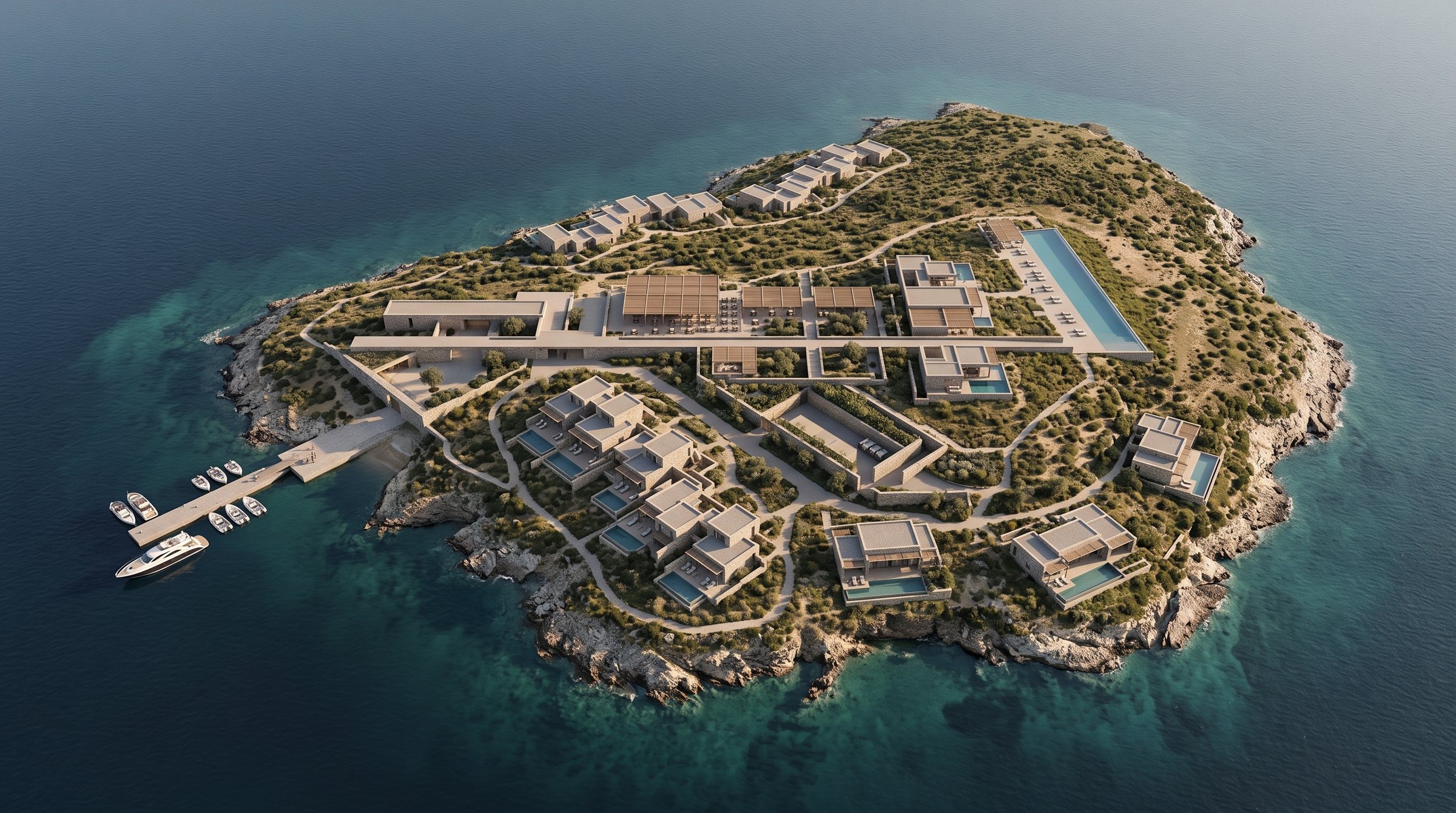
Every hotel has a diagram; on Xeronisi, the diagram is a line you can walk.
Xeronisi is the working hotel of the series, conceived for the North Aegean at a scale a boutique operator could run: sixty to one hundred keys plus eight to fifteen villas, potentially phased. The whole plan hangs on one move: the North Aegean Spine, a long, low public axis that begins at the pier and carries arrival, reception, lobby, restaurant approach, pool threshold and spa access in a single shaded sequence. Guest rooms sit in low-rise volumes terraced with the land, following the terrain, preserving views and keeping the visual mass down; premium villas take the best edges of the island. Behind all of it runs an equally deliberate service world — loading, laundry, plant, staff facilities and emergency access — planned with the same care as the sea view.
| Location | Island in the North Aegean · Greece |
|---|---|
| Site | Terraced island terrain; low-rise volumes follow the slope and keep the coastline legible |
| Programme | 60–100 rooms and suites, 8–15 private villas, spa, pool and beach zone, event terrace, full back-of-house |
| Identity | Architectural island hotel — boutique five-star, operable and phased |
| Status & Context | The most commercially realistic design in the series; phasing, capacity and infrastructure subject to Greek permitting and environmental review |
| Stage | Resort design — architecture, structure, MEP, BIM |
One spine, six zones.
§03 — Masterplan strategyA single public axis puts arrival, hotel core, villas, pool, wellness and services in an order everyone can read.
From a compact boat landing, the spine runs inland through courtyards and framed views, distributing guests to terraced room clusters and edge villas. The pool and dining zone opens off it towards the sea; the wellness hill sits apart and above, in a slower register. Behind everything, a planned service back handles loading, laundry, plant and staff movement without ever crossing the guest sequence.
Arrival and Spine
A compact pier, a shaded arrival court, then the spine itself: reception, lobby lounge, gallery walls and a sequence of courtyards. From the first minute, the hotel explains its own geography.
Hotel Core
Guest rooms sit in low-rise volumes terraced with the land. They follow the terrain, preserve views, create courtyards and keep circulation shaded, with guest and service routes separated throughout.
Villa Edge
Eight to fifteen premium villas take the island's best edges, each with a private terrace, a small pool, sea orientation and planted privacy buffers, served discreetly from behind.
Pool, Beach, Wellness Hill
The social zone gathers the main pool, a discreet beach club, all-day dining and a sunken lounge at the water. The spa, gym, yoga deck and treatment rooms sit higher and apart, deliberately slower.
Service Back
Kitchens, loading, laundry, waste, staff facilities, MEP plant, water systems and emergency access are drawn with the same precision as the lobby. In a hotel this size, the back of house is the business.
The North Aegean Spine.
§04 — The iconic pieceA long, low, shaded public structure that begins at arrival and becomes the hotel's main spatial experience.
The Spine is a linear building of stone walls, concrete slabs, timber ceilings and pergolas, punctuated by courtyards and controlled openings. Along its length it holds the arrival court, reception, lobby lounge, restaurant approach, gallery walls, pool threshold and spa access. Horizontal and unhurried, it gives the resort orientation, shade, public identity and service separation at once — the entire hotel becomes understandable in a single walk.
Structurally it is a repeating exercise: efficient bays, simple spans, reinforced concrete with steel or timber roofs, and coordinated MEP shafts running its length. Because it is linear, it phases naturally — the spine can be built with the first room clusters and extended as the hotel grows.
Architecture, engineering, ecology.
§05 — The technical layersNorth Aegean modernism
Low-rise hotel architecture with strong horizontal lines, shaded façades and integrated courtyards. Stone, board-formed concrete, warm timber, lime plaster and metal screens, under planted or mineral roofs — a restrained Mediterranean materiality with its technical logic left visible.
Modular grids, honest spans
Room volumes sit on modular structural grids with efficient bays, allowing repetition without monotony. Reinforced concrete carries the terraces, steel and timber carry the roofs, and retaining structures are used only where the terrain demands them.
Infrastructure planned as programme
A dedicated energy centre, water and wastewater systems, solar integration and greywater reuse are planned alongside the guest programme, with service tunnels and back-of-house corridors keeping deliveries, laundry and plant invisible to guests from opening day.
Phased and coordinated
The concept is structured for phased construction from the outset. Architecture, structure and MEP are coordinated in one BIM model, so each phase arrives with clash-checked services, resolved shafts and documentation ready for licensed local consultants.
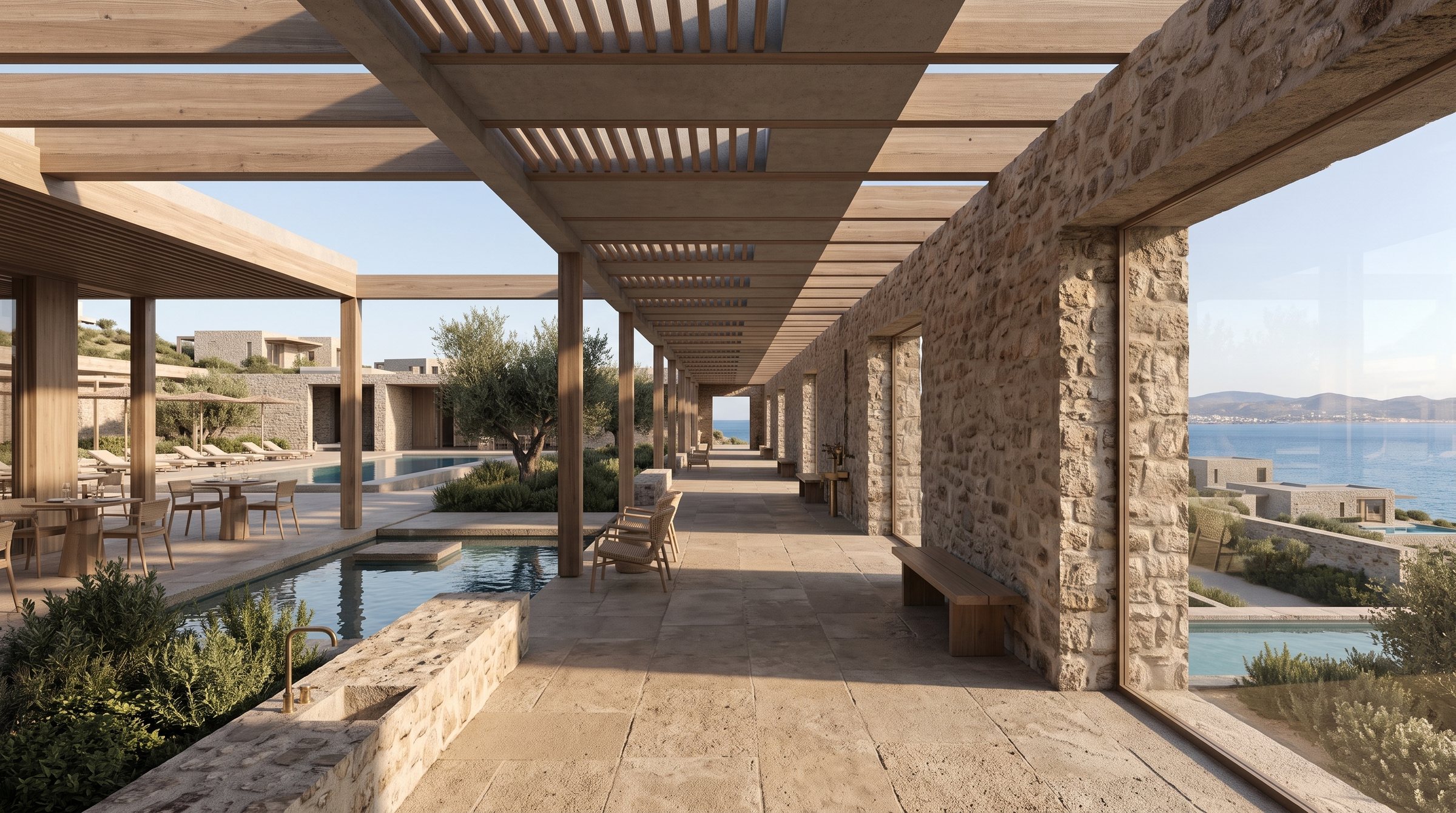
The spine is not a corridor; it is the instrument that makes the hotel legible.
Xeronisi is the studio's proof of technical credibility: a concept that thinks like an architect and an engineer at once, from guest experience down to loading bays and shaft positions. It is an in-house resort design, developed independently of any owner, investor, operator or authority. A real project would require ownership verification, zoning review, environmental assessment and coastal-regulation compliance, handled with licensed Greek consultants.
If a project here became live, we would work as the technical partner alongside the licensed local consultants who carry statutory responsibility in the jurisdiction — the architect of record, structural checkers, MEP and utilities engineers, and the environmental, coastal and fire specialists the approvals require. Our role is design, structural engineering, MEP coordination, BIM and construction-oriented documentation.