Whale Cay Runway & Heritage Club
Roughly 565 acres in the Berry Islands with a private runway of some 4,000 feet and historic estate buildings, reimagined as a private aviation and yachting club built on what is already there.
WHALE CAY · BERRY ISLANDS
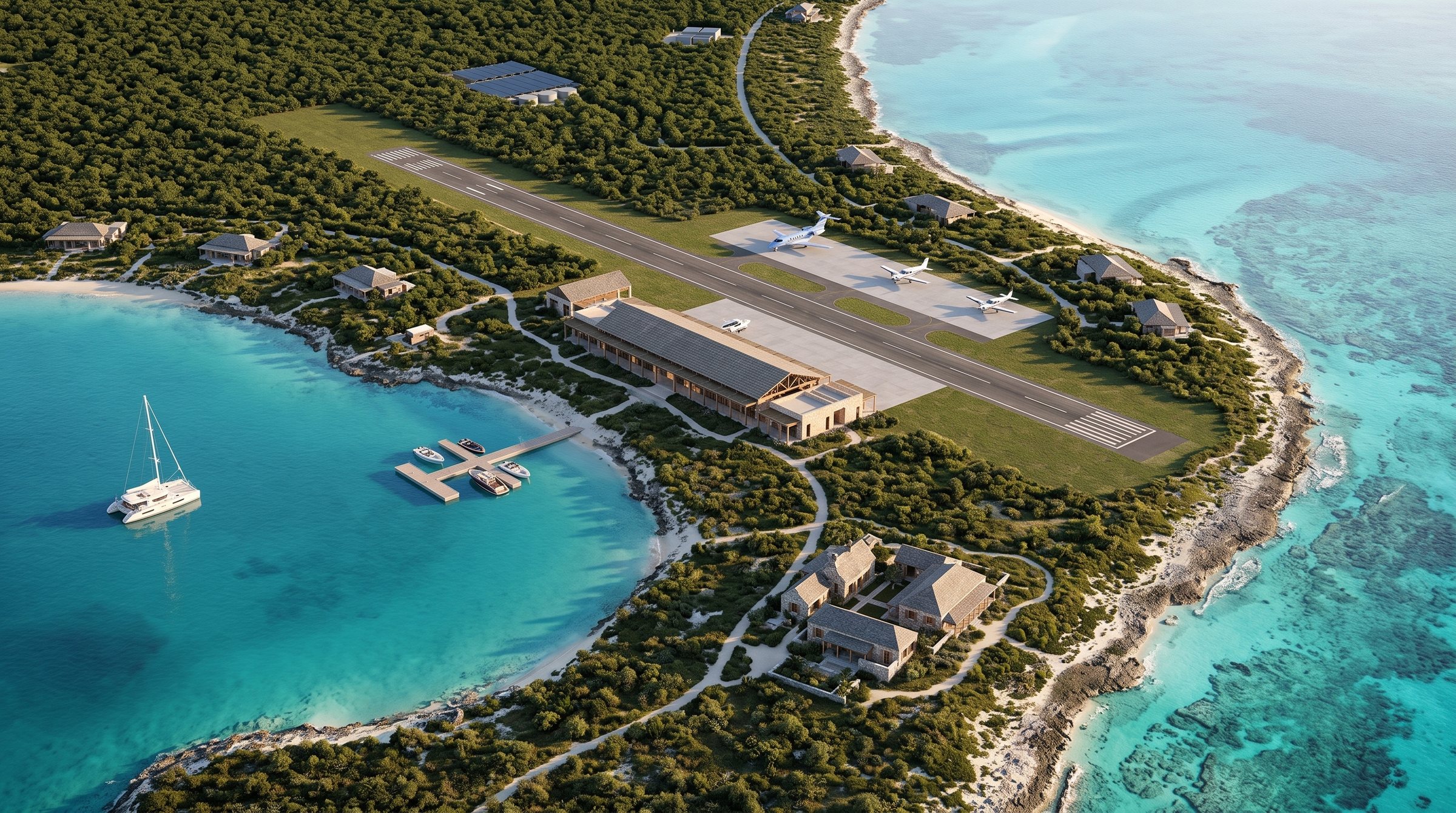
Most private islands begin with a beach; Whale Cay begins with a runway.
Whale Cay is unusual among listed Caribbean islands: roughly 565 acres in the Berry Islands with a private runway of approximately 4,000 feet, historic estate structures and existing infrastructure already in place. Public listings present it as a redevelopment opportunity with potential for canal-based yachting. This design resists the urge to wipe the slate. The island's identity is read as three inherited layers — aviation, heritage and water access — and the concept binds them into a private island club: a controlled 25 to 60 keys, estate villas in privacy clusters, historic buildings assessed and reused, and any marina ambition deferred until the environmental evidence exists. Arrival by private plane gives the island a logic few competitors can copy.
| Location | Whale Cay, Berry Islands, The Bahamas |
|---|---|
| Site | Approx. 565 acres with a private runway of approx. 4,000 ft, historic estate structures and existing infrastructure |
| Programme | 25–60 keys, members club, private estate villas, aviation arrival, yachting support, heritage reuse |
| Identity | Aviation-led island club built on inherited runway, heritage and water access |
| Status | Publicly listed for sale as a redevelopment opportunity. No affiliation with owners, brokers or Bahamian authorities. |
| Stage | In-house resort design — architecture, structure, MEP, BIM |
Three inheritances, one club.
§03 — Masterplan strategyThe plan organises the island around what already exists: the runway, the estate buildings and the water.
Runway arrival sets the sequence: guests land, pass through the Runway Clubhouse and disperse by buggy to villas grouped in privacy clusters. The historic estate becomes the cultural heart — library, dining, museum, owner club. Marine works stay deliberately light until studies justify more. Behind it all runs a technical backbone sized for an island that must fuel aircraft, service yachts and run its own utilities.
Runway arrival
The existing runway is treated as the island's defining asset: repaired, upgraded and folded into resort logistics, subject to a full pavement, drainage, lighting and safety review and the aviation approvals no concept can assume.
Heritage estate
The historic structures are assessed, stabilised and given working roles — library, dining room, island museum, owner club, concierge. Any demolition would follow heritage and legal due diligence, never convenience.
Villa districts
Villas group into distinct districts — aviation villas near the strip, waterfront villas, heritage estate villas and ridge villas with long sea views — so each cluster has its own character and none crowds another.
Marina restraint
The canal and marine setting invite yachting, but the plan starts with low-impact tender access and moorings. Any marina or canal activation is held behind EIA, bathymetry, hydrodynamics and seagrass and coral surveys.
Technical backbone
Fuel, power, water, waste, runway operations, boating logistics, staff housing and emergency services are planned as one system. An island with aircraft and yachts is judged on its logistics as much as its architecture.
The Runway Clubhouse.
§04 — The iconic pieceA long-span pavilion between the airstrip and the sea, where arrival becomes membership.
The Clubhouse sits between aviation arrival and hospitality: arrival lounge, members club, bar and restaurant, pilot and owner lounges, concierge and a gallery of island history, all under one long-span roof opening to shaded terraces and the sea. The architecture borrows hangar logic without becoming literal — a generous timber ceiling over coral stone walls, hurricane-rated glazed openings, large fans and a frankly expressed structure.
Long-span roofs are the studio's home ground: timber or steel trusses with tie rods, engineered for hurricane uplift under the Bahamas Building Code, on coral stone and concrete substructure. Corrosion-resistant detailing and robust maintenance access are designed in, because a building beside a salt-air runway earns its keep slowly.
Architecture, engineering, ecology.
§05 — The technical layersBahamian heritage modernism
Coral stone, timber trusses and steel tie rods, lime plaster, polished concrete and canvas shade — an aviation club vocabulary grounded in estate restoration. Long roofs and deep verandas give the scale; hurricane shutters and impact glazing keep it honest. The atmosphere is private club, unhurried and specific.
Audit, then build
Engineering starts with assessment: runway pavement and drainage, then a structural survey of every historic building, with concrete and masonry repair where viable. New construction is low-rise and hurricane-rated, with long-span clubhouse structure, corrosion-resistant details and buildings kept out of storm surge and wetland areas.
Autonomy with obligations
Autonomous power, desalination and water storage, wastewater treatment, fuel management and fire-fighting water form the utility core, alongside an emergency operations centre and hurricane shelter strategy. Bahamian environmental clearance — DEPP, likely EIA and EMP — is assumed as a precondition, and wetlands and marsh are treated as constraints.
A model of the existing
Because Whale Cay is a redevelopment, documentation begins with capturing what exists: runway, estate structures and infrastructure modelled as found, condition data attached. New work is coordinated against that record in one federated model, giving local consultants a defensible baseline for approvals and phasing.
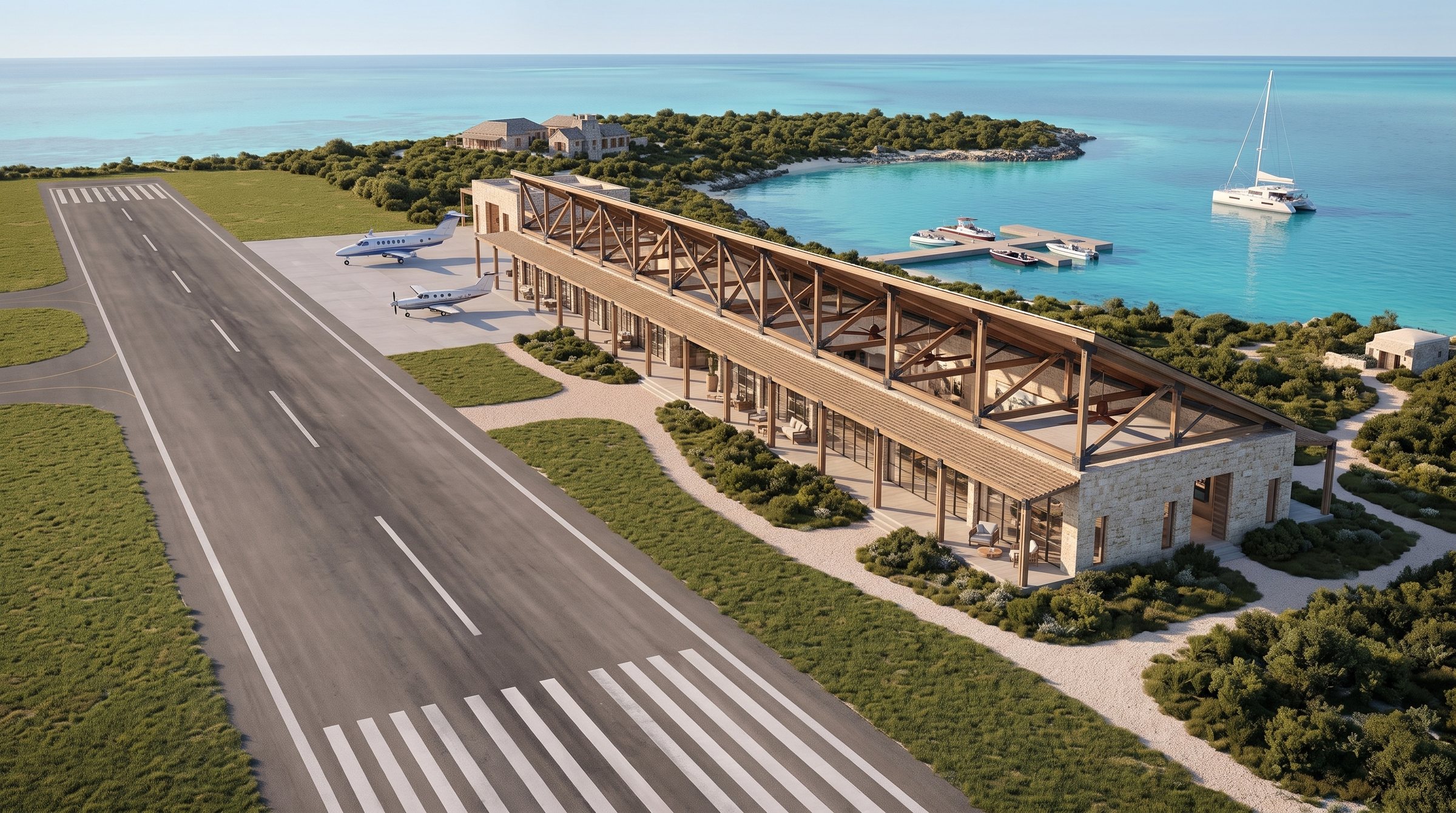
The rarest amenity in the Caribbean is a place to land.
It tests the studio's redevelopment method — audit before ambition — on infrastructure most practices never touch: a runway, salt-worn estate buildings and a working island's logistics. Whale Cay is privately owned and publicly listed for sale; we have no affiliation with its owners, brokers or Bahamian authorities, and no assumption is made that the runway can operate without aviation approvals. Any real project would require DEPP environmental clearance, heritage due diligence and licensed local consultants.
If a project here became live, we would work as the technical partner alongside the licensed local consultants who carry statutory responsibility in the jurisdiction — the architect of record, structural checkers, MEP and utilities engineers, and the environmental, coastal and fire specialists the approvals require. Our role is design, structural engineering, MEP coordination, BIM and construction-oriented documentation.