Vouvalos Lagoon Silence Resort
A lagoon retreat of 20–35 keys in northwestern Greece, where long, low architecture settles among olive groves, birdlife and still water, and the loudest event of the day is sunset.
VOUVALOS · NORTHWESTERN GREECE
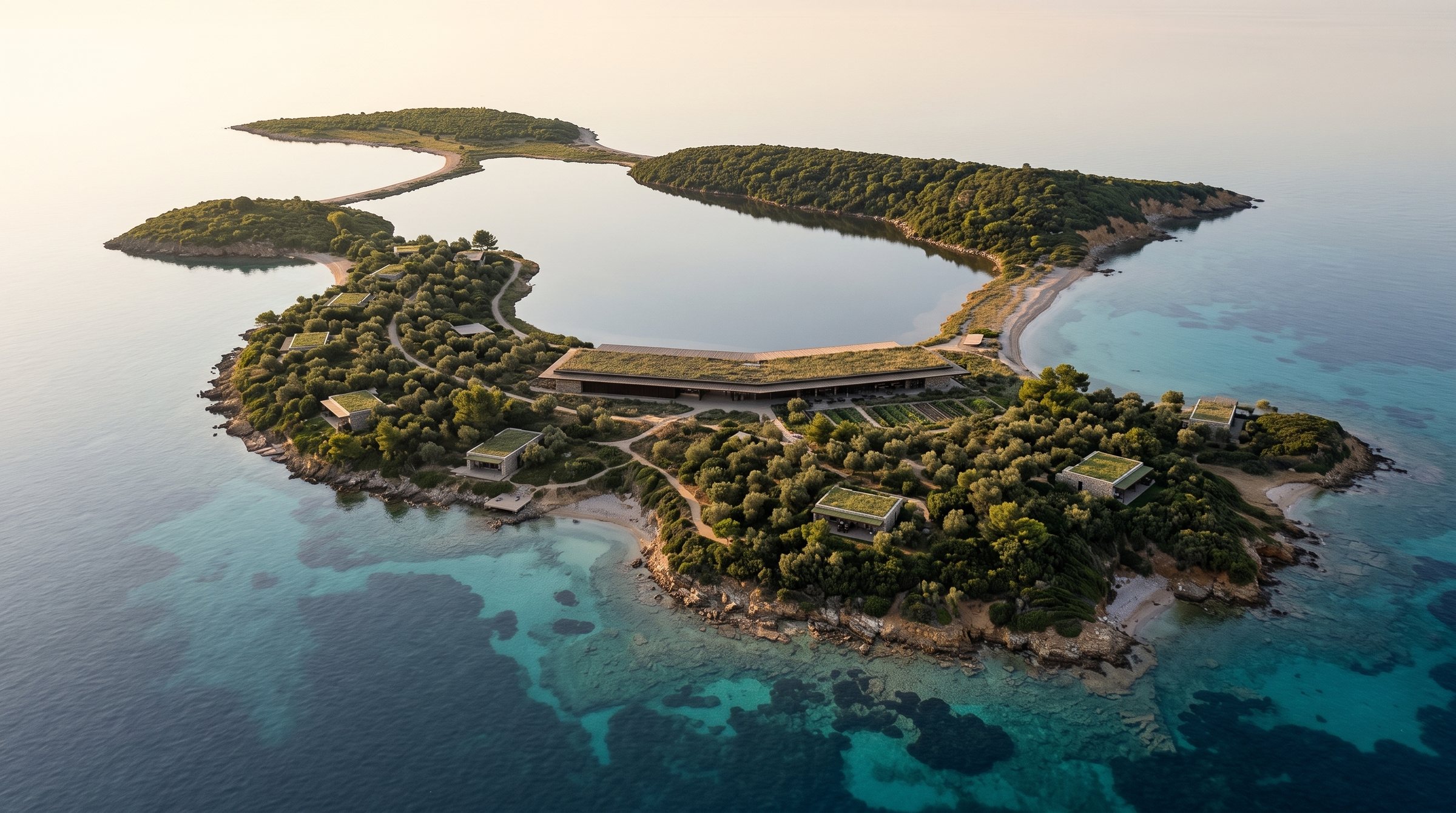
Nothing here stands taller than the trees, and that is the point.
Vouvalos belongs to a different Greece from the postcard Cyclades: flat light, calm water, olive trees, reeds and birds. The design follows the landscape's temperament. Its centre is the Lagoon Gallery, a long horizontal pavilion holding reception, lounge, restaurant, library, a nature observation room and a water deck, set low against the waterline. Villas hide among olives and pines, connected by footpaths, oriented to water or landscape and deliberately kept off the edge in places. Around them sit lightweight observation decks for birdwatching and reading, a small spa folded into the gardens, and a farm-to-table zone with kitchen and herb gardens where the site allows. At twenty to thirty-five keys, the resort is built for slowness: privacy, walking, food and long evenings.
| Location | Lagoon setting in northwestern Greece |
|---|---|
| Site | Still water, olive groves, pines and native vegetation; a protected, bird-rich landscape |
| Programme | 20–35 villas and suites, the Lagoon Gallery, spa, nature decks, small pool, farm-to-table gardens |
| Identity | Nature-based lagoon retreat — eco-luxury built around silence and slow living |
| Status & Context | Concept design for a sensitive lagoon landscape; any development subject to environmental assessment and Greek and EU regulation |
| Stage | Resort design — architecture, structure, MEP, BIM |
Everything low, everything slow.
§03 — Masterplan strategyArrival without spectacle, a gallery at the water, villas dissolved into the groves.
Arrival is deliberately understated: a careful transition from boat to landscape, with no grand gesture and no marina. The Lagoon Gallery anchors the plan at the water's edge. Nature villas scatter through olive and pine cover, linked by footpaths. Lightweight decks reach out for birdwatching and reading, a small spa and farm-to-table gardens complete the slow programme, and a compact, concealed back-of-house keeps the machinery of hospitality inaudible.
Silent Arrival
Arrival is discreet and slow — a careful transition from boat to landscape, with no marina and no grand gesture. Guests are received by trees and water before they are received by staff.
The Gallery at the Water
The Lagoon Gallery faces the still water and holds the resort's shared life: dining, reading, observing, talking. It is the social centre of the plan and it is kept intentionally low-key.
Nature Villas
Villas hide among olive trees, pines and native planting: low, private, shaded, connected by footpaths and oriented to water or landscape. Deliberately, they do not all claim the water's edge.
Decks and Slow Spa
Lightweight, discreet decks serve birdwatching, landscape observation and reading. The spa stays small and garden-bound: treatment rooms, hammam or sauna where appropriate, a water court, a yoga deck and unhurried planting.
Farm-to-Table and BOH
Where the site allows, kitchen and herb gardens, an olive grove experience and outdoor dining anchor the food programme. Behind it, a compact hidden zone carries staff, storage, water, energy and waste.
The Lagoon Gallery.
§04 — The iconic pieceA long, low pavilion at the waterline — reception, restaurant, library and observation room under one roof that almost disappears.
The Lagoon Gallery is the resort's single public building: a long horizontal pavilion containing reception, lounge, restaurant, library, art wall, a nature observation room, a shaded terrace, water deck, a small bar and farm-to-table dining. Its geometry is deliberately simple — long, low and deeply shaded — so that from across the water it registers as a line of shadow between landscape and lagoon rather than as an object.
It is also the easiest kind of building to do well: lightweight low-rise structure, minimal foundation impact, deep roof overhangs doing the climatic work, natural ventilation throughout, and low-noise MEP kept away from the observation spaces. Its ambition is horizontal, which is precisely what makes it credible.
Architecture, engineering, ecology.
§05 — The technical layersLagoon modernism, warm minimalism
Low horizontal architecture in local stone, timber, lime plaster and muted concrete, with reed-inspired shading interpreted in a modern way. Earth tones, natural fabrics, shaded glass and water surfaces let the buildings recede into groves and waterline.
Light frames, light footprint
Lightweight low-rise structures with minimal foundation impact, deep roof overhangs and simple spans, designed for gentle assembly with small plant and short works. The engineering effort goes into touching the ground lightly — a discipline this landscape both enforces and rewards.
Designed for the birds too
Passive cooling, natural ventilation, solar integration, water reuse and on-site wastewater treatment, plus low light pollution and low-noise MEP, keep the resort a good neighbour to the lagoon's birdlife. Fire and emergency access is planned without carving up the landscape.
Restraint, fully documented
The masterplan's ecological zones, villa placements, decks and services are coordinated in a single BIM model, giving environmental consultants and licensed Greek engineers exact footprints, drainage and infrastructure data — precisely the documentation a sensitive site demands.
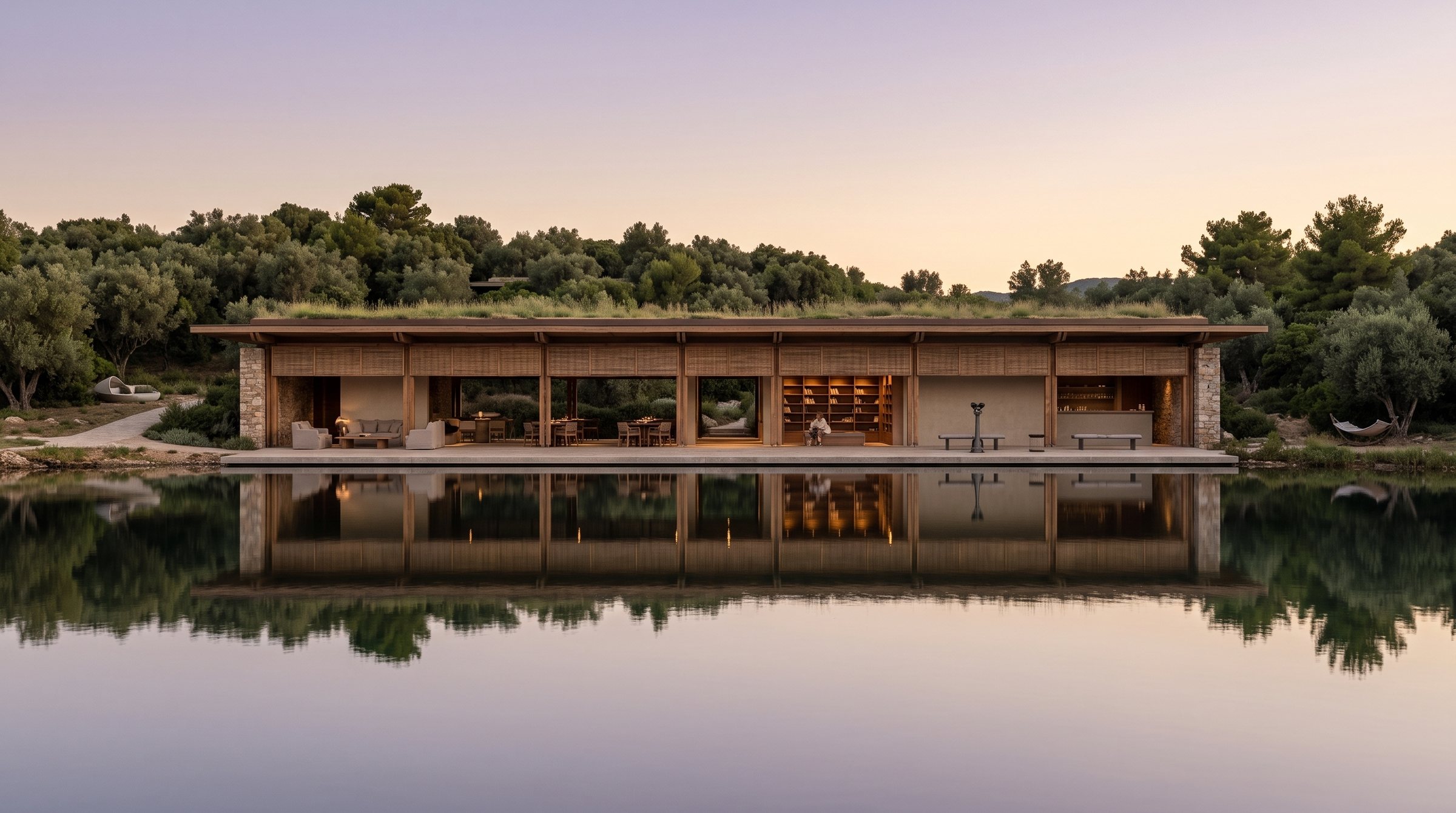
The most ambitious line in the project is the horizon.
Vouvalos shows the studio's most mature register: proportion, climate, landscape and engineering restraint doing the work usually assigned to decoration. An in-house concept design for a lagoon landscape of this character. Wetland and coastal settings in Greece carry strict environmental protections; any real project would begin with environmental assessment and licensed local consultants.
If a project here became live, we would work as the technical partner alongside the licensed local consultants who carry statutory responsibility in the jurisdiction — the architect of record, structural checkers, MEP and utilities engineers, and the environmental, coastal and fire specialists the approvals require. Our role is design, structural engineering, MEP coordination, BIM and construction-oriented documentation.