Ungasan Lost Cliff Resort
A resort design for transforming obsolete cliffside hospitality assets in South Bali into a low-impact retreat. The cliff sets the rules; the architecture follows them.
UNGASAN · SOUTH BALI CLIFFS
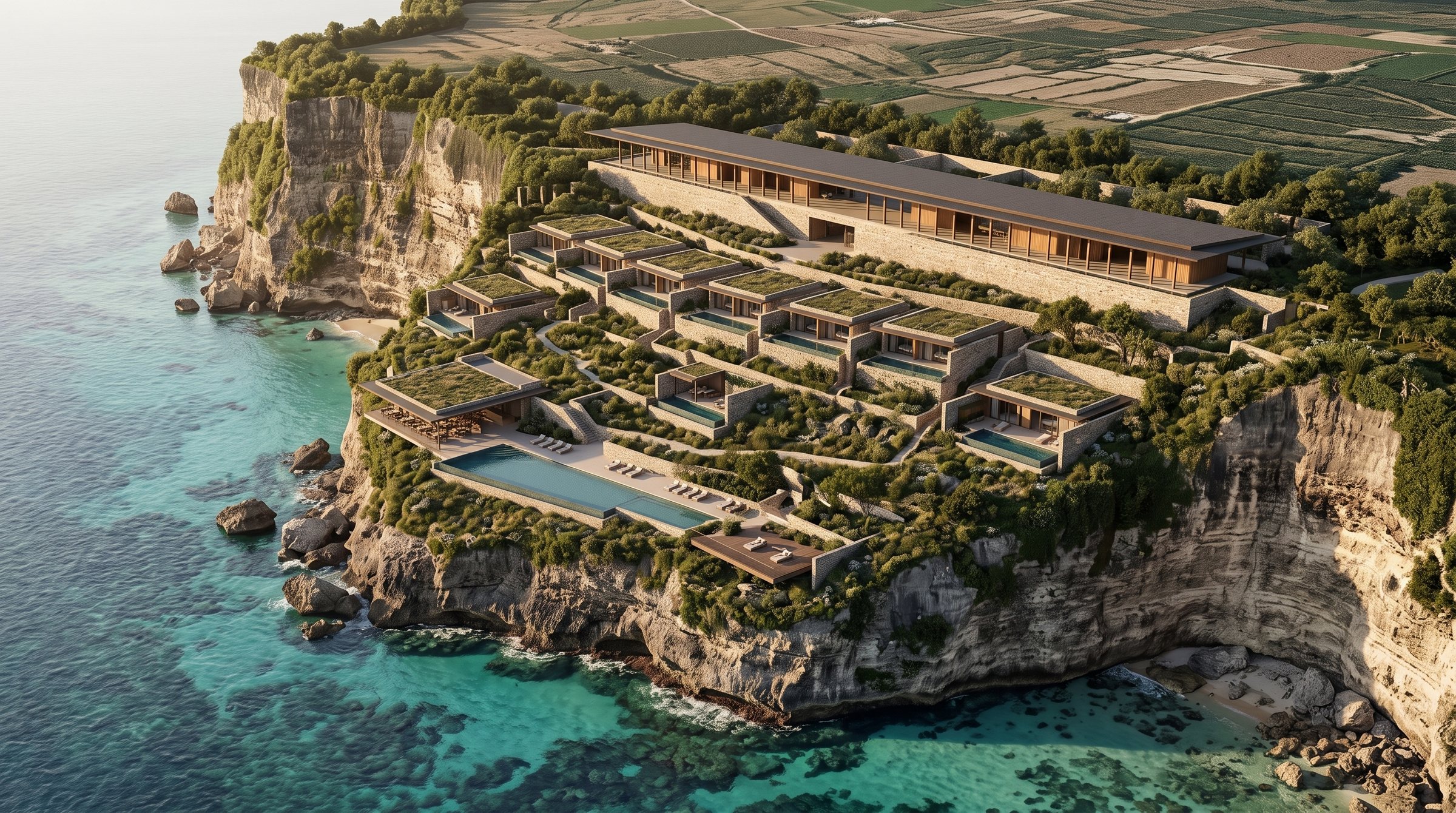
Along the Ungasan cliff line, obsolete resort platforms sit above one of the best coastlines in Indonesia, doing very little with either.
South Bali's clifftops around Uluwatu and Ungasan carry a generation of hospitality assets that have aged badly: platforms cut into the edge, structures that fight the wind, views squandered by planning. This design treats the typology, not a specific property. A former cliffside resort is reimagined as a sequence of terraces, courtyards and villas worked into the landscape. The architecture does not dominate the cliff; it frames the ocean, stabilises the site and organises access. Fewer rooms, stronger views, better landscape, more precise engineering — an anti-mega-resort. Geotechnics and drainage are treated as design tools, because on a cliff they are the design.
| Location | Ungasan / Uluwatu cliff zone, South Bali, Indonesia |
|---|---|
| Site | Obsolete cliffside resort terrain — existing platforms, steep slopes, ocean frontage |
| Programme | Low-impact retreat with 40–70 suites and villas, sunset restaurant, spa, cliff pool, art corridor and event terrace |
| Identity | Terraced cliffside retreat — luxury through topography and view, not mass |
| Context | Resort design for obsolete South Bali cliffside assets; no specific property targeted, and any real project would need geotechnical review, zoning clearance and Indonesian licensed consultants |
| Stage | In-house resort design — architecture, structure, MEP, BIM |
The cliff sets the plan.
§03 — Masterplan strategyArrival happens away from the edge; everything after it steps down the slope in small, deliberate moves.
Guests arrive at a garden court on the upper plateau, then orient themselves along the Cliff Gallery — a shaded horizontal spine holding the main public spaces. Rooms step down the slope in small clusters, villas take the quiet edges, and wellness terraces shelter from the wind. Service routes, emergency access and guest paths never cross.
Upper plateau arrival
Guests arrive at a calm garden court set back from the cliff edge. The ocean is withheld at first — the plan spends it slowly, terrace by terrace.
The orientation spine
The Cliff Gallery organises the main public spaces along one shaded horizontal line at the upper cliff: lounge, art corridor, restaurant approach and event terrace in sequence.
Terraced rooms
Guest rooms step down the slope in small clusters, never forming a large block. Each terrace holds a few rooms, a retaining wall and its own framed slice of ocean.
Villas and wellness
Larger villas occupy the quiet edges with pools and ocean views, while yoga, spa and pools sit in wind-protected terraces — placed by exposure, not by rendering.
Controlled access
Service routes, emergency access and guest paths are clearly separated, with the back-of-house yard screened by landscape and water storage and MEP plant integrated uphill.
The Cliff Gallery.
§04 — The iconic pieceA long, deep-shaded pavilion along the upper cliff line — arrival, art corridor and orientation spine in one.
The Cliff Gallery is a long horizontal pavilion positioned along the upper cliff line. It works as arrival gallery, ocean-view lounge, art corridor, restaurant approach, event terrace and the resort's orientation spine. It is emphatically not a glass box: a stone base, timber ceiling and thin roof form a deep shaded architectural line, punctuated by carved courtyards, framed ocean views and integrated art. Guests read the whole resort from this one datum.
Structurally, the Gallery is conservative where it matters: a stepped reinforced concrete base tied into the retaining wall strategy, lightweight roof systems above, drainage behind every wall. Wind exposure design and corrosion-resistant detailing suit the clifftop environment, and the whole line sits behind the geotechnically assessed edge.
Architecture, engineering, ecology.
§05 — The technical layersHorizontal lines, deep shade
Cliffside modernism in warm minimalist register: strong horizontal lines, stone retaining walls, shaded concrete and timber pavilions with deep overhangs. Local stone, lime plaster, bronze metal and deep shaded glass build luxury from topography and view rather than volume.
Geotechnics before geometry
The engineering starts with geotechnical review and cliff stability assessment, then a retaining wall strategy with drainage behind every wall. A stepped reinforced concrete structure carries lightweight roofs, detailed for wind exposure and corrosion, with safe evacuation routes built into the section.
No new scars on the cliff
Existing platforms are reused where possible and excavation is minimised — the cliff face gains no new scars. Rainwater management, greywater reuse, passive shading, cross ventilation, native planting and solar on non-visible service roofs keep the environmental load low and invisible.
A terraced site in section
A stepped cliff site is a coordination problem in section: retaining walls, drainage lines, service routes and room terraces all interlock vertically. The design is developed as a BIM exercise where structure, MEP and landscape share one model of the slope.
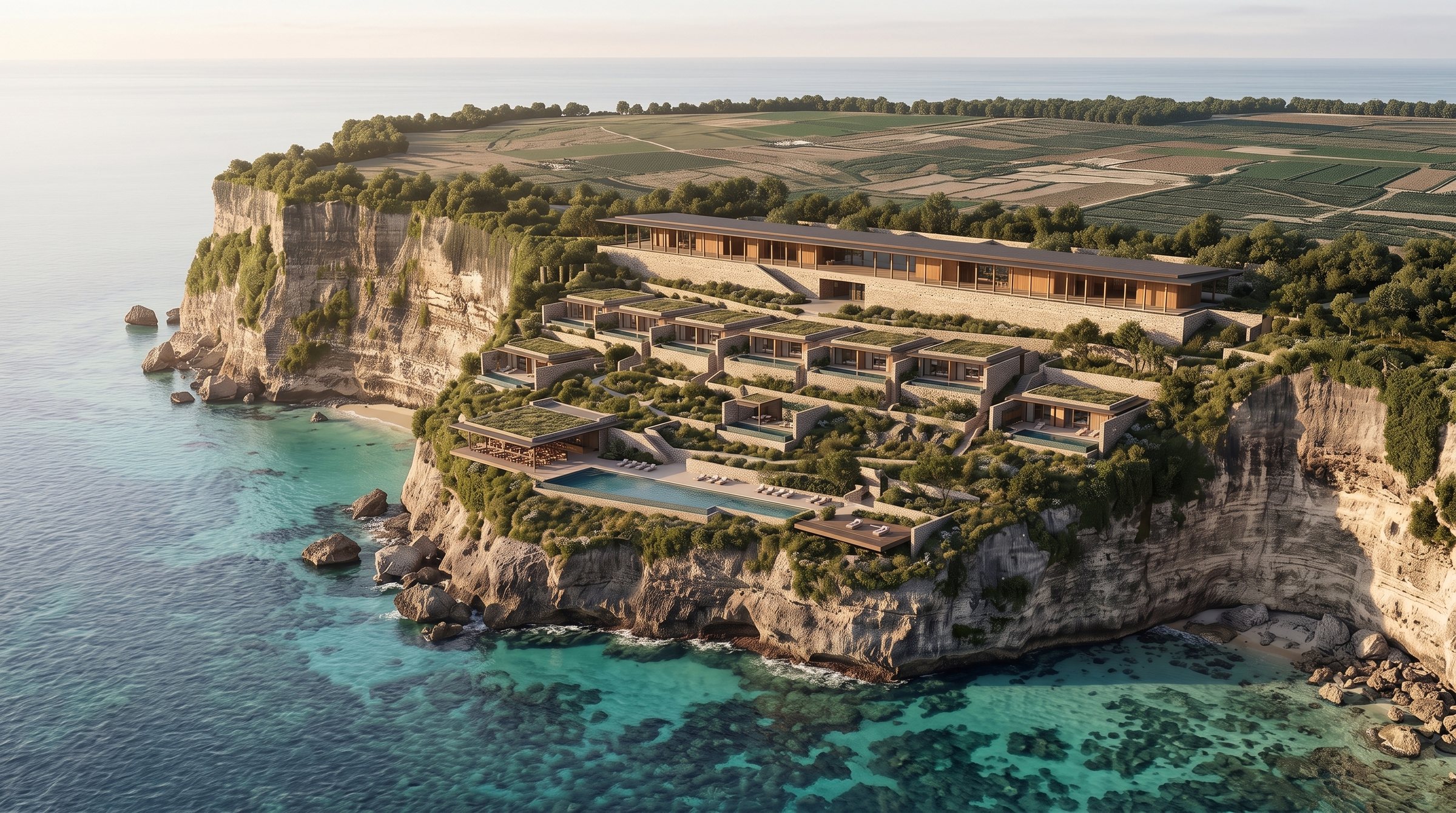
A cliff does not need architecture to be impressive. It needs architecture that knows this.
Cliff sites concentrate the studio's structural instincts: retaining strategy, drainage, wind and seismic exposure all become architecture. This project is where engineering discipline is most visible as design. This is a concept design for obsolete cliffside hospitality assets in South Bali, not tied to any specific property. No affiliation with any owner, operator or authority exists or is implied; a real project would require geotechnical and zoning review with Indonesian licensed consultants.
If a project here became live, we would work as the technical partner alongside the licensed local consultants who carry statutory responsibility in the jurisdiction — the architect of record, structural checkers, MEP and utilities engineers, and the environmental, coastal and fire specialists the approvals require. Our role is design, structural engineering, MEP coordination, BIM and construction-oriented documentation.