Tragonisi Athenian Private Island Retreat
A private island within reach of Athens, arranged around a single mineral courtyard. Villas keep their distance from one another, the service logic stays out of sight, and the sea arrives one frame at a time.
TRAGONISI · NEAR ATHENS
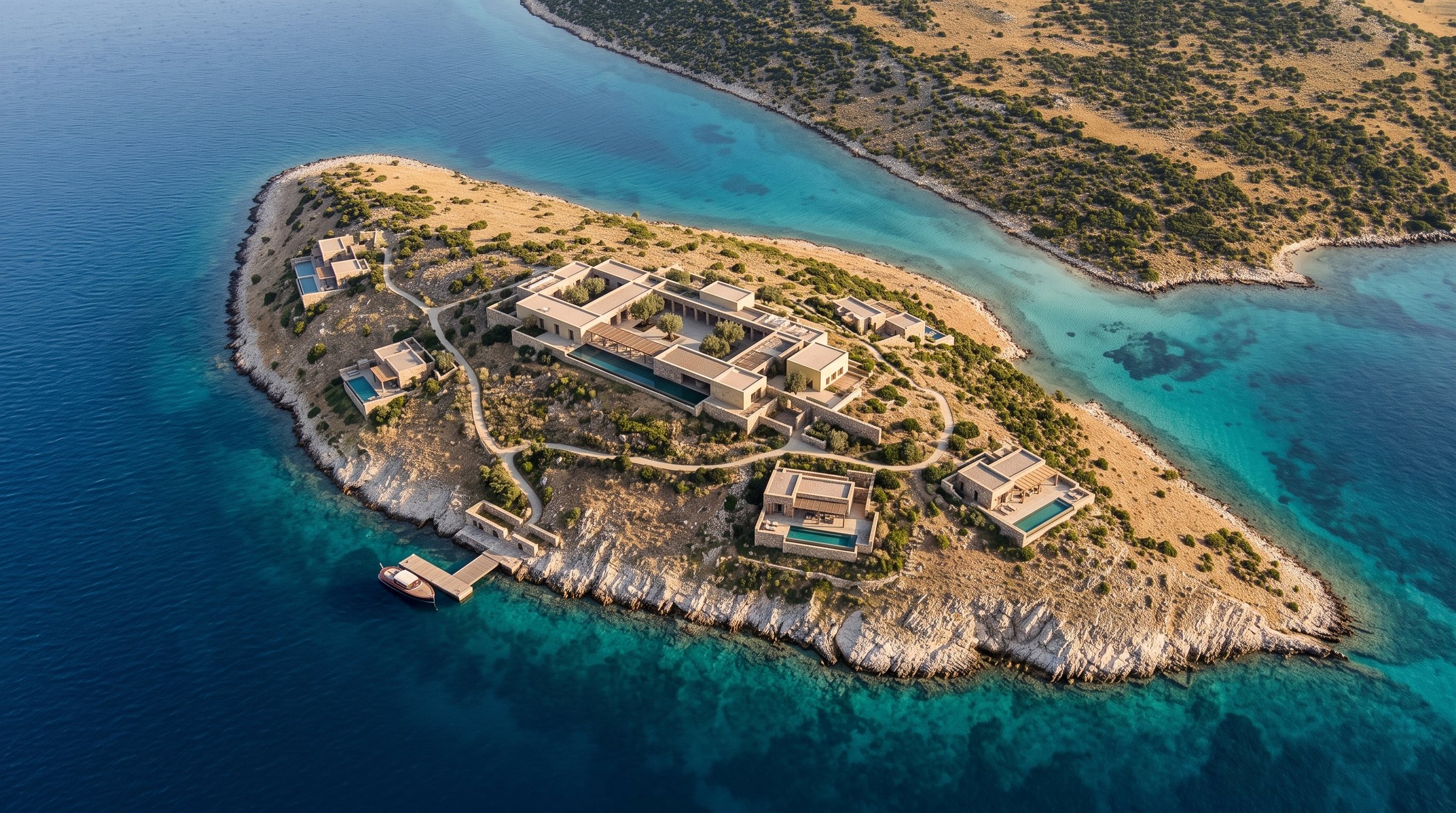
Proximity to Athens is the asset; restraint is what makes it worth having.
Tragonisi lies close enough to Athens for an afternoon crossing, and far enough that the city drops out of hearing. This design treats that combination as the entire brief. Buildings are few and placed with discipline; topography and vegetation do the work of walls. The architecture stays low and mineral, in the manner of a contemporary island monastery: thick masonry, shaded passages, water in courtyards, sea views released one frame at a time. The programme is written for private use — a buyout retreat, a family office residence, a members-only destination, a collector's island, a small wellness retreat. At twelve to twenty-five keys, subject to zoning, approvals and environmental limits, density is the first design decision here, and it is deliberately a low one.
| Location | Private island near Athens · Aegean Sea, Greece |
|---|---|
| Site | Compact island terrain; the coastline kept dominant, topography and planting used as the privacy structure |
| Programme | 12–25 keys: villas, the Aegean Court, spa and silent coast, compact back-of-house |
| Identity | Ultra-exclusive island estate — private buyout, family office residence or members' retreat |
| Status & Context | Concept design for an island opportunity; scale depends on zoning, ownership strategy, approvals and environmental limits |
| Stage | Concept design — architecture, structure, MEP, BIM |
Four zones, one discipline.
§03 — Masterplan strategyThe island is organised by intensity of use, from the arrival court to a coastline left nearly untouched.
Public life is concentrated at the arrival end: pier, shaded path, the Aegean Court, pool and gallery. Villas thin out from there, each with sea orientation, planted buffers and a low profile from the water. A silent coast holds the spa, swimming platforms and trails. Back-of-house sits compact and screened, off every guest route. Nothing built on the island competes with its edge.
Arrival & Court Zone
A discreet pier, a shaded path, then the Aegean Court: stone, water and filtered sea views. Restaurant, gallery, library and the main water court all sit within this first, unhurried sequence.
Private Villa Zone
Villas are placed sparsely, never as a continuous row. Each takes sea orientation, a shaded terrace, a small private pool and planted buffers, and holds a low visual profile when seen from the sea.
Silent Coast
A reserved stretch of the island carries the spa, yoga deck, meditation platform, sea swimming platform, sunset belvedere and an art walk, all linked by natural trails and nothing louder.
Technical Zone
Staff facilities, kitchen back-of-house, laundry, storage, waste, water storage, desalination if required and the energy plant occupy one compact, hidden zone. Service routes never conflict with guest routes.
The Long Reveal
Views are rationed along the route: a wall, an opening, then the sea. The plan withholds the full panorama so that each courtyard and villa terrace earns its own frame.
The Aegean Court.
§04 — The iconic pieceA low mineral pavilion wrapped around water, olive trees and shaded galleries — the social and climatic centre of the island.
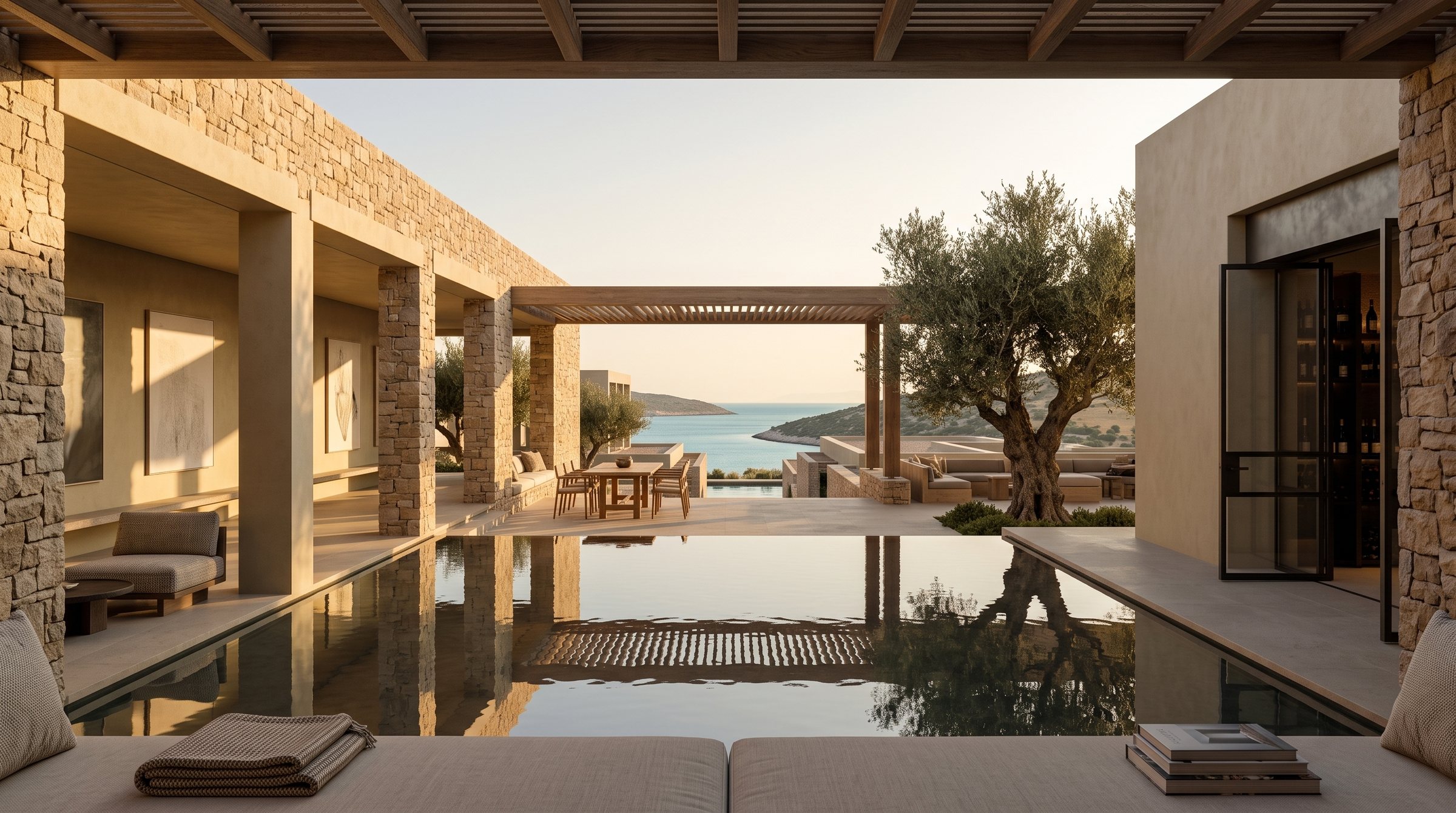
The Aegean Court gathers the retreat's shared life into a single building: arrival lounge, reception, private dining room, all-day lounge, wine room, gallery space and an event courtyard for private gatherings. Its rooms wrap an interior court of water, olives and stone walls, reached through shaded colonnades. It reinterprets the Greek island courtyard as a contemporary spatial device — familiar in temperament, exact in execution, and legible as the heart of the island from the first minute.
Its performance case is straightforward. Thick walls provide thermal mass; the courtyard generates its own microclimate; colonnades control light; water cools the moving air. Spans are short, structures low-rise, and service circulation is concealed within the wall system — all of it buildable with conventional masonry and concrete trades.
Architecture, engineering, ecology.
§05 — The technical layersStone, shade and restraint
Low-rise, mineral and deeply shaded. Local stone, lime plaster, warm concrete, timber pergolas, bronze-toned metal and deep-set glass, set in a palette of warm white, limestone beige, pale grey and olive green. The sea is allowed in as background; the buildings hold their own tone.
Mass, shade and short spans
Low-rise concrete and masonry construction provides thermal mass where the climate needs it; lightweight timber pergolas carry the shade. Excavation is minimised, structures follow the ground, and the engineering stays as reticent as the architecture it supports.
Shading as energy strategy
A semi-off-grid services concept: photovoltaics on service roofs, water treatment and storage, rainwater collection where viable, desalination only if required. Passive cooling, cross ventilation and deep shade do the first round of work before any plant is asked to switch on.
One model, hidden services
The design is developed the way the studio would deliver it: architecture, structure and MEP coordinated in one BIM model, concealed service routes resolved early, and documentation prepared so that licensed Greek consultants can carry approvals without redesign.
A retreat for silence, not for crowds.
Tragonisi lets the studio demonstrate its central conviction: that restraint, precise materiality and integrated engineering can carry a premium hospitality brief without a single loud gesture. An independent concept design for an island opportunity near Athens, developed without commission, ownership, listing or any affiliation with owners, brokers or authorities. A real project would begin with ownership verification, Greek zoning and coastal-regulation review, environmental assessment and licensed local consultants.
If a project here became live, we would work as the technical partner alongside the licensed local consultants who carry statutory responsibility in the jurisdiction — the architect of record, structural checkers, MEP and utilities engineers, and the environmental, coastal and fire specialists the approvals require. Our role is design, structural engineering, MEP coordination, BIM and construction-oriented documentation.