Rangiroa Blue Lagoon Reinvention Retreat
A design for a publicly listed motu on Rangiroa: a dive and conservation retreat of light pavilions, off-grid systems and almost no visual impact.
RANGIROA · TUAMOTU ATOLL
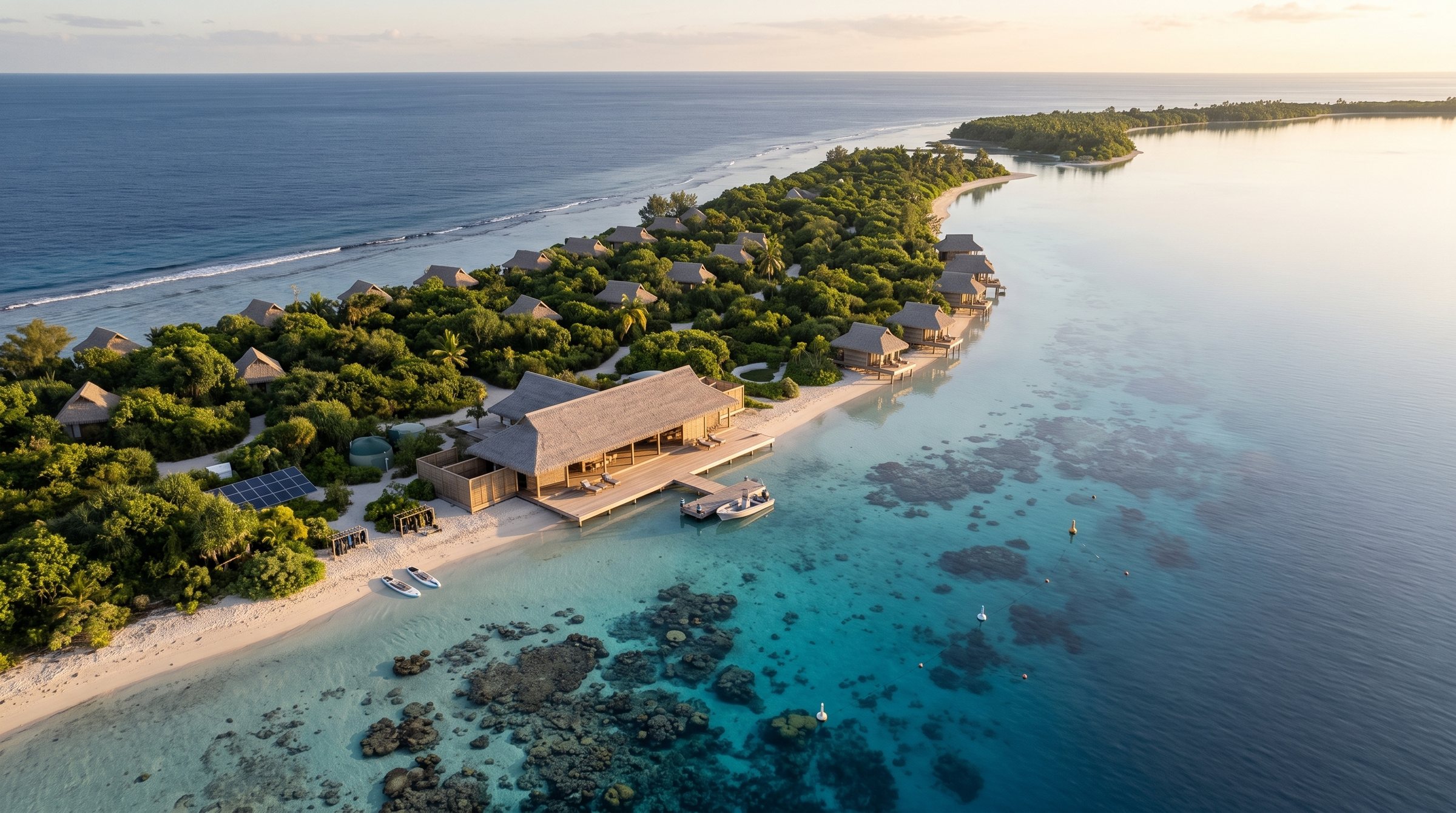
On Rangiroa the lagoon does the architecture; the buildings only need to provide shade and stay out of the way.
Rangiroa is vast lagoon, reef, sky and diving, a long way in character from Bora Bora's postcard density. Among the Tuamotu atolls, private motu are publicly listed as available or waiting to be reinvented, which makes this the cleanest brief in the series: no closed hotel, no ruin, just low land, live reef and silence. The design proposes an essential form of Polynesian hospitality — eight to twenty keys in small pavilions behind the vegetation line, a single lagoon house holding dining, dive centre and marine education, an untouched conservation area, and an off-grid core for energy, water and wastewater. What the guest gets is the atoll itself, carefully hosted.
| Location | Rangiroa, Tuamotu Islands, French Polynesia |
|---|---|
| Site | Small private motu: reef edge, lagoon frontage, vegetated interior |
| Programme | 8–20 keys as a micro-resort or private buyout; dive centre, marine education room, small spa, guest pavilions, off-grid service core |
| Identity | Essential Polynesian minimalism — dive and conservation retreat |
| Context | Based on publicly listed motu opportunities on Rangiroa; land title and lagoon rights would require verification before a project proceeds |
| Stage | Concept design — architecture, structure, MEP, BIM |
Almost nothing, carefully placed.
§03 — Masterplan strategyThe plan reserves most of the motu for the motu.
Arrival is by small tender, with no large dock unless one is approved. The Blue Lagoon House anchors guest life and operations at the shore; pavilions sit behind vegetation or along chosen edges; diving and snorkelling run as controlled operations in a defined reef zone. A share of the island is set aside untouched as conservation area, and a compact off-grid core — solar, water, wastewater, waste, storage — keeps the retreat self-sufficient and out of sight.
Arrival by tender
Guests arrive by small boat across the lagoon. No large dock is assumed; marine access is designed at minimal footprint and built only within what the maritime authorities actually approve.
Pavilions behind the green
Eight to twenty guest pavilions sit behind the vegetation line or along carefully selected edges, invisible from the water where possible. Each is small, naturally ventilated and shaded, with the lagoon as its single luxury.
A working reef zone
Diving and snorkelling operate as controlled programmes with briefing, defined routes and marine education built into the stay. The reef is the destination; the retreat is its base camp.
The untouched share
Part of the motu is simply left alone, held as a conservation area outside the guest circuit. Its role in the masterplan is to stay exactly as it was found.
Off-grid by design
Solar and battery power, rainwater and desalination, packaged wastewater treatment and waste handling are gathered into one compact, concealed core, engineered from day one because there is no grid to fall back on.
The Blue Lagoon House.
§04 — The iconic pieceNot a luxury lobby. A lagoon house.
The Blue Lagoon House is the motu's one significant building: arrival lounge, dining room, dive centre, marine education room and lagoon lounge under a single deep roof, with a shaded deck, small spa, water court, research table and equipment storage folded in. It is simple, open and useful, organised so that a dive briefing, dinner and an afternoon of reading all happen within the same shaded structure.
Its construction is deliberately ordinary in the best sense: lightweight modular framing, cyclone-resistant roof detailing, corrosion-resistant fasteners and low-impact foundations, prefabricated to keep site disturbance short. Natural ventilation replaces most mechanical cooling, and a compact service core handles the building's needs without touching the reef.
Architecture, engineering, ecology.
§05 — The technical layersEssential Polynesian minimalism
Light pavilions, deep shade, natural ventilation and lagoon decks, in timber, woven screens, mineral plaster and engineered thatch-inspired roofing. There is no decorative excess to maintain, which in a salt climate is both an aesthetic and a budget.
Light, modular, storm-ready
Lightweight modular construction with cyclone and wind-resistant roofs, low-impact foundations and corrosion-resistant fasteners throughout. Prefabrication shortens the construction window on a remote atoll and keeps heavy plant, spoil and disturbance away from the reef.
A complete off-grid core
Solar and battery microgrid, rainwater harvesting with desalination backup, packaged wastewater treatment with no lagoon discharge, and a waste-handling plan sized for boat logistics. Coral and seagrass protection governs construction routes as strictly as it governs operations.
Modelled for remoteness
Every component is coordinated in BIM for prefabrication and barge delivery, with permits, impact documentation and off-grid system sizing developed together. On an atoll, the drawing set is also the logistics plan; nothing ships twice.
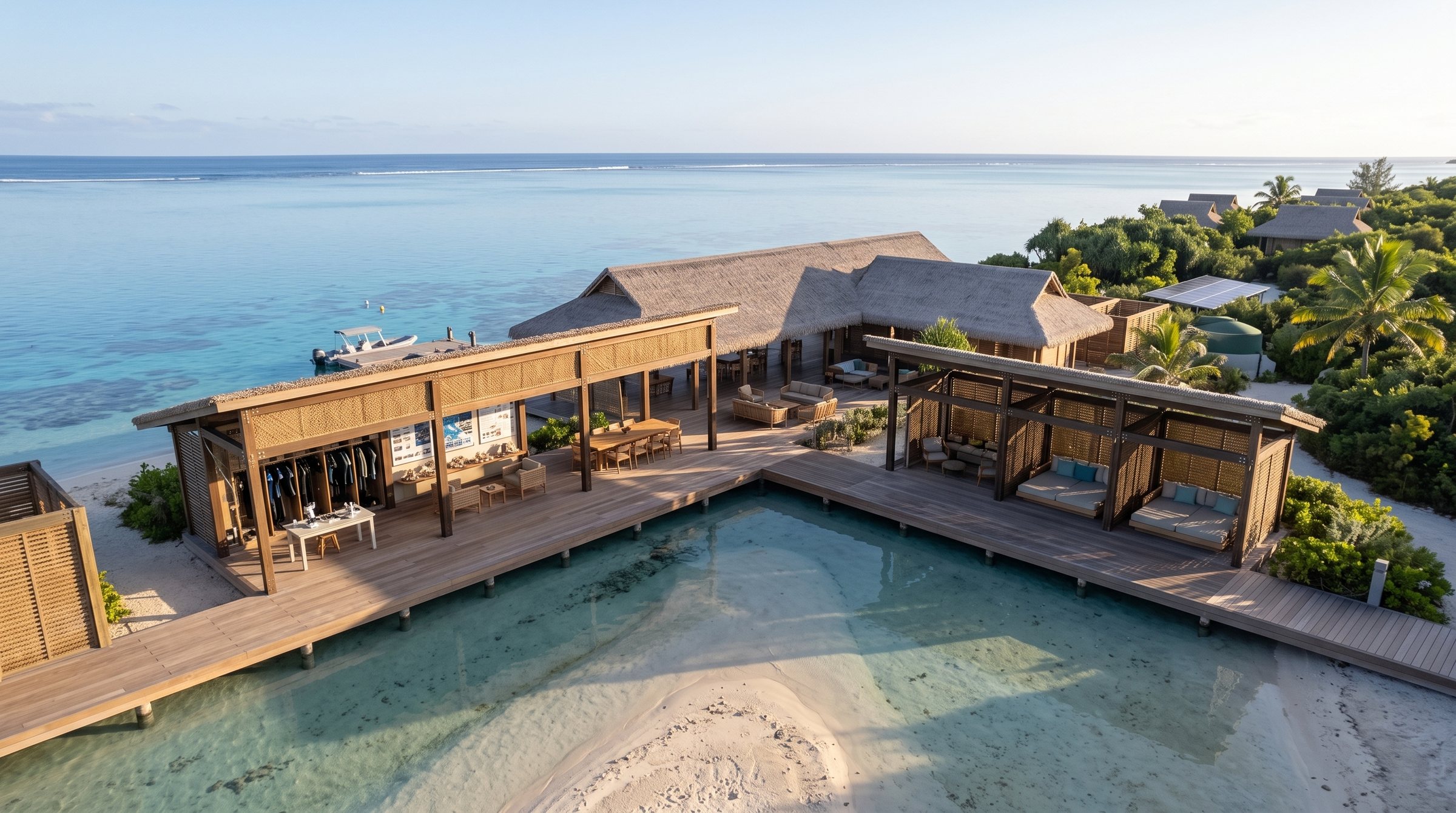
Most of the motu stays as found. That is the design.
Rangiroa tests the studio's minimum-footprint method at full strength: off-grid MEP, prefabricated structure and construction logistics that treat the reef as a hard constraint. The smallest design in the series, and the most complete engineering exercise. Based on publicly listed private motu opportunities on Rangiroa; the studio has no affiliation with any owner, seller or broker. A commissioned project would begin with title and lagoon-rights verification, local permits and environmental impact review.
If a project here became live, we would work as the technical partner alongside the licensed local consultants who carry statutory responsibility in the jurisdiction — the architect of record, structural checkers, MEP and utilities engineers, and the environmental, coastal and fire specialists the approvals require. Our role is design, structural engineering, MEP coordination, BIM and construction-oriented documentation.