Praslin Round Island Recovery Resort
A recovery design for a 15-hectare private island near Praslin: repair what exists, remove the noise, and give the island an atelier-like heart in granite and shade.
ROUND ISLAND · PRASLIN · SEYCHELLES
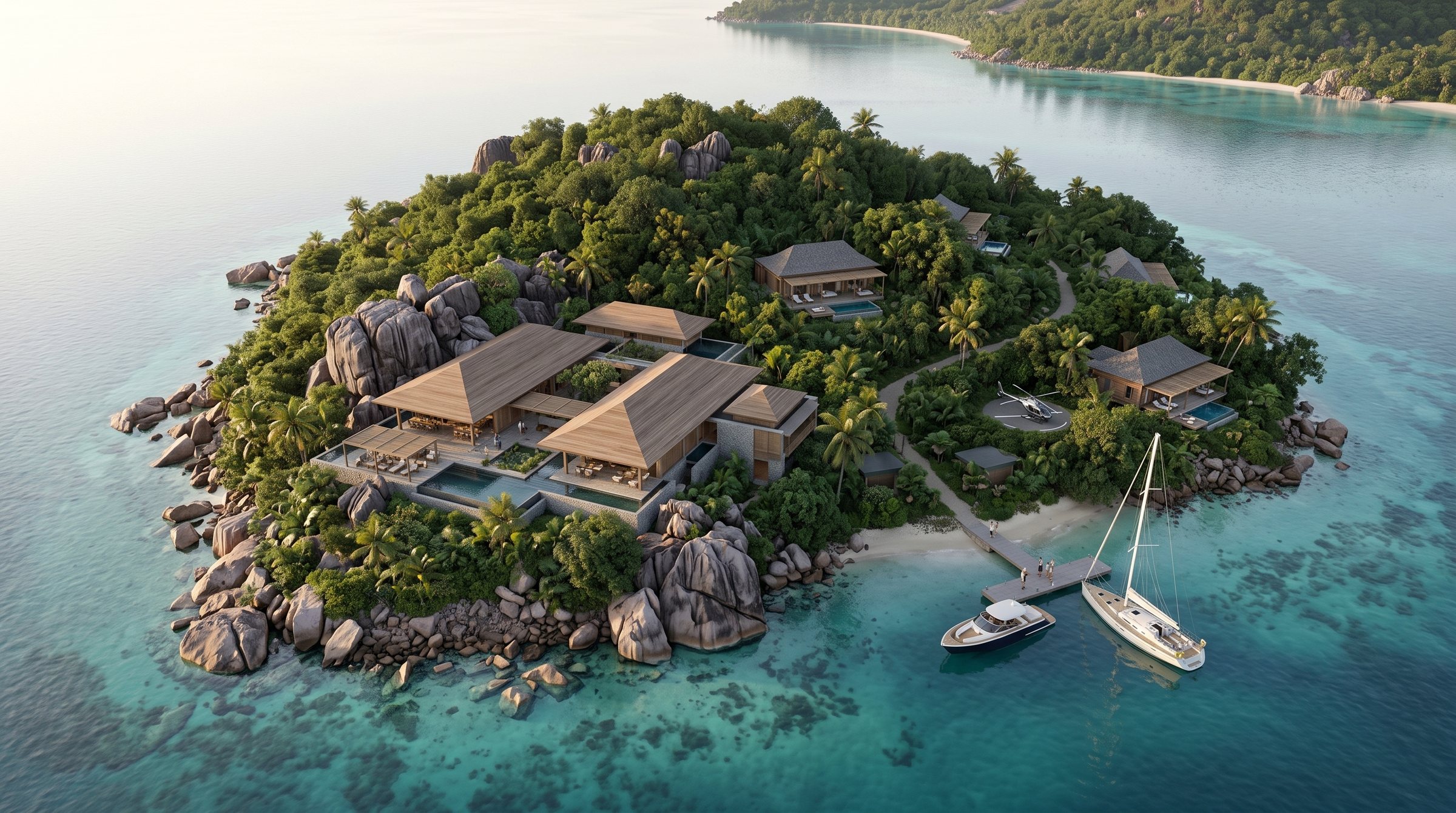
Round Island is not a blank site; it already has a past to repair.
Public listings describe Round Island, off Praslin, as roughly 15 hectares carrying more than 2,000 m² of infrastructure to renovate: a restaurant, nautical base, staff accommodation, helipad and pontoon. Some listings mention land at Anse La Farine on Praslin as a possible companion parcel. That inventory sets the brief. This is recovery and refinement: audit the existing villas and rework them, upgrade the utilities, reduce the visual clutter that accumulates on a working island, and improve the yacht and helicopter arrival. The Seychelles supplies the identity ready-made — granite outcrops, dense vegetation, deep shade — and the design's job is to let that identity back through. Density stays very low; expansion is off the table.
| Location | Round Island, near Praslin, Seychelles |
|---|---|
| Site | Approx. 15 hectares; granite outcrops, forest and shoreline, with existing built fabric |
| Existing assets | Over 2,000 m² to renovate: restaurant, nautical base, staff accommodation, helipad, pontoon |
| Programme | 12–25 keys, ultra-low density; restoration-first, with yacht and helicopter arrival |
| Status / Context | Appears publicly listed; some listings note potential land at Anse La Farine on Praslin |
| Stage | Resort design — architecture, structure, MEP, BIM |
Repair first. Then refine.
§03 — Masterplan strategyThe plan restores what stands, re-plans what serves, and adds almost nothing new.
Existing villas are renovated and upgraded instead of replaced. The helipad, pontoon, staff village and restaurant facilities are audited and re-planned as one coherent service system. A walking circuit links arrival, atelier, villas, beach and viewpoint, giving a small island a legible geography. If the Anse La Farine parcel is involved, a support and arrival strategy spans the water to Praslin. Throughout, clearing is minimised and the granite landscape is treated as the client.
Restore the Villas
Every existing villa is assessed, renovated and upgraded before any demolition is considered. Refurbishment keeps embodied carbon in place, shortens approvals and preserves the island's established clearings; new footprint is the exception, never the default.
Rework the Infrastructure
Helipad, pontoon, staff village and restaurant are audited and re-planned. Pontoon and helipad upgrades are treated as approval-critical items under Seychelles planning rules, with wastewater and water supply brought up to a high standard.
The Island Circuit
One walking route links pontoon arrival, the Granite Atelier, the villas, the beach and a viewpoint. On fifteen hectares, a single well-made path is the masterplan; everything else is placement and shade.
Across to Anse La Farine
If the Praslin parcel joins the project, it hosts support, arrival and residential functions across the water, easing pressure on the island itself and simplifying logistics, staffing and guest transfer.
Protect the Island
Density stays very low and unnecessary clearing is avoided. Granite outcrops, shoreline vegetation and marine habitat are held as fixed constraints; environmental assessment is assumed for any work near coast, wetland or forest.
The Granite Atelier.
§04 — The iconic pieceA central pavilion of granite, timber and deep shade that feels like a refined island house.
The Granite Atelier gathers the island's public life: reception, dining, spa lounge, art room, nautical club, shaded courtyard, a pool or water court and a sunset terrace. Built from granite and timber under large, deep-shading roofs, it reads as a house that grew on the island. It replaces the scattered fabric of the old operation with one composed heart, sized for a dozen to two dozen keys.
Granite loadbearing walls and timber roof structures sit well within local building practice, and the 2024 Seychelles building regulations (structural stability, durability, moisture, termites, fire, roof anchorage) define the compliance path. Heavy rainfall, salt exposure and humidity drive the detailing, and every junction is designed to be maintained.
Architecture, engineering, ecology.
§05 — The technical layersSeychelles granite modernism
Refurbishment architecture in warm minimalism: granite, timber, lime plaster, bronze-dark metal, woven screens and stone terraces under deep tropical shade. The atelier atmosphere favours rooms with character over lobby theatrics, and the existing fabric sets the scale.
Repair as engineering
Structural repair and coastal-structure review lead the workload: villa condition assessment, pontoon and helipad checks, roof anchorage upgrades. New work complies with the 2024 building regulations for stability, durability, moisture, termite and fire performance.
Upgrade, then protect
Wastewater and water supply systems are rebuilt to a high standard as a precondition of everything else. Coastal setbacks, flood-prone rules and environmental assessment govern siting; granite outcrops, shoreline habitat and vegetation are protected throughout.
A renovation model
A BIM renovation model built from survey captures the existing villas, plant and coastal structures, then sequences refurbishment phasing, MEP replacement and high-end detail coordination so the island can keep operating while it is repaired.
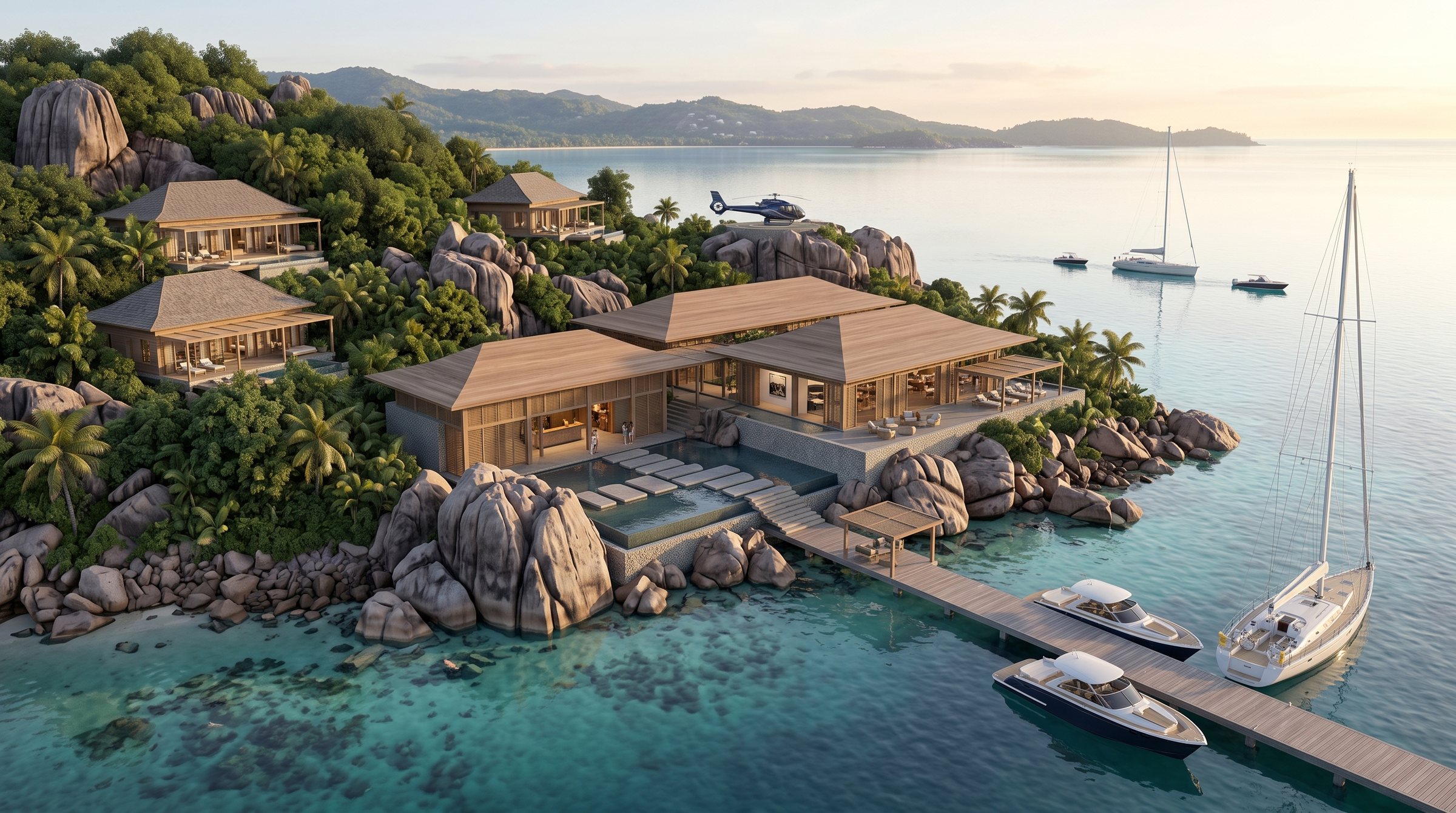
The island already has an identity; the work is letting it back through.
Refurbishment on a serviced private island is a different craft from greenfield design: audit, repair, phasing and value judgement. This design keeps that craft sharp. Round Island is privately owned and appears publicly listed; this design is based on listing information, and unaffiliated with any owner, broker or Seychelles authority. Planning Authority approval, environmental assessment and specific pontoon and helipad permits would govern any real work.
If a project here became live, we would work as the technical partner alongside the licensed local consultants who carry statutory responsibility in the jurisdiction — the architect of record, structural checkers, MEP and utilities engineers, and the environmental, coastal and fire specialists the approvals require. Our role is design, structural engineering, MEP coordination, BIM and construction-oriented documentation.