Petit Nevis Marine Heritage Sanctuary
Roughly 71 acres beside Bequia, once tied to a whaling station, redirected toward marine conservation: a small sanctuary of diving, reef education and boutique hospitality.
PETIT NEVIS · GRENADINES
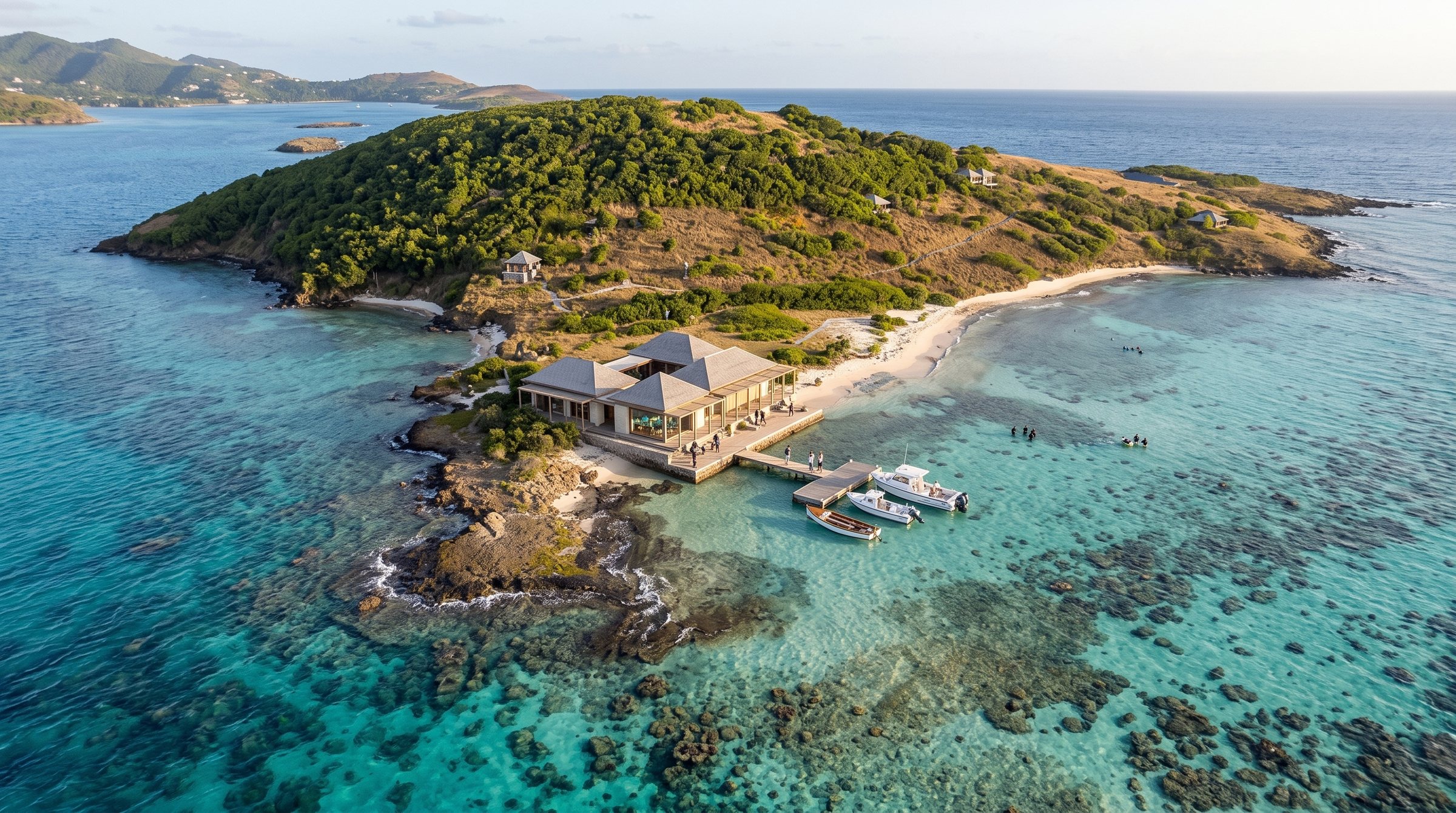
The island once served a whaling station; the design asks it to protect the sea instead.
Petit Nevis lies just off Bequia: roughly 71 acres of freehold land, undeveloped, with a natural deepwater harbour and the remains of a former whaling station. That history is the design problem. Treated as theme, it would be grotesque; erased, it would be dishonest. The design proposes a third route — from extraction to conservation. The island becomes a small sanctuary for marine education, diving, reef protection and yachting, with 15 to 30 keys and a few carefully placed villas. The whaling-station remains are surveyed, stabilised and interpreted along a heritage trail, while the working heart of the island shifts to the Marine House: part dive centre, part classroom, part restaurant, facing the harbour that made the island useful in the first place.
| Location | Near Bequia, St. Vincent & The Grenadines |
|---|---|
| Site | Approx. 71 acres, freehold, non-developed, with a natural deepwater harbour |
| Programme | 15–30 keys, a few carefully placed villas, Marine House with dive centre and education rooms, heritage trail |
| Identity | Marine conservation sanctuary on former whaling-station ground |
| Status | Publicly listed as available; historically connected to a former whaling station. No affiliation. |
| Stage | Resort design — architecture, structure, MEP, BIM |
From extraction to conservation.
§03 — Masterplan strategyA small plan with firm limits: the harbour receives, the Marine House teaches, and the rest of the island stays close to how it was found.
The natural deepwater harbour handles arrival by tender and modest yachting support — no marina, no dredging, no breakwater. From the water, the sequence is short: Marine House, heritage trail, guest pavilions dispersed into vegetation and higher ground. Dive and conservation operations are organised and controlled rather than casual, and the back-of-house stays compact, screened and complete.
Harbour arrival
The natural harbour does what it has always done — receives boats. Tender arrival and small-scale yachting support replace any marina ambition; even a pier is treated as a planning and environmental approval item.
Heritage trail
The whaling-station remains are surveyed, stabilised and joined into a walking trail with careful interpretation. The history is neither hidden nor sold as atmosphere; it is explained, and left with its weight.
The Marine House
One pavilion concentrates public life: arrival, restaurant, dive centre, marine education room, small spa and a research room, connected directly to the harbour so operations and hospitality share a front door.
Guest pavilions
Fifteen to thirty keys and a few villas sit in vegetation or on slightly elevated ground, holding a conceptual 30-metre coastal setback where possible. Density stays low because the island's character is the product.
Dive and conservation
Diving, snorkelling, reef education and marine monitoring run as guided, managed operations with proper gear wash and boat storage. The sea around Petit Nevis is treated as the primary asset, with rules to match.
The Marine House.
§04 — The iconic pieceA simple, strong pavilion where the dive centre, the classroom and the restaurant share one roof.
The Marine House is the island's public heart: arrival lounge, restaurant, dive centre, marine education room, small spa, gear storage and a research room, gathered under deep shade with a heritage interpretation area and a direct connection to the harbour. It is deliberately plain-spoken architecture — coral stone, timber, lime plaster and shaded decks — built to handle wet gear in the morning and dinner at dusk.
Its engineering is modest by intent: small foundations, elevated pavilions where needed, hurricane-resistant roofs and marine-grade galvanised or stainless connections. Simple modular construction suits a small island's logistics, and the dive centre's drainage and gear-wash systems are designed in from the start rather than retrofitted.
Architecture, engineering, ecology.
§05 — The technical layersPavilions under deep shade
Simple pavilions of coral stone, timber and lime plaster under deep roofs, with woven shade screens, hurricane shutters, stone paths and shaded decks. Functional dive and wellness spaces are given the same design care as dining. Nothing about the whaling past is ornamental; restraint is the respect.
Modest structures, marine grade
Small foundations, elevated pavilions where flooding or surge demands, hurricane-resistant roof structures and corrosion-resistant marine-grade connections throughout. Modular construction keeps builds short and barge deliveries few. An emergency shelter and a low-impact pier design complete a structural scope sized honestly for 71 acres.
No reef pays for this
Off-grid energy, desalination and water storage, and packaged wastewater treatment with no discharge toward the reef. Turtle-safe, wildlife-sensitive lighting keeps nights dark. EIA and ESIA screening are assumed for hospitality, pier, utilities and any coastal works before a single element is fixed.
Heritage on the record
The whaling-station remains enter the model first, as surveyed geometry with condition notes, so every later design decision is checked against them. Architecture, structure and MEP for the pavilions are coordinated in the same model — small project, full documentation discipline.
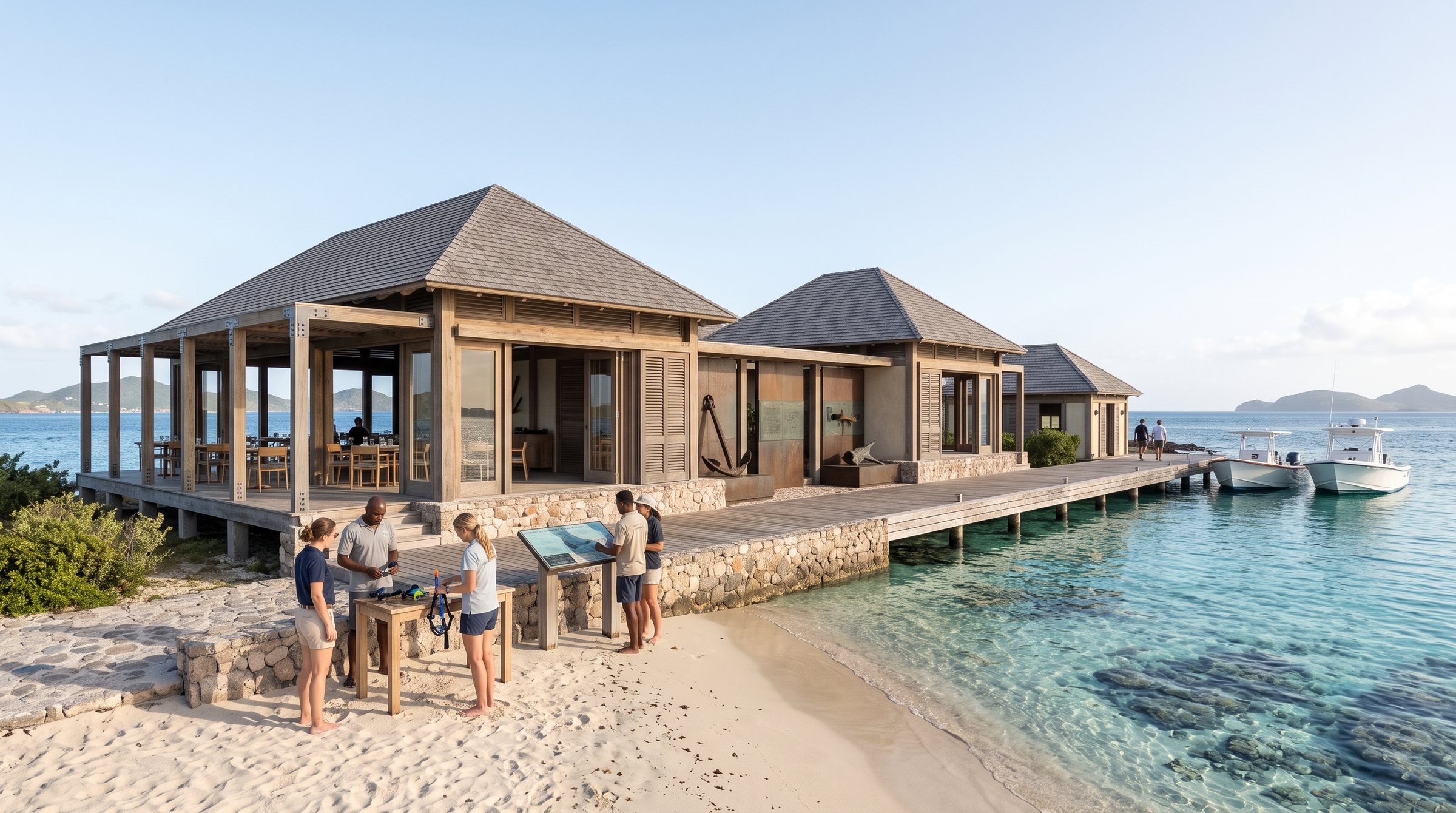
The best future for a whaling station is a reef that outlives it.
It shows the studio working at its smallest scale with its strictest ethics: heritage handled without decoration, and hospitality subordinated to a conservation brief. Petit Nevis is privately owned and publicly listed; we have no affiliation with its owners, brokers or the authorities of St. Vincent & The Grenadines. The whaling-station history is treated with care, and any real project would require EIA/ESIA screening, heritage survey and licensed local consultants.
If a project here became live, we would work as the technical partner alongside the licensed local consultants who carry statutory responsibility in the jurisdiction — the architect of record, structural checkers, MEP and utilities engineers, and the environmental, coastal and fire specialists the approvals require. Our role is design, structural engineering, MEP coordination, BIM and construction-oriented documentation.