Pecatu Hills Hotel Retrofit
A concept design for turning underperforming hilltop hotel structures near Bali's surf coast into a modern surf, wellness and lifestyle hotel. Less mystery, more value engineering.
PECATU · BUKIT PENINSULA
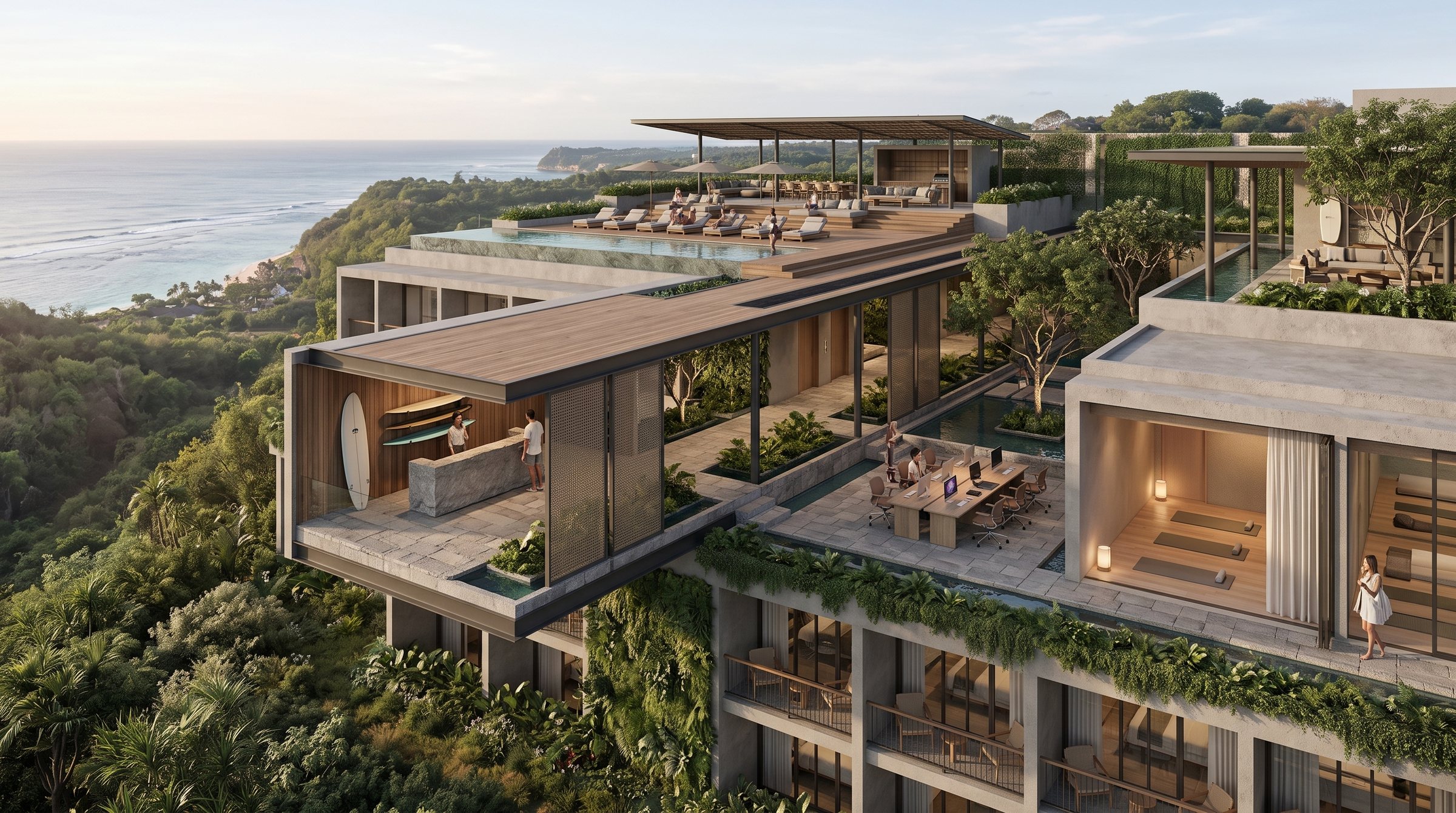
Above Bali's surf coast, tired hilltop hotels hold good bones, good positions and bad numbers.
Of the five Bali projects, this is the most commercially grounded. Investors regularly acquire existing hotel structures near the Bukit's surf coast that need repositioning, not replacement. This project takes that brief seriously. An underperforming hilltop hotel keeps its concrete frame and is stripped back, reorganised and opened to light. The ground floor becomes shaded public space; selected bays are removed to create courtyards; small rooms merge into suites; the roof gains a pool deck and sunset bar where the structure allows. A surf-wellness identity — board storage, surf concierge, recovery spa, co-working — replaces the tired one. The question throughout is a value-engineering question: how do you make an asset that is not working desirable, at a cost a new build cannot match.
| Location | Pecatu hills, near Bali's surf coast, Indonesia |
|---|---|
| Site | Existing hilltop hotel structure — partially abandoned or underperforming, concrete frame retained |
| Programme | Surf-wellness lifestyle hotel with 80–140 rooms, surf club, co-working lounge, recovery spa, gym and rooftop pool or terrace |
| Identity | Retrofit modernism — a repositioned asset with a surf-wellness core, premium but not themed |
| Context | Generic retrofit concept for the underperforming hilltop hotel typology; any real project would require a full structural survey and Indonesian licensed consultants |
| Stage | Concept design — architecture, structure, MEP, BIM |
Keep the frame. Change everything it holds.
§03 — Masterplan strategyThe strategy reuses the existing structure wherever it is viable and spends the budget where guests will feel it.
The existing frame is kept where structurally sound, making redevelopment faster and cheaper than a new build. The ground floor opens up for shade and airflow, selected bays become planted courtyards, small rooms merge into suites, and the roof gains a pool deck and sunset bar where loads allow. A new spine ties the whole reorganisation together.
Keep the frame
The existing concrete structure is retained wherever it is structurally viable, becoming the basis for cost-efficient redevelopment — faster, cheaper and lower-carbon than demolition and rebuild.
Open the ground floor
The ground level is stripped back into shaded public space with better airflow: café, surf club and lounge flow into one another instead of hiding behind a sealed lobby.
Cut courtyards
Selected bays and walls are removed to bring vegetation and daylight into the building's depth. Each cut is a structural decision as much as an architectural one.
Rework the rooms
Small, dated rooms are combined into larger suites where the market demands it, with room count landing between 80 and 140 depending on the existing structure.
Rooftop and identity
Where the structure can carry it, the roof gains a sunset bar, pool deck or yoga terrace. Board storage, surf concierge, recovery spa and gym anchor the new surf-wellness identity.
The Retrofit Spine.
§04 — The iconic pieceA single precise cut through the existing hotel that reorganises everything around it.
The Retrofit Spine is a new linear space cut through the existing building. It organises arrival, reception, lobby, café, surf club, co-working lounge, wellness studio and access to the rooms — one legible route through a structure that previously had none. The intervention is precise rather than grand: a shaded linear volume with timber ceiling, stone floor, water channels, planting, art and framed views, threading between the retained concrete columns.
The spine is buildable because it works with the frame, not against it. A full structural survey, reinforcement scanning and seismic review determine which bays can open; concrete repair and targeted strengthening follow. MEP shafts are rationalised along the spine, and fire escape and accessibility upgrades ride the same route.
Architecture, engineering, ecology.
§05 — The technical layersRetrofit without a costume
Retrofit modernism and technical minimalism: the existing structure stays exposed, joined by warm timber insertions, stone floors, metal screens and woven panels. Surf-lifestyle in attitude but premium in execution — no fake beach theme, everything clean and operational.
Survey first, then cut
A full structural survey, seismic review and reinforcement scanning precede any design move. Concrete repair and selective strengthening follow, with rooftop load assessment governing what the roof can host and façade replacement completing the envelope. Nothing is cut on faith.
Carbon saved by not demolishing
Reusing the frame avoids the embodied carbon of a new structure. Passive shading, natural ventilation in public areas, rooftop solar, rainwater capture, greywater reuse, water-saving fixtures and an improved envelope bring the operating numbers down alongside the capital ones.
BIM-based retrofit planning
The retrofit is planned in BIM from the survey onward: existing frame modelled, scanned reinforcement recorded, MEP shafts rationalised, phasing sequenced. For an investor, the model is the audit — it shows what is kept, what is cut and what it costs.
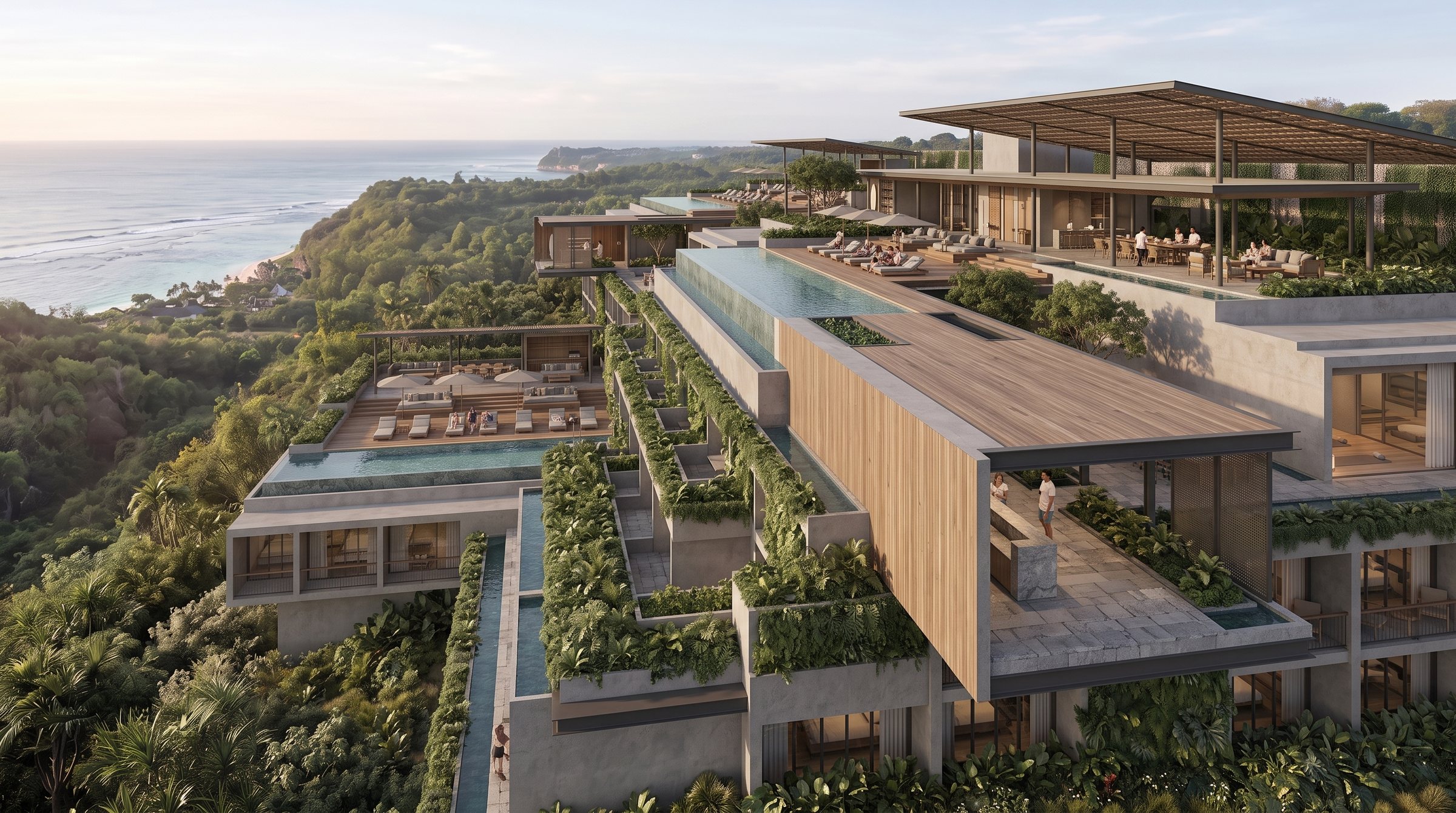
The cheapest structure on any site is the one already standing.
This project sharpens the studio's most bankable skill: turning a technical audit of an existing structure into a design and cost argument an investor can act on. This is a concept design for the underperforming hilltop hotel typology near Bali's surf coast; a real retrofit would require a full structural survey, zoning review and Indonesian licensed consultants.
If a project here became live, we would work as the technical partner alongside the licensed local consultants who carry statutory responsibility in the jurisdiction — the architect of record, structural checkers, MEP and utilities engineers, and the environmental, coastal and fire specialists the approvals require. Our role is design, structural engineering, MEP coordination, BIM and construction-oriented documentation.