Bora Bora Overwater Brownfield Recovery Prototype
A repeatable engineering method for abandoned and unfinished overwater structures: survey, selective demolition, coral restoration and a handful of stronger, lighter villas.
BORA BORA · OVERWATER BROWNFIELD
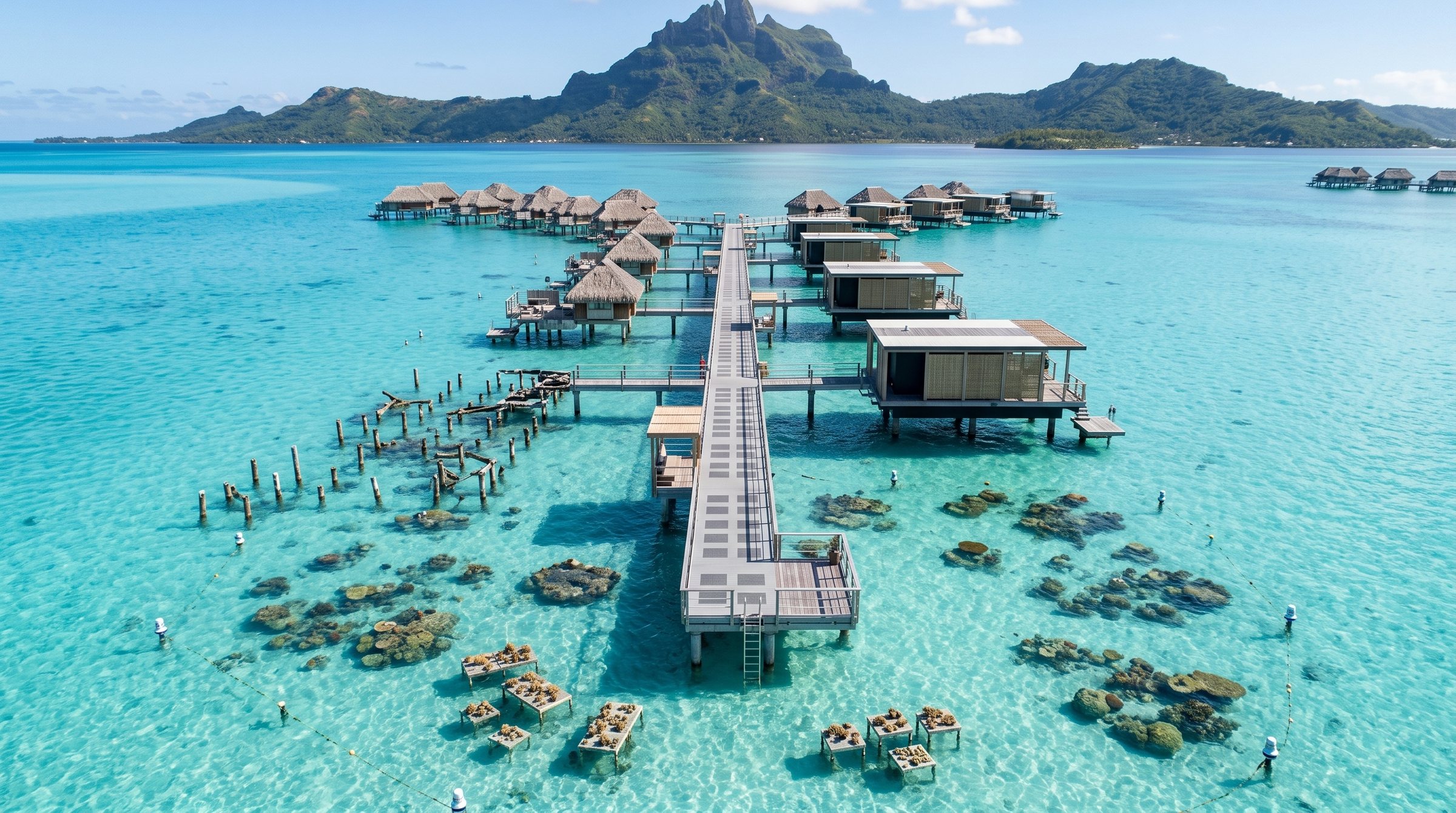
Can an abandoned overwater resort be repaired without repeating the damage that created it?
French Polynesia's lagoons hold unfinished and abandoned overwater projects: pile fields with no decks, decks with no future, structures that shade coral and obstruct currents while their steel corrodes on schedule. They are brownfields standing in living water. This prototype is a staged recovery system rather than a single-property design: survey the field, map coral and marine life, classify every pile and deck, remove what is unsafe or unpermitted, and keep only what is legal, sound and ecologically acceptable. Along the corridors that survive, fewer and larger villas are rebuilt, with monitoring and coral restoration folded into the guest experience. The method is written once and applied wherever a lagoon has been left holding someone's ambition.
| Location | Bora Bora and other French Polynesian lagoons |
|---|---|
| Site | Abandoned or unfinished overwater bungalow fields: degraded piles, deck remnants, live coral beneath |
| Programme | 8–24 recovered overwater villas per brownfield cluster, widely spaced at reduced density, with a marine restoration corridor |
| Identity | Marine engineering minimalism — a lagoon recovery prototype |
| Context | A repeatable technical approach applicable across Polynesian lagoons; every element sits in the public maritime domain and requires authorisation |
| Stage | In-house resort design — architecture, structure, MEP, BIM |
Survey, remove, rebuild fewer.
§03 — Masterplan strategyThe masterplan is a decision tree that starts underwater.
First comes a technical survey: piles, deck remnants, utilities, coral, seagrass, bathymetry and currents mapped into one model. Removal follows, taking out structures that are unsafe, unpermitted or unmaintainable, or that shade coral and block flow, under strict containment. Only along approved corridors does the Floating Repair Walk go in, serving fewer, larger villas, while coral nurseries, substrate recovery and water monitoring turn the recovering lagoon into the resort's main amenity.
Map the brownfield
Existing piles, deck remnants and utilities are recorded alongside coral, seagrass, bathymetry and currents. Unsafe zones are flagged. Every later decision — keep, strengthen, remove — traces back to this single dataset.
Remove what harms
Structures come out if they are unsafe, unpermitted, impossible to maintain, or if they shade coral and obstruct lagoon flow. Removal is engineered work: method statements, debris containment and environmental monitoring throughout.
One spine, few piles
New circulation is concentrated into a single lightweight walk along approved corridors, aligned to avoid coral heads. Water, power, fire and communications travel inside its spine, so services never touch the lagoon bed twice.
Fewer, larger villas
Many small bungalows are replaced by a handful of generously spaced, larger villas. Density drops, value per key rises, and open water returns between structures, restoring light and current to the reef below.
Restoration as amenity
Coral nurseries, substrate recovery, water-quality monitoring and marked snorkelling routes become part of the stay. Guests are briefed on the recovery at arrival; the lagoon's condition is the resort's headline metric.
The Floating Repair Walk.
§04 — The iconic pieceA walkway that is also the resort's technical backbone and its marine classroom.
The Walk is a lightweight overwater spine linking the shore pavilion to the villas along corridors the survey has cleared. Along its length sit coral observation platforms, water-quality monitoring points, shaded rest stops and interpretive marine stations; beneath its deck run the water, power, fire and communications services. Removable panels open the whole route for inspection, and the same spine doubles as the maintenance and emergency access path.
It is buildable because it is modest: modular bays, minimal piles set clear of coral heads, marine-grade steel or aluminium with stainless and duplex fasteners, and composite or engineered-timber decking. The structure is checked for fatigue, wave and wind loading, designed for uplift, and partially demountable ahead of major storms.
Architecture, engineering, ecology.
§05 — The technical layersLow visual weight
Marine engineering minimalism: light modular villas, shaded decks, dark undersides to cut glare on the water, and detailing precise enough to be read at arm's length. The architecture's job is to sit lightly and age honestly in salt air.
Piles are the project
Underwater inspection and corrosion-loss assessment decide each pile's fate, with load testing where possible. Replacement piles are designed at minimal footprint; villas arrive as prefabricated modules; decks are engineered for uplift; electrical isolation keeps dissimilar metals from feeding corrosion.
Nothing enters the lagoon
No wastewater discharge, no fuel storage over water, and construction run to low-light, low-noise methods with mandatory debris containment. Environmental monitoring brackets the works — before, during and after — and every storm-exposed component carries an emergency removal plan.
Condition mapping in BIM
Every pile, deck and defect lives in a BIM-based condition model, which then generates the demolition and rebuilding phasing diagrams. The same model carries the maritime-domain authorisation drawings and the environmental monitoring record, one dataset from survey to handover.
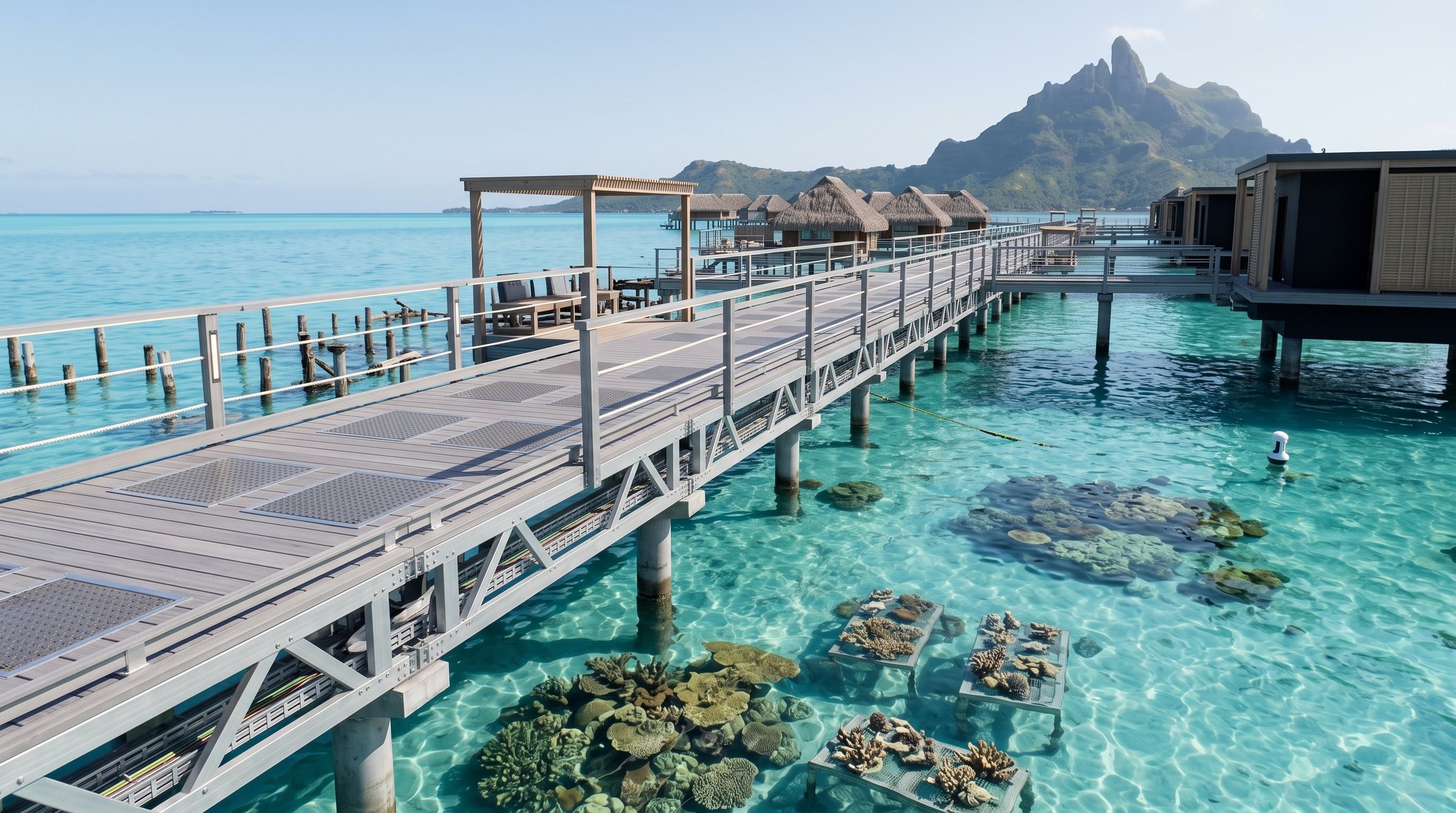
The first act of construction is removal.
This is the project where the studio's structural and marine engineering carries the argument: pile audits, corrosion assessment, demolition sequencing and modular rebuilding, written as a method any Polynesian lagoon could reuse. An in-house technical prototype based on publicly documented abandoned and unfinished overwater projects, tied to no specific property or owner. Any real recovery would require maritime-domain authorisation, underwater inspection, environmental studies and licensed local consultants.
If a project here became live, we would work as the technical partner alongside the licensed local consultants who carry statutory responsibility in the jurisdiction — the architect of record, structural checkers, MEP and utilities engineers, and the environmental, coastal and fire specialists the approvals require. Our role is design, structural engineering, MEP coordination, BIM and construction-oriented documentation.