Nusa Lembongan Low-Impact Island Retrofit
A concept for transforming abandoned or underperforming small-island hospitality assets near Bali into low-impact reef and wellness retreats. Humble in scale, precise in engineering.
NUSA LEMBONGAN · ISLAND
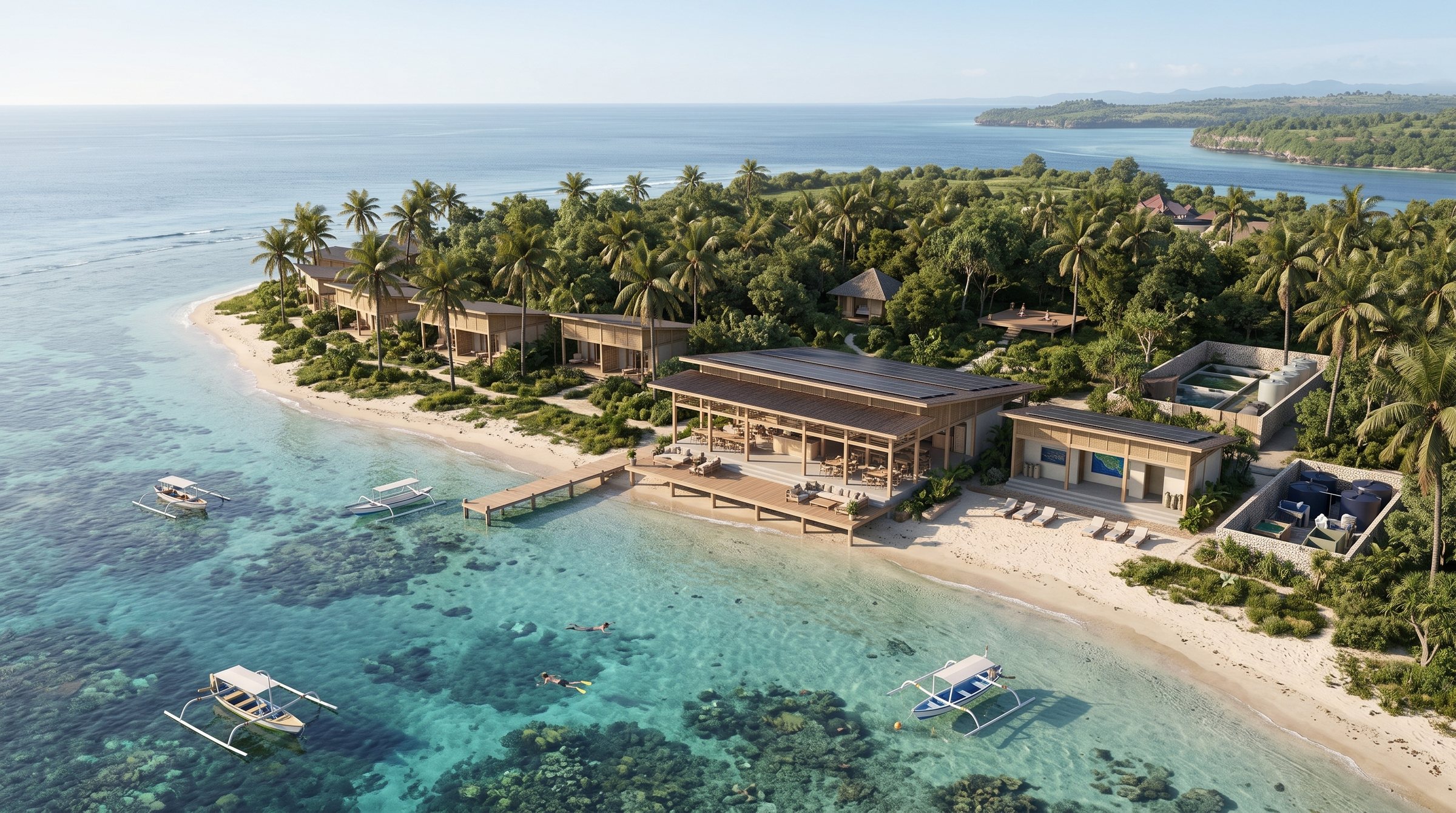
Nusa Lembongan is small enough that every building decision is felt by the reef, the village and the shoreline at once.
A short crossing from Bali, Nusa Lembongan is fragile, touristic and entirely island-scaled. Its hospitality stock includes small resorts that no longer perform, sitting on coastlines that cannot absorb heavier replacements. This design retrofits rather than rebuilds. Existing rooms and structures are repaired and reused where possible; new additions are lightweight timber; setbacks protect vegetation and the shoreline. The retreat is organised around lagoon access, reef education, diving, wellness and slow living, with local boat operators, guides, crafts and food woven into the concept rather than displaced by it. The intended character is humble but premium — not flashy, not huge, not invasive — with the technical infrastructure of water treatment and waste handled as seriously as the architecture.
| Location | Nusa Lembongan, off southeast Bali, Indonesia |
|---|---|
| Site | Small underperforming island resort — existing buildings, fragile coastline and reef frontage |
| Programme | Low-density reef retreat with 25–50 rooms and villas, family suites, dive and snorkel centre, marine education room, small spa and yoga deck |
| Identity | Reef-sensitive island retreat — boutique scale, dive and wellness identity, community-connected |
| Context | Generic concept for small-island hospitality assets near Bali; no specific property, and any real project would need community consultation and Indonesian licensed consultants |
| Stage | In-house resort design — architecture, structure, MEP, BIM |
Small island, strict rules.
§03 — Masterplan strategyThe plan keeps what can be repaired, limits what is added, and gives the reef the final word on both.
Existing rooms and structures are reused wherever repair is viable, and new rooms are deliberately limited in favour of quality and low density. The Reef House anchors arrival and orientation, setbacks protect vegetation and the coastline, and guest and service movement stay separate even at this scale. Local operators, guides, crafts and food are part of the concept, not decoration around it.
Repair before adding
Existing rooms and structures are kept and repaired wherever possible. On a small island, every avoided demolition is saved barge traffic, saved waste and a lighter footprint.
The Reef House first
Arrival is organised around a single orientation point: the Reef House, where guests meet the lagoon, the dive programme and the island's terms before they meet their room.
Deliberately few rooms
New rooms are limited in favour of quality and low density — 25 to 50 rooms and villas in total, including family suites. The business model is restraint, priced accordingly.
Setbacks and soft edges
Vegetation and coastline are protected through setbacks and the avoidance of hard edges. Hardscape is minimal, light pollution is kept low, and the shoreline keeps its own profile.
Community inside the plan
Local boat operators, guides, crafts, food and reef education are integrated into the concept, with dedicated vendor space — the island's economy runs through the retreat, not around it.
The Reef House.
§04 — The iconic pieceA small public pavilion where the resort's dive, dining and education life converges at the water.
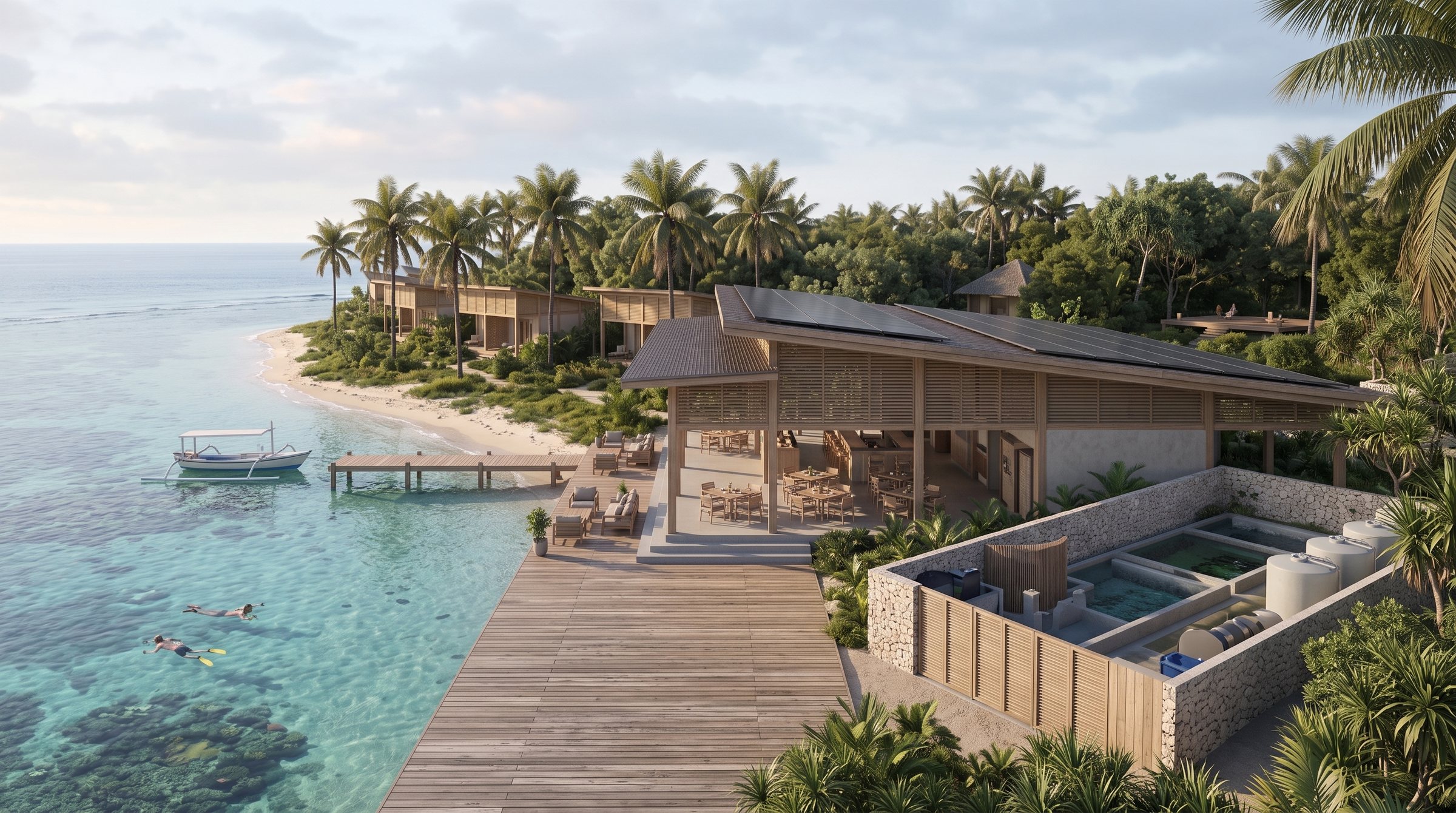
The Reef House is a modest public pavilion combining marine education, the dive centre, restaurant, lounge and a sunset deck — the heart of the retreat. It is light, deeply shaded, open to the breezes and closely connected to the sea. Alongside meals and briefings, it carries educational content on coral, tides, marine life and responsible tourism, so the first building guests inhabit is also the one that explains where they are.
As a lightweight timber pavilion with shaded openings, the Reef House suits island logistics: small members, simple connections, local erection. Coastal foundation checks, corrosion protection, wind resilience appropriate to the site, and integrated drainage make it durable; its modest scale keeps it honest.
Architecture, engineering, ecology.
§05 — The technical layersBarefoot but refined
Island minimalism in lightweight timber: shaded pavilions, carefully used bamboo-inspired screens, natural stone, lime plaster and woven panels, with concrete only where needed. Small-scale, reef-sensitive hospitality — barefoot but refined, with no mega-resort language anywhere on the island.
Light additions, checked foundations
A condition survey of existing buildings and foundation checks in the coastal environment come first. New work is lightweight timber and steel with corrosion protection, roof upgrades and improved drainage, plus wind resilience appropriate to the site and clear emergency access.
Infrastructure the reef can live with
Small-scale wastewater treatment, rainwater capture, water storage and water-saving systems form the island's quiet backbone. Solar roofs, natural ventilation, low light pollution, a plastic-free service strategy and waste sorting keep operations reef-safe rather than merely reef-adjacent.
Precision at boutique scale
Small projects forgive nothing: on an island, an undocumented pipe run or a misplaced foundation costs a boat trip. The design documents existing structures, lightweight additions, water and waste systems in one coordinated model sized to the project.
On a small island, restraint is not a style. It is the structural system.
Small-island retrofit compresses everything the studio cares about — reuse, water, waste, community, lightweight structure — into a scale where none of it can be hidden. This is a concept for small-island hospitality assets near Bali, not a proposal for any specific Nusa Lembongan property. No commission or affiliation exists; a real project would require ownership verification, community consultation and full compliance with Indonesian and Balinese regulations through licensed local professionals.
If a project here became live, we would work as the technical partner alongside the licensed local consultants who carry statutory responsibility in the jurisdiction — the architect of record, structural checkers, MEP and utilities engineers, and the environmental, coastal and fire specialists the approvals require. Our role is design, structural engineering, MEP coordination, BIM and construction-oriented documentation.