Naranjo Three-Island Expedition Resort
A 447-hectare, three-island masterplan design in the Naranjo Islands, where logistics concentrate on one island and each of the other two keeps its own identity.
NARANJO ISLANDS · PHILIPPINES
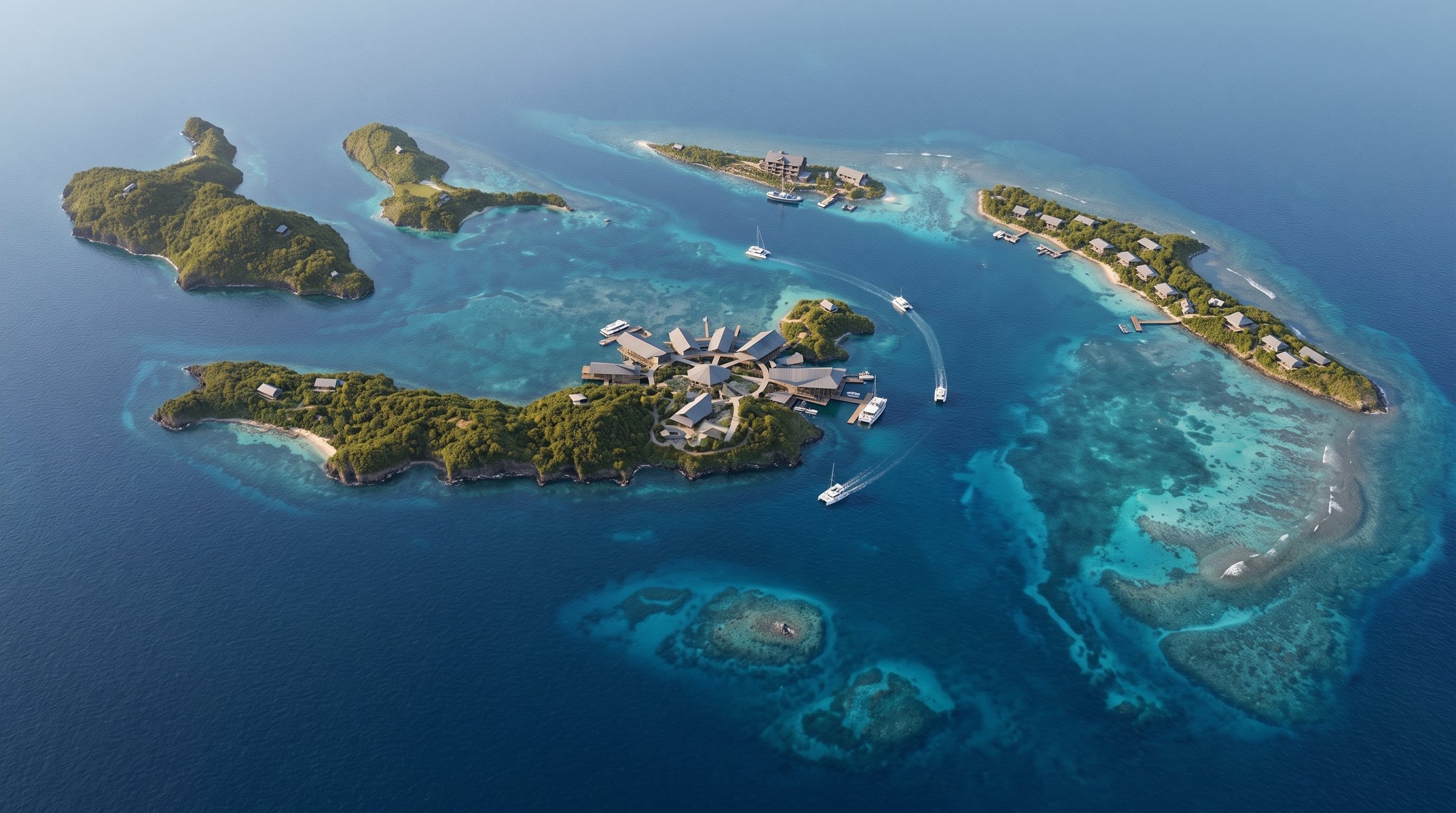
The Medio group is one property but three different islands, and the plan treats that as its whole idea.
The Medio Island Group — Medio, Rasa and San Andres — appears publicly listed as a single holding of around 447 hectares in the Naranjo Islands. Land at this scale invites overbuilding; the design resists it. Heavy infrastructure, arrival, staff and utilities concentrate on Medio, the base island. Rasa becomes the wellness island: spa, silent villas, forest paths. San Andres becomes the adventure island: diving, sailing, a trail lodge and a marine research station. Guests move between them by boat, so the water becomes the corridor and the journey becomes the product. The built footprint stays small against the land area, mangroves and reefs stay untouched, and the archipelago reads as one resort with three tempers.
| Location | Medio Island Group, Naranjo Islands, Philippines |
|---|---|
| Site | Three islands — Medio, Rasa and San Andres — approx. 447 hectares (1,104 acres) in total |
| Programme | 60–100 keys distributed across three islands; expedition centre, spa, dive and research facilities |
| Identity | Expedition luxury with a marine research layer; one base island, three roles |
| Status / Context | Appears publicly listed; foreign landholding requires local legal structuring; ECC/EIA and foreshore permits apply |
| Stage | Resort design — architecture, structure, MEP, BIM |
One base island, three identities.
§03 — Masterplan strategyHeavy infrastructure concentrates on Medio so that Rasa and San Andres can stay light.
The masterplan is a logistics decision before it is an image. Medio carries arrival, the main restaurant, staff housing, utilities and the expedition centre; a tender dock is contemplated only if approvals allow. Rasa and San Andres receive small, dispersed nodes with distinct typologies. Controlled boat routes connect the three, and a reef monitoring and dive education programme runs through the whole plan. No dredged marina, no continuous beachfront villas, no discharge to sensitive waters.
One Logistics Island
Power, water, wastewater, fuel, storage and staff housing concentrate on Medio. Centralising the heavy plant on one island keeps the other two low-impact and makes maintenance, deliveries and emergency response manageable at archipelago scale.
Three Distinct Identities
Each island keeps its own character and villa typology. Rasa is for stillness: spa, yoga, silent villas, forest paths. San Andres is for exertion: diving, sailing, trails and marine education. Copy-paste typologies are explicitly banned.
Boat-Based Journey
Movement between islands happens on controlled boat routes, timed and weather-managed. Crossing the water is part of the programme: departure, passage and landfall replace corridors, and the expedition desk on Medio choreographs the whole sequence.
Marine Research Layer
Reef monitoring, dive education and conservation programming run alongside hospitality. A research station on San Andres gives the resort scientific content and gives guests a reason to return that no infinity pool can supply.
Low-Density Distribution
The land area is large; the built footprint must stay small. Nodes are kept compact and dispersed, mangroves and reefs are avoided entirely, and typhoon-resilient construction is assumed from the first sketch.
The Island Compass.
§04 — The iconic pieceA radial arrival pavilion on Medio that organises the routes to all three islands.
The Island Compass is the group's point of orientation: arrival lounge, expedition desk, restaurant, marine room, map room, briefing room, boat deck and equipment stores arranged around shaded courtyards and one central gathering space. It is not literally a compass; it is spatially radial, so that every departure — to Rasa, to San Andres, to the reef — begins and ends in the same legible place.
Lightweight pavilion construction suits the site: timber frames on stone and concrete bases, typhoon-resilient roofs, marine-grade metal and composite decking. The radial plan breaks into repeatable structural bays for prefabrication, and every wet, powered or fuelled function sits on the base island where it can be serviced.
Architecture, engineering, ecology.
§05 — The technical layersExpedition tropical modernism
Lightweight pavilions with storm-resilient roofs, shaded decks and a working marine-research atmosphere. This is practical luxury: timber, woven screens and shaded glass assembled with the directness of a field station and the comfort of a resort.
Typhoon-resilient by default
Stone and concrete bases carry timber superstructures with high-durability roofs and marine-grade connections. Structures are modular and repeatable across the three islands, sized for boat-delivered components and designed to be repaired with what the base island stocks.
Distributed utilities, zero discharge
Utilities concentrate on Medio with satellite micro-plants on the outer islands. Wastewater is treated with zero discharge to sensitive waters; mangroves, reefs and seagrass are avoided outright. Disaster preparedness, medical response and evacuation planning sit inside the MEP brief from day one.
Archipelago-scale masterplanning
Multi-island BIM coordination covers boat routes, distributed utilities and service concentration as designed systems. Modular architecture and prefabrication strategies are documented for phased delivery, so each island can open in sequence without stranding infrastructure.
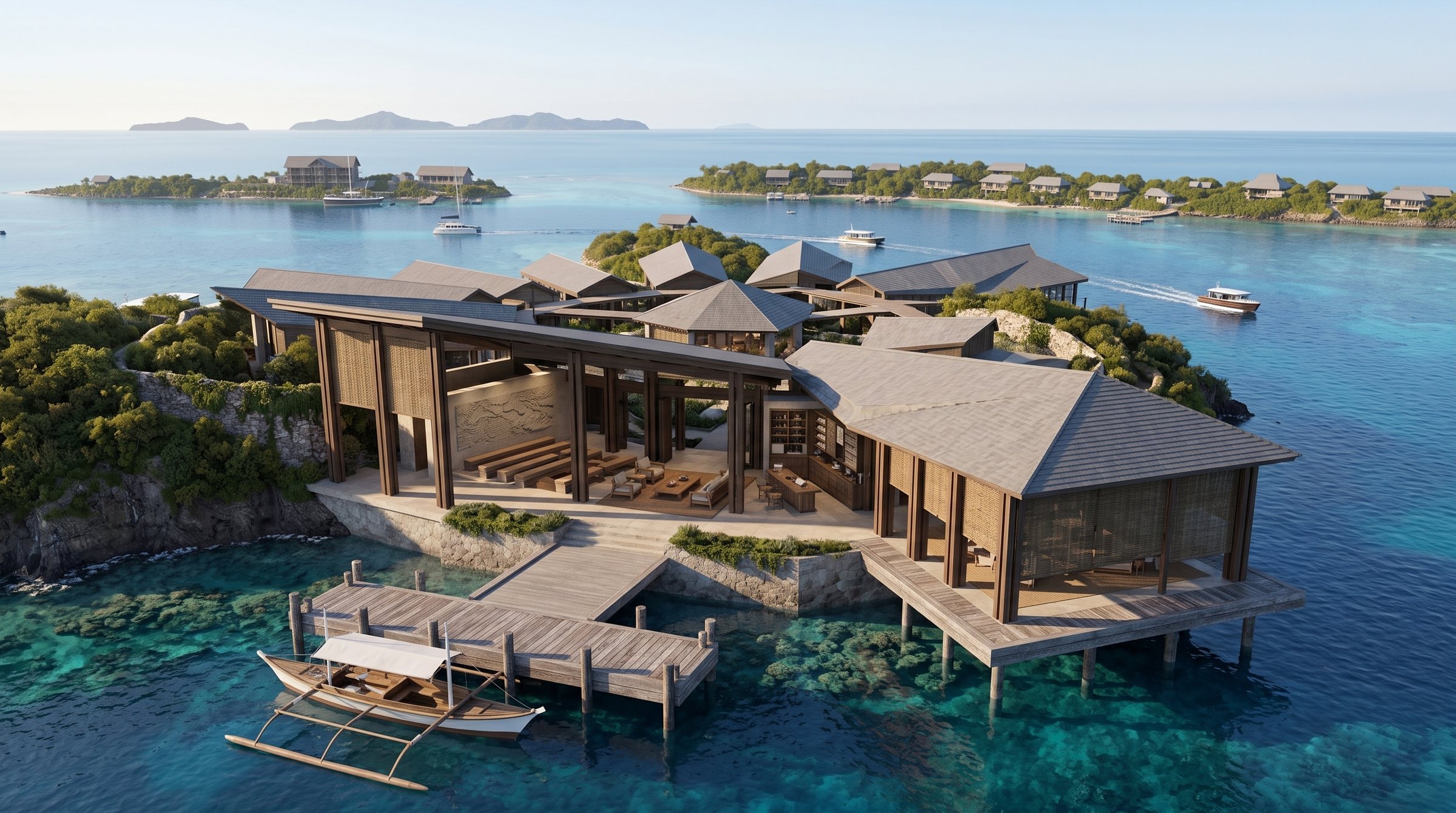
Three islands, three tempers, one small footprint.
Archipelago logistics (distributed utilities, boat routes, phased delivery) are a planning discipline few resort designs rehearse; this one exists to rehearse it. The Medio Island Group appears publicly listed for sale; this design is unaffiliated with any owner, broker or Philippine authority. Foreign landholding in the Philippines requires local legal structuring, and any works would need ECC/EIA clearance, LGU zoning and foreshore permits.
If a project here became live, we would work as the technical partner alongside the licensed local consultants who carry statutory responsibility in the jurisdiction — the architect of record, structural checkers, MEP and utilities engineers, and the environmental, coastal and fire specialists the approvals require. Our role is design, structural engineering, MEP coordination, BIM and construction-oriented documentation.