Motu Tane Atelier Island Estate
A repositioning design for a privately owned island estate near Bora Bora: restoration, climate resilience and discreet service upgrades, gathered under an atelier identity.
MOTU TANE · NEAR BORA BORA
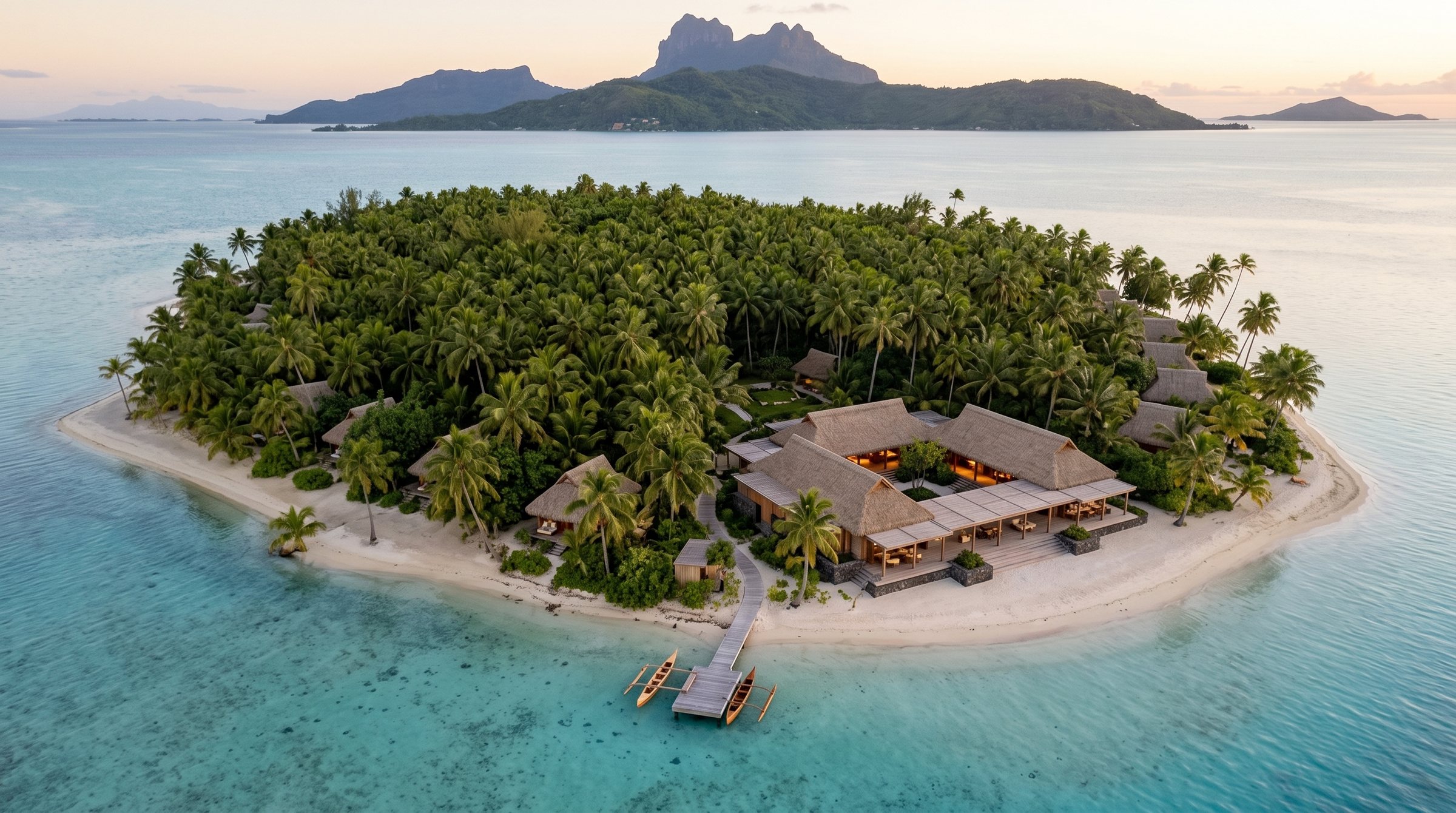
The island already has its architecture; the design concerns everything guests never see.
Motu Tane is publicly known as a private island estate near Bora Bora, formerly associated with François Nars, with design-led Polynesian structures already in place. Nothing about it asks for a resort. This design treats the island as a work to be curated: existing buildings surveyed and restored, roofs technically upgraded against cyclones, services modernised to lagoon-safe standards, and a wellness garden and refined lagoon deck added at domestic scale. The identity shifts from private retreat to atelier — a setting for art, design, writing, photography and slow hospitality, run as a private buyout of eight to sixteen suites. The lagoon is asked to carry nothing new of any consequence.
| Location | Motu Tane, near Bora Bora, French Polynesia |
|---|---|
| Site | Private island estate with existing design-led Polynesian structures |
| Programme | 8–16 suites on a private buyout model; salon, artist studio, design library, gallery, wellness garden, refined lagoon deck |
| Identity | Curated Polynesian estate — art and design atelier |
| Context | Privately owned island known through public sources; a repositioning and upgrade design, with no resort-scale development proposed |
| Stage | Concept design — architecture, structure, MEP, BIM |
Restore, connect, conceal.
§03 — Masterplan strategySix moves, none of them large.
The existing buildings are surveyed and restored first, then linked into an atelier circuit: salon, studio, library, gallery, wellness and lagoon deck along one shaded walking sequence. Guest structures become upgraded suites with outdoor showers and shaded decks. A small spa and water garden are added, and the lagoon deck is refined without growing. Back-of-house — staff, storage, water, wastewater, energy — is modernised discreetly, because on a private island the infrastructure is the luxury.
Restore the fares
Every existing building is surveyed for structure, moisture, termites and corrosion before any design move. Restoration and technical upgrade come ahead of addition; the estate's original craft is treated as the primary material.
The atelier circuit
Salon, artist studio, design library, private gallery, wellness rooms and lagoon deck are linked by one shaded walking route, so the island reads as a single curated house spread among the palms.
Suites, upgraded
Existing guest structures become eight to sixteen refined suites with privacy, outdoor showers, shaded decks and lagoon views. No new density; the comfort arrives through detail, servicing and climate resilience done properly.
Wellness garden and water
A small spa, yoga deck, massage pavilion and water garden settle into the planting, while lagoon access remains a refined deck. Marine works stay minimal and within whatever the lagoon domain permits.
Invisible engineering
Water, wastewater, energy, storage and staff facilities are rebuilt to current standards and hidden in the section. Solar and battery systems, lagoon-safe wastewater treatment and discreet routing keep the island's image untouched.
The Atelier House.
§04 — The iconic pieceIt should feel like a house rather than a hotel lobby.
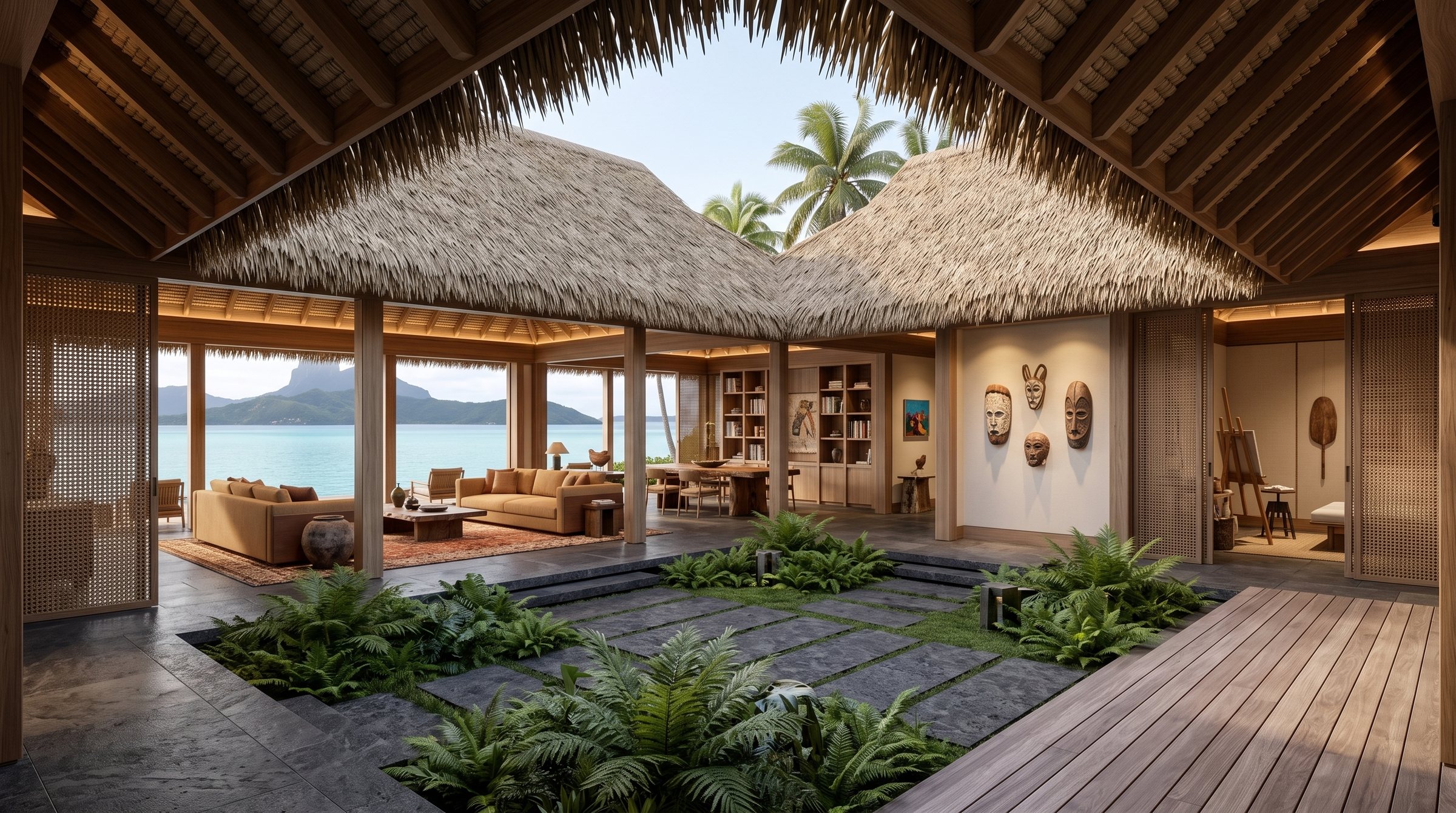
The Atelier House is the island's creative heart: salon, private dining, design library, artist studio, spa room, private gallery, shaded courtyard, lagoon deck and an owner's lounge, gathered under traditional roof silhouettes. Its rooms are intimate and tactile — linen, timber, stone, woven surfaces — sized for one household and its guests, with the studio and gallery giving the estate its working identity.
Credibility comes from renovation engineering: condition survey, roof upgrade and tie-down strategy for cyclone winds, corrosion-resistant fixings throughout, and engineered timber reinforcing the traditional silhouettes. MEP modernisation, solar and battery integration and fire-safety planning are threaded through the existing fabric with minimal disturbance.
Architecture, engineering, ecology.
§05 — The technical layersCraft, kept and upgraded
A curated Polynesian estate language: traditional roof silhouettes technically upgraded, existing timber retained and reinforced, natural woven surfaces, stone, lime plaster and shaded glass. Warm interiors at intimate scale; nothing that announces a hotel.
Renovation as engineering
Condition surveys of every structure, termite and moisture inspection, corrosion audit and a roof tie-down strategy for cyclone resistance. Strengthening uses engineered timber and marine-grade connections, detailed for inspection and eventual replacement in a maintenance-hostile climate.
Lagoon-safe systems
Septic and wastewater systems upgraded to lagoon-safe standards, solar and battery generation, restrained night lighting and modernised water and fire services. The environmental posture is simple: a private island that takes better care of its own water.
A record model of the estate
Existing buildings are captured in a measured BIM record carrying condition data, which then drives the renovation packages, permit documentation for structural changes and phased works planning, so upgrades can proceed without disrupting the island's operation.
Curate the island. Build almost nothing.
Restoration on a supply-by-boat island is engineering at its most disciplined: every intervention must justify its own logistics. The design rehearses doing less, extremely well. Motu Tane is a privately owned island; this concept is based on public sources and has no affiliation with its owner, past or present, or with any broker. Real work would proceed only under an owner's mandate and full French Polynesian approvals.
If a project here became live, we would work as the technical partner alongside the licensed local consultants who carry statutory responsibility in the jurisdiction — the architect of record, structural checkers, MEP and utilities engineers, and the environmental, coastal and fire specialists the approvals require. Our role is design, structural engineering, MEP coordination, BIM and construction-oriented documentation.