Makri Ionian Conservation Retreat
A manifesto concept asking whether the right project for a protected island is almost no project at all: four to twelve keys, reversible structures, and a masterplan defined by what it refuses.
MAKRI · IONIAN SEA
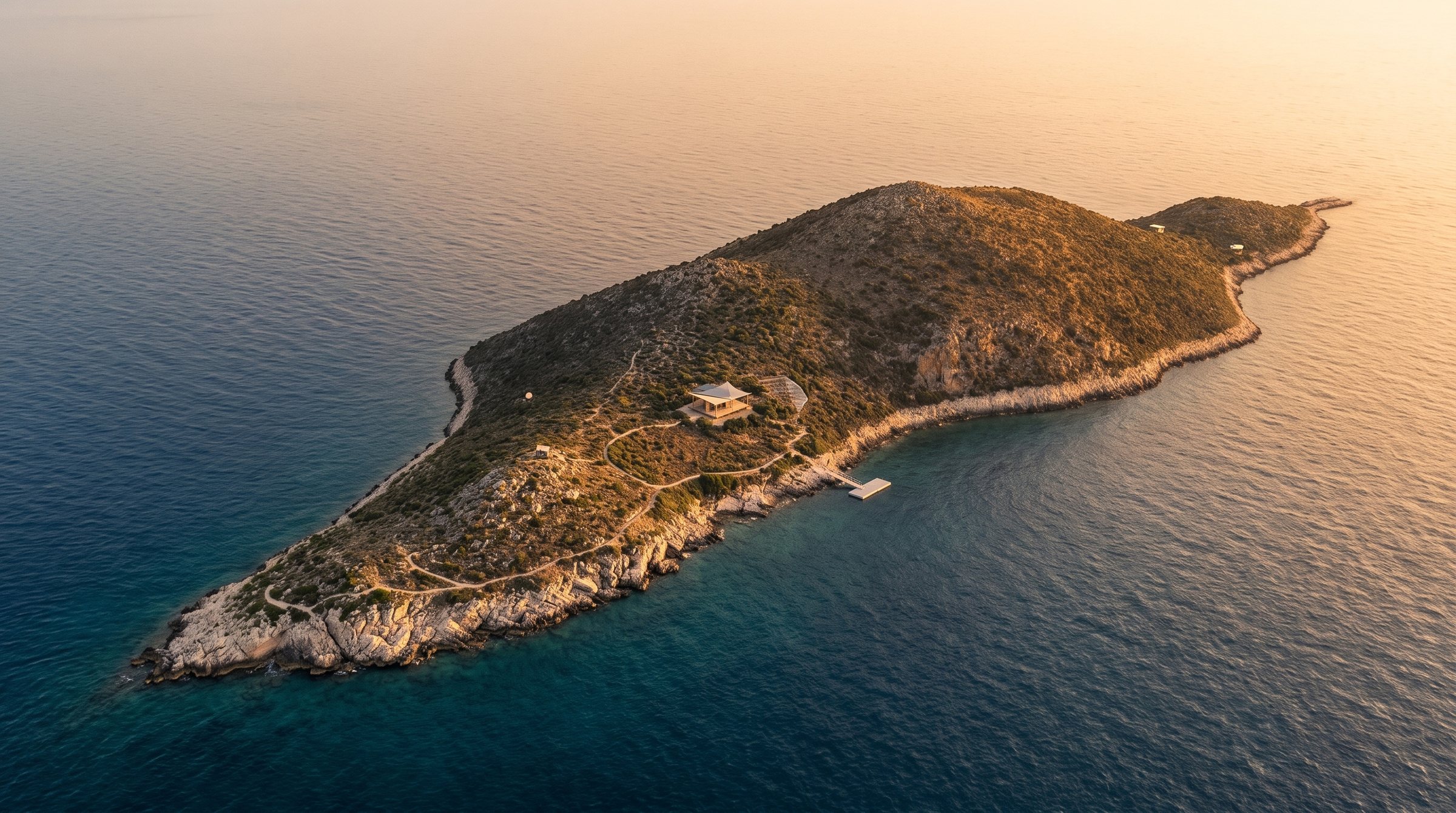
Some sites ask for a masterplan; Makri asks for a justification.
Makri is the project this series needs precisely because it resists development. For a sensitive Ionian island, the honest hospitality concept may be a conservation retreat: four to twelve keys at most, and only if any development proves legally and environmentally possible at all. The proposal is written largely in negatives: no conventional resort, no major roads, no aggressive coastline works, no large marina. What remains is small and reversible — lightweight pavilions that can be removed without trace, strict conservation zones, low-impact access, off-grid energy, a composting and waste strategy, and water independence where feasible. Guests come for research, observation, silence and limited private use. The project exists to show investors that the studio understands limits as clearly as it understands opportunity.
| Location | Sensitive island in the Ionian Sea, Greece |
|---|---|
| Site | Protected island landscape; conservation value treated as the primary design constraint |
| Programme | 4–12 keys, if development is legally and environmentally possible; research and observation pavilion, minimal removable structures |
| Identity | Conservation retreat and off-grid research lodge — a manifesto of restraint |
| Status & Context | Bonus concept framed as an editorial question, when not to build; all figures conditional on environmental and legal feasibility |
| Stage | Concept design — architecture, structure, MEP, BIM |
A plan defined by refusals.
§03 — Masterplan strategyThe strategy is a list of things the island will never receive.
No conventional resort, no major roads, no aggressive coastline development, no large marina. In their place: minimal removable pavilions, strict conservation zones, a research and monitoring programme, low-impact access, off-grid energy, a composting and waste strategy, and water independence if feasible. Every intervention must be reversible; the exit strategy is drawn before the entrance.
Strict Conservation Zones
The island is zoned for protection before it is zoned for use. Conservation areas are fixed first and held absolutely; any occupation happens in the small remainder, on conservation's terms.
Minimal Removable Pavilions
The only structures are lightweight pavilions designed for removal without trace: raised, dry-jointed, demountable. If the experiment ends, the island returns to its previous state, and the drawings say how.
Research and Monitoring
Hospitality is coupled to purpose: nature monitoring, research residencies, lectures and observation. Guests fund and witness conservation work; occupancy stays within four to twelve keys, if permitted at all.
Low-Impact Access
No large marina and no road network. Access stays light: a small-boat landing, footpaths, and service logistics scaled to what can be carried rather than driven.
Off-Grid Autonomy
Off-grid energy, a composting and waste strategy, and water independence where feasible. The island is planned to owe nothing to mainland infrastructure and to leave nothing behind when it is done.
The Rewilding Observatory.
§04 — The iconic pieceA lightweight, reversible pavilion for research, observation, lectures and shared meals — an environmental instrument with rooms.
The Observatory is the island's one shared building. It hosts research and nature monitoring, dining, observation, lectures and small gatherings under a single lightweight roof. It has no lobby ambitions: its dignity comes from its purpose and from its promise to leave. Everything about it — siting, footprint, materials — is decided by what the island's ecology can absorb, and by how completely the structure could one day be removed.
Reversibility is a solvable engineering problem, and the Observatory treats it as the main one: light demountable framing, dry connections, minimal-impact foundations and components small enough to arrive by boat. Disassembly is documented as carefully as assembly, so the bill of materials doubles as a promise of restitution.
Architecture, engineering, ecology.
§05 — The technical layersArchitecture at whisper volume
Small, low, lightweight structures in natural materials, sited to be barely visible from the water and reversible by design. Here the architectural ambition shows in restraint, exact detailing and the discipline of building almost nothing, well.
Engineered to be removed
Lightweight demountable frames, dry joints throughout, minimal-impact groundworks and components sized for boat transport. Structural design here is judged by two states: how well the building stands, and how completely it can be made to disappear.
Off-grid and closed-loop
Off-grid energy, a composting and waste strategy, and water independence where feasible, all sized for a handful of keys. Services are treated as part of the conservation case: monitored, reported and kept deliberately small for the island's sake.
Evidence, then drawings
For a protected site, the documentation is the project: environmental baselines, reversible construction sequencing, disassembly plans and exact quantities, coordinated in a BIM model and prepared for scrutiny by regulators, conservation bodies and licensed Greek consultants.
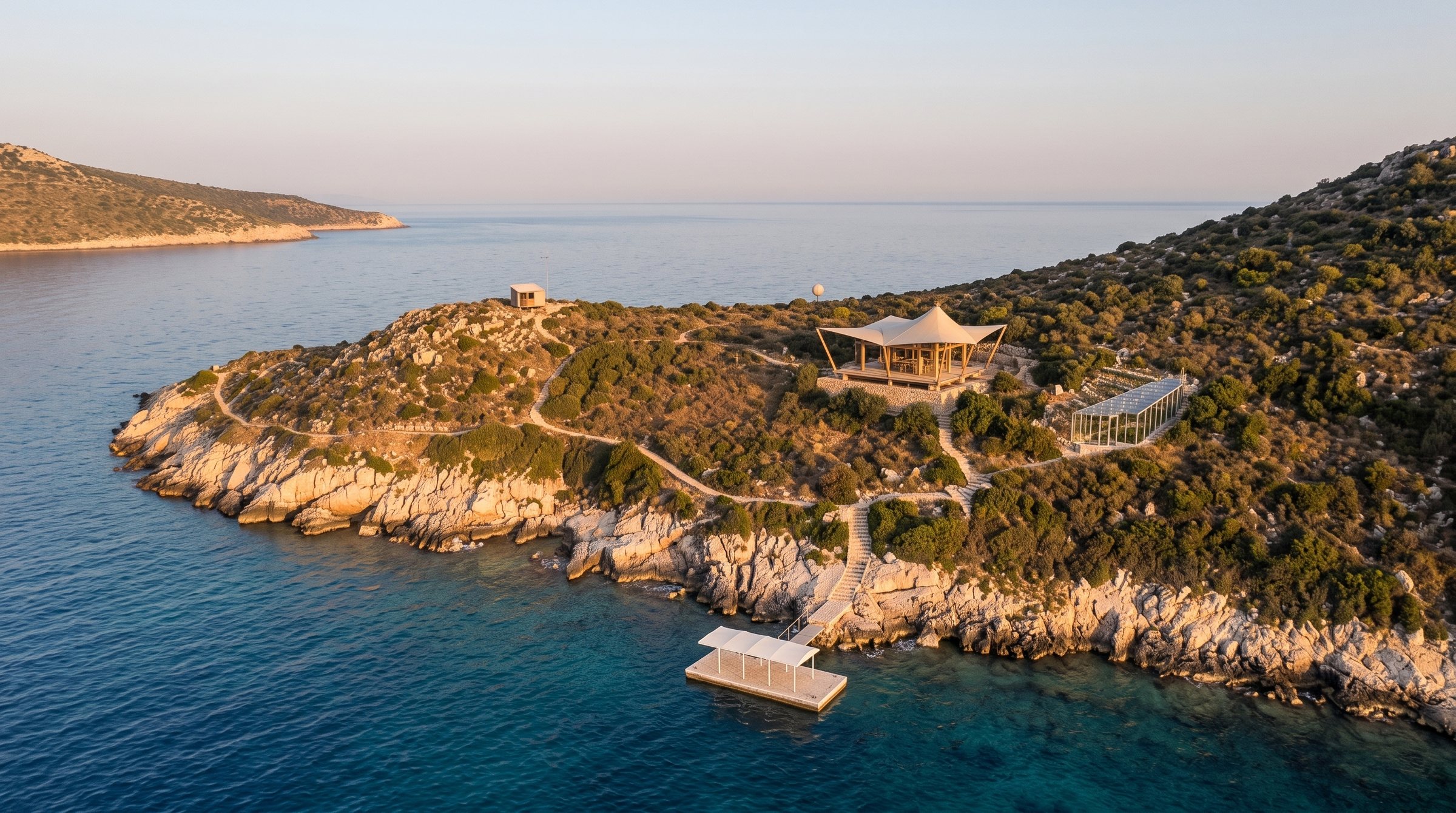
Knowing when not to build is also a design skill.
Makri tells investors something the other projects cannot: that the studio recognises limits, prices restraint honestly, and will say so before a project begins. A manifesto concept for a sensitive Ionian island, with no owner, authority or conservation body involved. The premise is explicit: development here may prove legally or environmentally impossible, and the concept treats that outcome as a legitimate result.
If a project here became live, we would work as the technical partner alongside the licensed local consultants who carry statutory responsibility in the jurisdiction — the architect of record, structural checkers, MEP and utilities engineers, and the environmental, coastal and fire specialists the approvals require. Our role is design, structural engineering, MEP coordination, BIM and construction-oriented documentation.