Bora Bora Lagoon Ruins Retreat
An adaptive reuse design for a closed lagoon resort, editing abandoned structures into a small wellness and art retreat of stabilised walls, water courts and deep shade.
BORA BORA · RUIN GARDEN
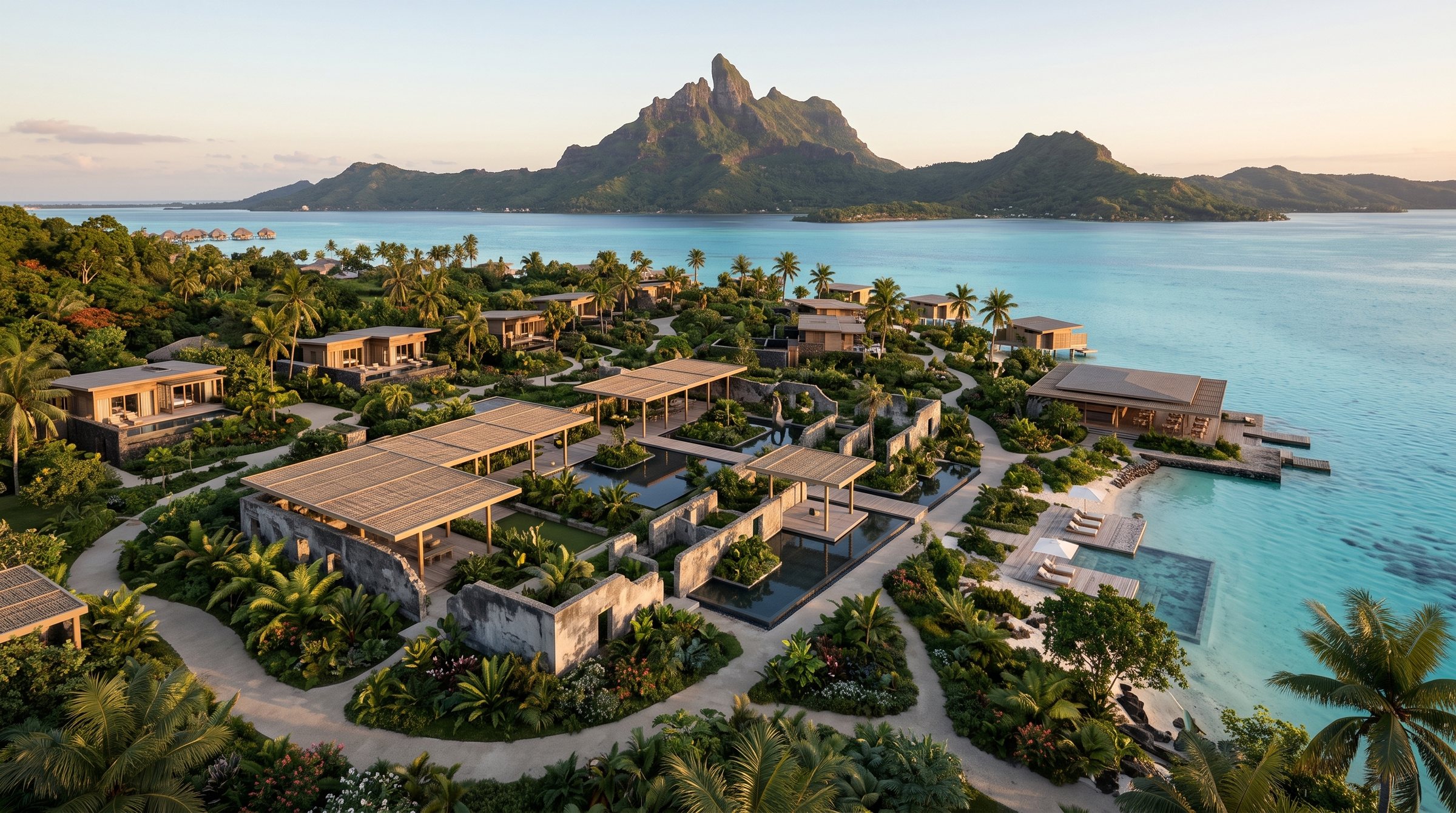
Every closed resort leaves two sites behind: the land, and the memory standing on it.
Bora Bora holds more than one closed resort. Behind the postcard lagoon there are abandoned hospitality sites where vegetation has moved back in, concrete traces mark the old grid, and derelict marine structures still shade the water. Demolishing everything wastes embodied material and erases the site's memory; rebuilding the old density repeats the mistake that produced the ruin. This design proposes a third route. The structures are classified and edited: some removed, some stabilised, some reworked into garden walls, shaded passages, spa rooms and art spaces. Around them grows a small wellness retreat of 25–45 keys, mostly on land, with the lagoon cleared of unsafe structures and left to recover.
| Location | Bora Bora, French Polynesia |
|---|---|
| Site | Closed lagoon resort brownfield: abandoned structures, regrown vegetation, lagoon frontage |
| Programme | 25–45 keys, mostly land-based villas and suites; spa and wellness core, art spaces, very limited overwater units |
| Identity | Ruin garden retreat — Polynesian adaptive reuse |
| Context | Typology drawn from closed Bora Bora resort sites; reuse of any structure is conditional on structural survey and environmental approval |
| Stage | In-house resort design — architecture, structure, MEP, BIM |
Classify, soften, inhabit.
§03 — Masterplan strategyThe former resort grid becomes raw material for a garden.
Every structure on site is sorted into one of five fates: retain, keep as landscape memory, repair, remove, or lift out of the lagoon. Planting, water and shade then soften what remains, with the wellness core — spa, yoga, hydrotherapy, treatment rooms — woven directly into the stabilised walls. New villas arrive sparingly, placed for privacy and lagoon views, while a compact, hidden back-of-house keeps the whole retreat running without being seen.
Five fates for every ruin
Each existing structure is classified: safe to retain, kept as landscape memory, structurally repaired, removed completely, or removed from the lagoon. Nothing is reused without a survey; nothing is demolished without a debris-containment method.
Garden-first planning
Planting, water mirrors, shade and new paths dissolve the old resort geometry. The landscape does the masterplanning; buildings follow where the garden leaves room for them.
Wellness in the walls
Spa, yoga, meditation, hydrotherapy and treatment rooms are set directly into the ruin garden, using stabilised walls for enclosure and lightweight roofs for shelter. The retreat's identity is rest inside repair.
Villas placed sparingly
New land-based villas are positioned for privacy, shade and lagoon views, at a density the site barely registers. Overwater accommodation is limited to the few platforms that pass engineering and environmental review.
Lagoon cleanup
Unsafe marine structures are lifted out under controlled sequencing that keeps sediment and debris out of the water. Useful platforms return to service only after underwater inspection and formal approval.
The Reef Ruin Garden.
§04 — The iconic pieceA public garden made of stabilised walls, water mirrors and everything the resort left behind.
The Reef Ruin Garden is the retreat's centre: arrival pavilion, lounge, meditation garden, spa reception, restaurant terrace and a coral restoration interpretation space, threaded through stabilised ruin walls and existing concrete traces. Water mirrors double the light; planted courts and lightweight timber roofs bring shade; an art wall gives the place a curatorial spine. Decay is kept firmly in the past tense.
The engineering is conservative by design. Retained concrete is tested for carbonation and chloride ingress before anything leans on it, and new timber roofs stand on their own independent structure so the ruins carry only themselves. Demolition sequencing and temporary works are planned to keep the lagoon untouched.
Architecture, engineering, ecology.
§05 — The technical layersLight roofs over heavy ruins
Polynesian ruin garden modernism: warm minimalism in stone, timber, water and vegetation, with woven shading and mineral plaster over repaired masonry. New elements stay visibly light so the retained walls keep their weight and their history.
Testing before trusting
Abandoned buildings get a full structural audit: carbonation and chloride testing of concrete, corrosion survey of embedded steel, underwater inspection of every pile. Retained structures are strengthened; the rest is dismantled under planned temporary works and careful sequencing.
Demolition without a plume
Debris and sediment containment governs every removal. Coastal vegetation is preserved or restored, wastewater is treated on site with stormwater controlled, and lighting stays soft and low. Works near the lagoon proceed only after environmental assessment and coordination with local stakeholders.
A model of what remains
The retained fabric is captured in a condition-mapped BIM model that drives strengthening design, demolition sequencing and phasing. The same dataset supports the structural, environmental and cultural documentation a French Polynesian permit process would demand.
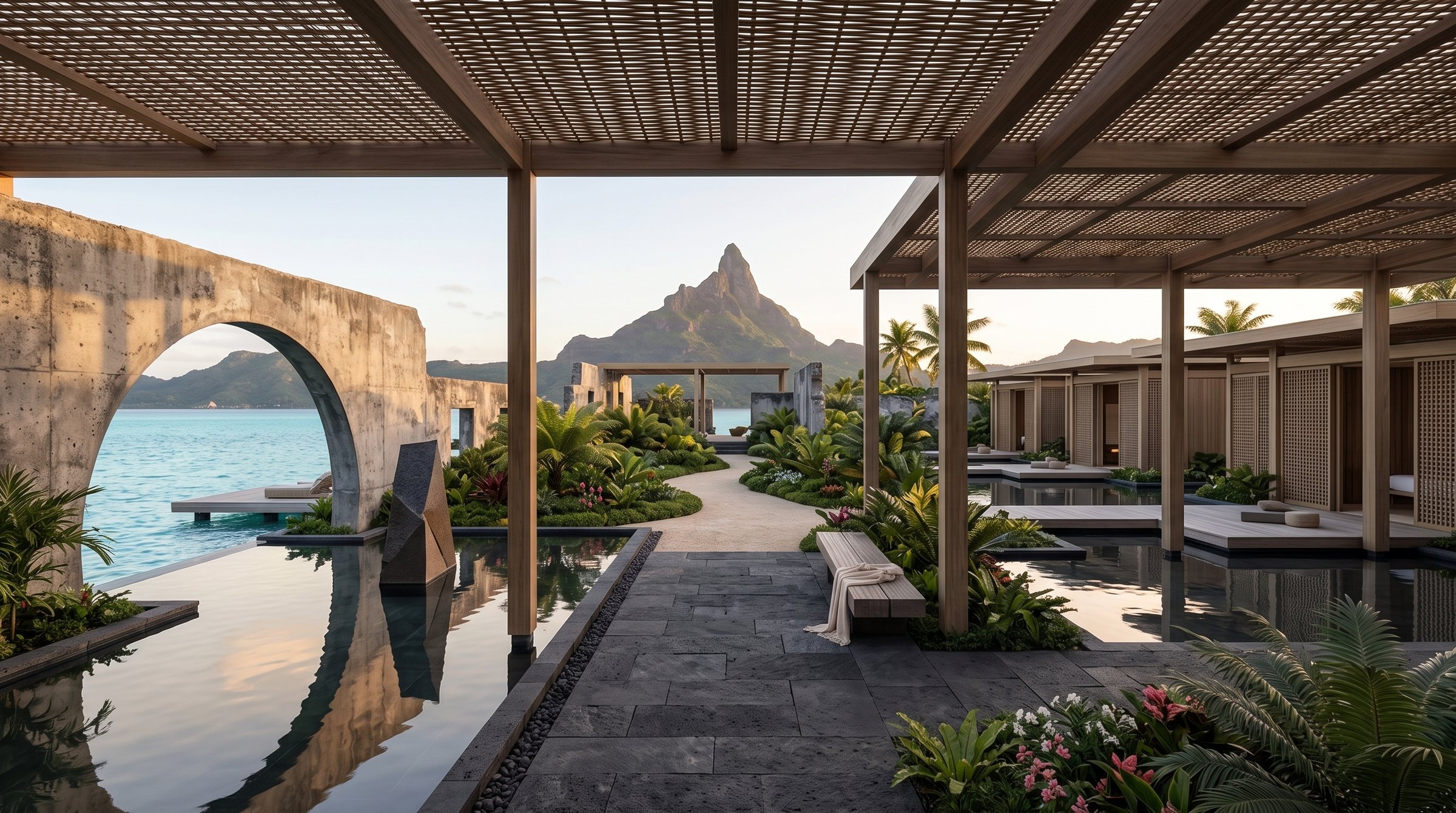
The ruins are not erased. They are edited.
Adaptive reuse in a marine climate is a test of judgement: what to keep, what to test, what to let go. This design exists to sharpen that judgement. A concept inspired by closed Bora Bora resort sites, developed independently of any owner or operator. Reuse of any structure shown here would depend on ownership verification, structural and underwater surveys, environmental assessment and French Polynesian approvals.
If a project here became live, we would work as the technical partner alongside the licensed local consultants who carry statutory responsibility in the jurisdiction — the architect of record, structural checkers, MEP and utilities engineers, and the environmental, coastal and fire specialists the approvals require. Our role is design, structural engineering, MEP coordination, BIM and construction-oriented documentation.