Isle à Quatre Grenadines Legacy Estate Resort
An uninhabited Grenadines island of roughly 376 acres, planned as a low-density legacy estate: heritage ruins restored at its heart, western bays kept distinct, villas held to the ridgelines.
ISLE À QUATRE · GRENADINES
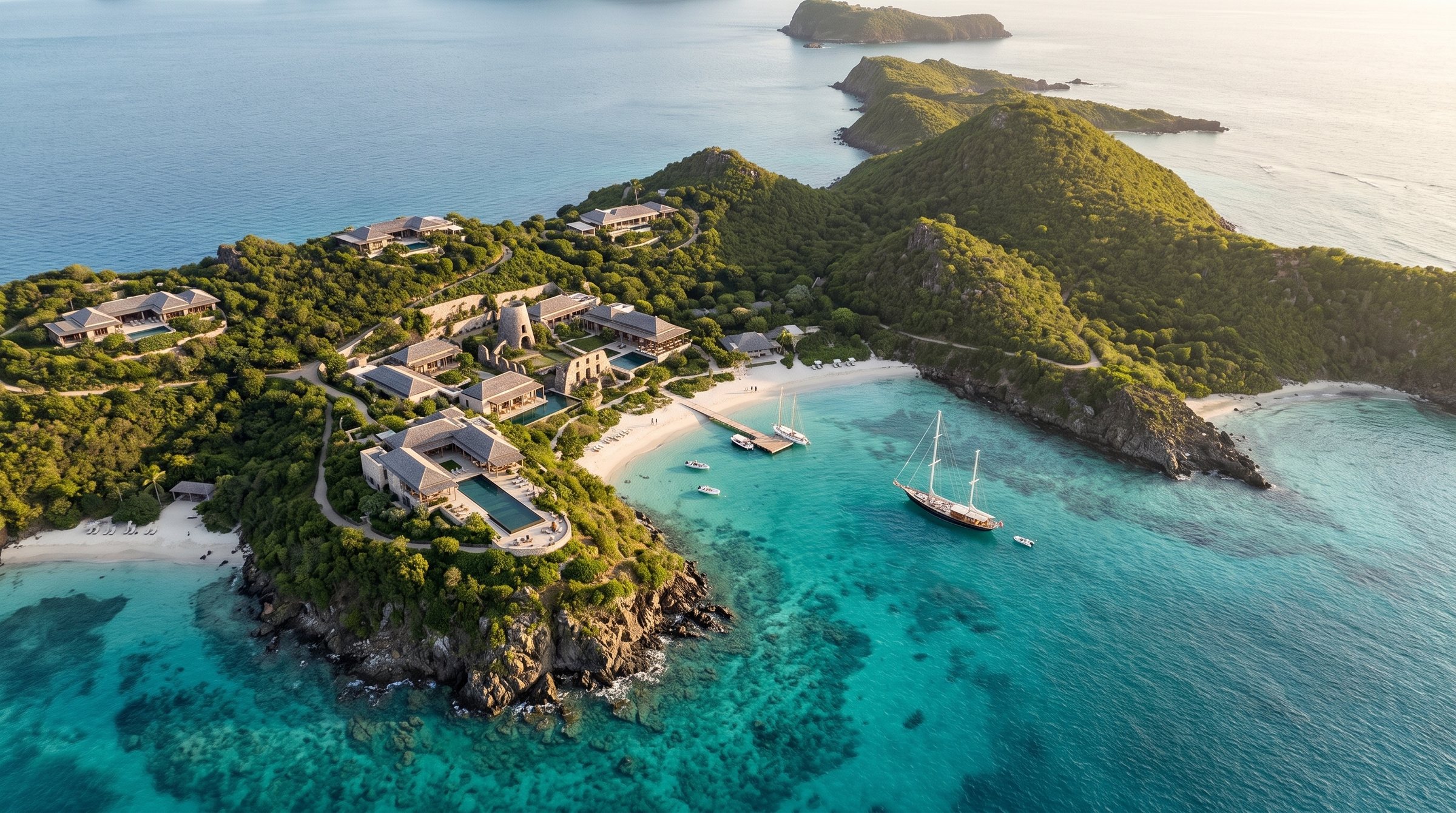
The only architecture on Isle à Quatre is a ruin, and the plan begins by taking it seriously.
Isle à Quatre sits a short sail from Bequia, within the wider Grenadines chain: roughly 376 acres, uninhabited, largely untouched, with the ruins of an old estate house and a basic cart road as the only marks of previous use. Public listings describe it as available for low-density development — a boutique hotel, up to 45 private villa plots, a possible marina — under a dedicated resort legislative framework. That brief could produce a generic luxury resort. This design argues for something slower: a legacy estate organised around the restored ruins, a chain of western bays each given a single purpose, and villas held back on the ridgelines so the coast stays legible as landscape.
| Location | Near Bequia, St. Vincent & The Grenadines |
|---|---|
| Site | Approx. 376 acres, uninhabited and largely untouched, with estate ruins and a cart road |
| Programme | Phase 1 boutique hotel of 30–40 keys with Estate Forum, beach club and wellness; later phases add 10–20 keys, villas and up to 45 private villa plots |
| Identity | A legacy estate with memory: heritage ruins, western bays, ridge villas |
| Status | Publicly listed as available; linked to a special resort legislative framework (Quatre Isle Resort Act). No affiliation. |
| Stage | Resort design — architecture, structure, MEP, BIM |
Three layers, one island.
§03 — Masterplan strategyThe plan divides the island into an estate heart, a chain of purposeful bays and sparsely settled ridgelines.
Rather than distributing buildings evenly across 376 acres, the masterplan concentrates life in three layers: the Estate Forum around the old ruins, the western bays as a sequence of distinct destinations, and villas set along ridges and view corridors. Arrival is by boat, deliberately understated. Trails and buggy paths do the connecting; a compact back-of-house does the work. Whole bays remain untouched by design.
Estate Forum
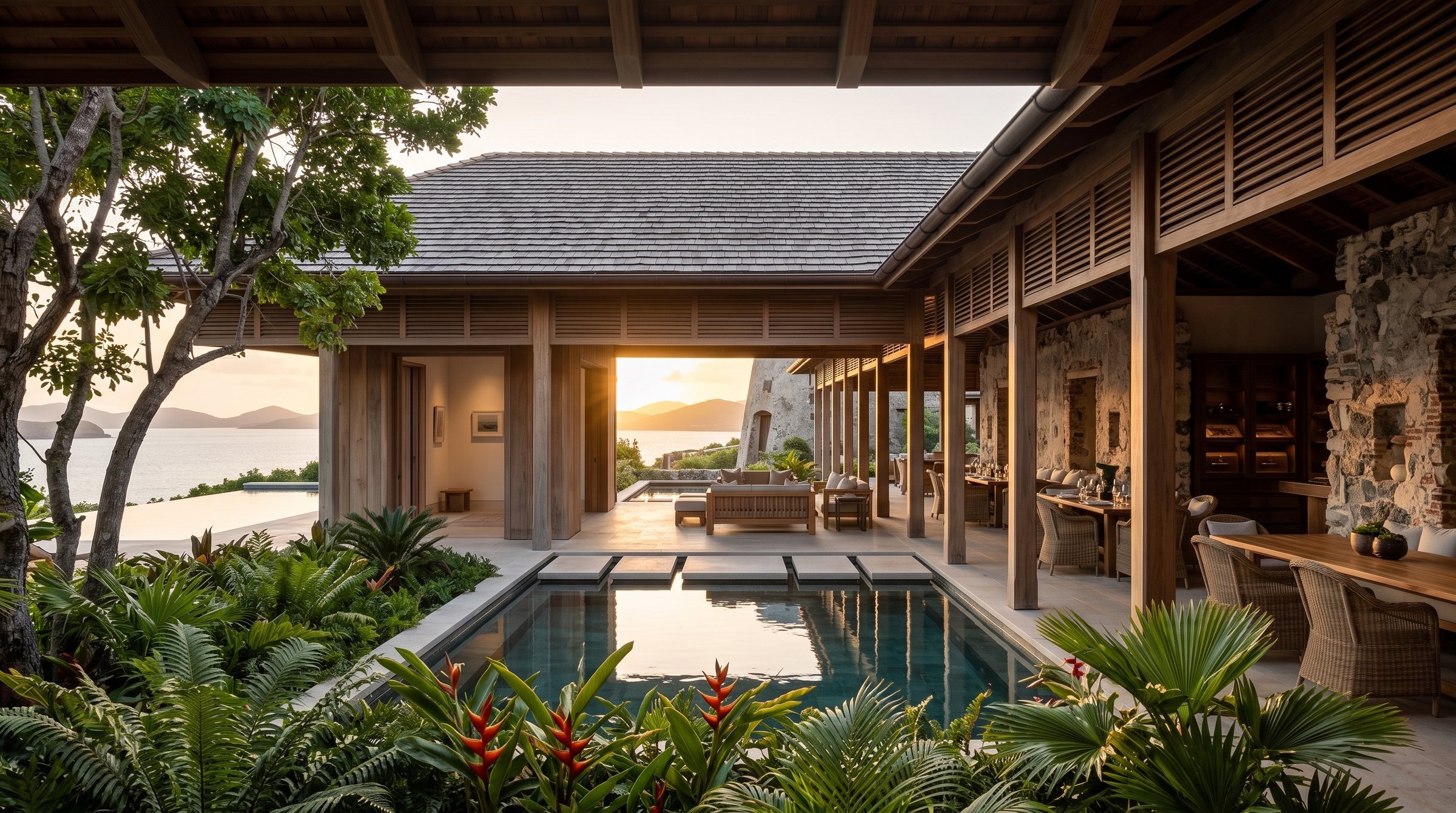
The ruins of the estate house are surveyed, stabilised and absorbed into a contemporary hospitality pavilion — arrival, dining, library, gallery and courtyard gathered around walls that keep their age visible.
Western bays
Each bay takes one role: main guest beach, wellness beach, family and water sports, yacht and tender access, and one bay left entirely to conservation. No shoreline is asked to do everything.
Villa hills
Villas sit on ridgelines and elevated sites, each with pool, shaded deck, rainwater strategy and a hurricane-resistant envelope. Placing them high keeps pressure off the beaches and gives every plot its own horizon.
Arrival and trails
Guests land at a small tender pier and walk a shaded path to the Forum. A network of walking and buggy trails links villas, beaches, spa, ruins and viewpoints without a formal road hierarchy.
Back of house
Staff housing, kitchens, laundry, desalination, wastewater treatment, solar-and-battery power, fuel and emergency storage are planned from day one — compact, screened from guest areas, and sized to grow phase by phase.
The Estate Forum.
§04 — The iconic pieceA hospitality pavilion built around the ruins of the old estate house — the island's memory made habitable.
The Forum is the heart of the resort: arrival lounge, reception, all-day dining, a signature restaurant, rum and cigar room, library, gallery and a shaded courtyard around a still pool, opening to a sunset lawn and the heritage trail. Coral stone and thick walls carry timber roof structures; deep verandas and water courts temper the heat. The ruins are not scenery. They are surveyed, stabilised and kept as the oldest layer of the plan.
Structurally it is conservative: low-rise masonry and reinforced concrete, timber roofs with engineered tie-downs, corrosion-resistant fixings and impact protection throughout. The heritage walls carry no new loads until a structural assessment says they can. Everything here is buildable with regional trades and materials long proven in the Grenadines.
Architecture, engineering, ecology.
§05 — The technical layersEstate language, restrained
Refined Caribbean estate architecture: coral stone and limestone, lime plaster, timber beams, bronze-dark metalwork, woven screens and deep roofs. Verandas and courtyards do the environmental work; hurricane shutters and shaded glass do the rest. Low-rise throughout, one to two storeys, nothing competing with the landscape.
Ruins first, roofs second
The engineering sequence starts with structural assessment and stabilisation of the heritage walls, then low-rise concrete, masonry and timber structures designed for hurricane wind and seismic exposure — engineered roof tie-downs, corrosion-resistant steel and timber connections, and impact protection at every opening.
An island that runs itself
A solar-and-battery microgrid, desalination with water storage, packaged wastewater treatment and greywater reuse — sized per phase, with no discharge near the reefs. Turtle-safe beach lighting, stormwater managed along natural drainage paths, conservation bays held undeveloped, and emergency shelter planning built into the brief.
Phased and fully modelled
The design is structured for a three-phase build, so the BIM model carries phasing logic from the start: hotel core first, villas second, estate community last. Structure, MEP and infrastructure are coordinated in one model, ready for local consultants to test against surveys and approvals.
An island this intact deserves a plan that mostly leaves it alone.
It is the studio's most complete test of estate-scale masterplanning: heritage reuse, phased infrastructure and hospitality design carried in a single coordinated model. Isle à Quatre is privately owned and publicly listed for sale; we have no affiliation with its owners, brokers or authorities. This is a design concept — any project on the ground would require title review, planning approval under St. Vincent & The Grenadines law, environmental assessment and licensed local consultants.
If a project here became live, we would work as the technical partner alongside the licensed local consultants who carry statutory responsibility in the jurisdiction — the architect of record, structural checkers, MEP and utilities engineers, and the environmental, coastal and fire specialists the approvals require. Our role is design, structural engineering, MEP coordination, BIM and construction-oriented documentation.