Hauraki Gulf Island Rebirth
A repositioning design for Pakatoa, a former resort island near Auckland: fewer, better rooms, restored landscape and a new pavilion built for fire, wind and cool light.
PAKATOA · HAURAKI GULF · NZ
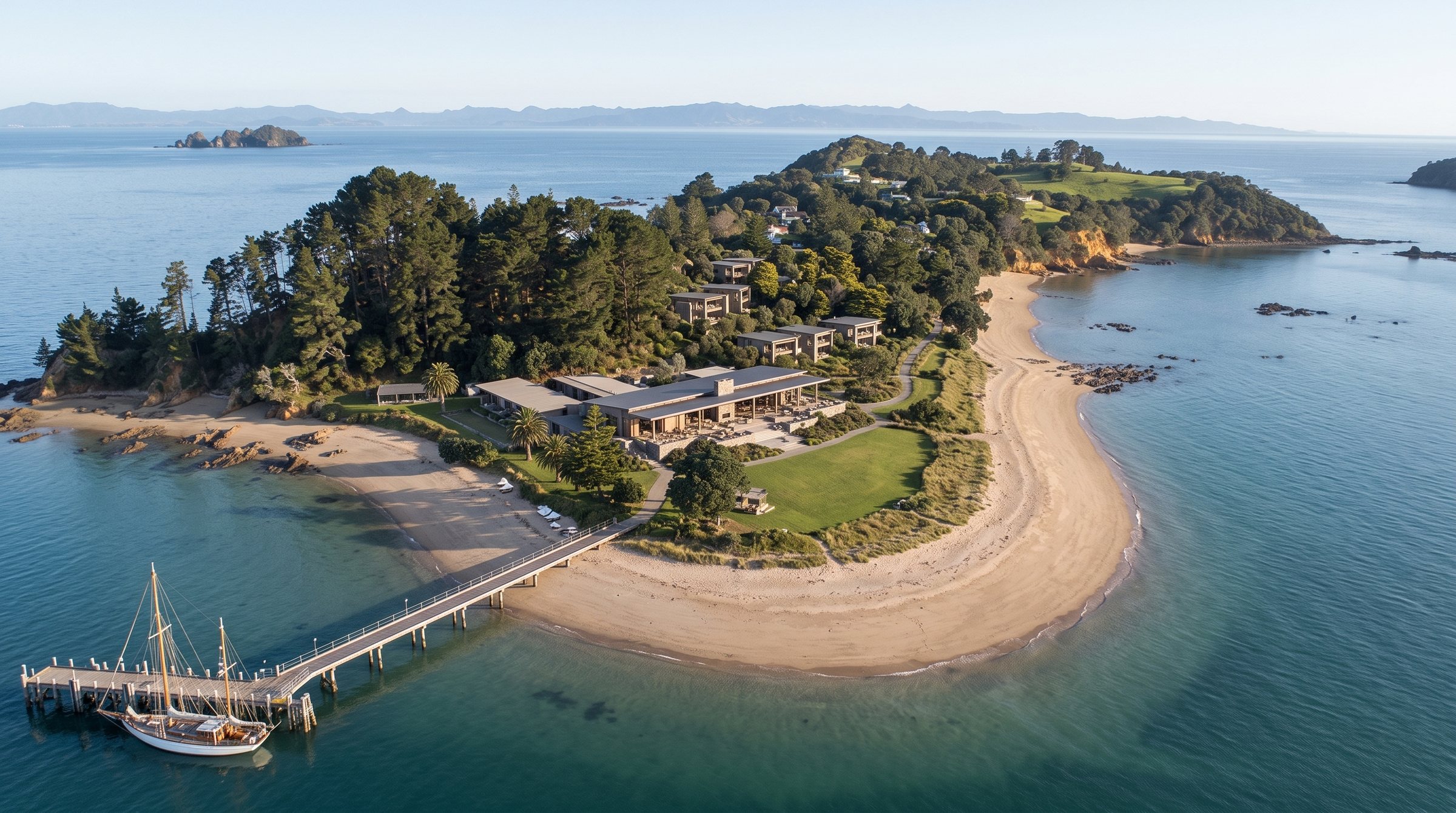
Pakatoa already has 62 rooms and a golf course; the question is what to keep.
Pakatoa Island sits in the Hauraki Gulf within reach of Auckland: about 24 hectares of freehold land, publicly listed as a former resort awaiting refurbishment. The inventory is substantial — 62 accommodation units, a conference centre, a golf course, three beaches, a deep-water wharf, solar and bore infrastructure — and much of it is obsolete. The design proposes a mature repositioning: audit everything, remove or repurpose the poor-quality units, consolidate into fewer and better suites, and build one strong public pavilion as the new heart. The palette is temperate: timber, stone, fireplaces, shelter from wind. Listings note the island as OIO-sensitive land, so any overseas acquisition would face consent review before a single drawing mattered.
| Location | Pakatoa Island, Hauraki Gulf, New Zealand |
|---|---|
| Site | Approx. 60 acres / 24 hectares, freehold; three beaches, deep-water wharf, solar and bore infrastructure |
| Programme | 40–70 keys retained and reworked from 62 existing units; conference, wellness, private buyout events |
| Identity | Mature island retreat near Auckland; wellness, food, wine, art and sailing |
| Status / Context | Publicly listed former resort; noted as OIO-sensitive land, with resource and building consents governing redevelopment |
| Stage | In-house resort design — architecture, structure, MEP, BIM |
Fewer rooms, better island.
§03 — Masterplan strategyThe plan subtracts before it adds: audit, consolidate, restore, then build one new heart.
All 62 units, the conference spaces, the wharf and the infrastructure are assessed first. Poor-quality buildings are removed or repurposed; the keys consolidate into fewer, better suites. The Gulf House becomes the social and operational core. Landscape work restores walking routes, beaches, the golf and nature areas and native planting. Underneath it all, water, wastewater, fire, power, access and emergency systems are upgraded, because a decades-old island resort is mostly an infrastructure problem wearing architecture.
Audit Everything First
Every accommodation unit, conference space and service building is condition-surveyed before design begins, alongside the wharf and utilities. The audit decides what is kept, upgraded or removed; sentiment does not get a vote.
Consolidate the Keys
Obsolete units are removed or repurposed, and the room count settles at 40–70 refurbished keys. Fewer, larger, warmer suites suit the Auckland retreat market better than a full sheet of tired rooms.
A New Retreat Core
The Gulf House becomes the island's social and operational heart, binding dining, conference and wellness into one sheltered building and replacing the scattered pavilions of the old resort with a single address.
Restore the Landscape
Walking routes, three beaches, the former golf ground and native planting are restored as the island's principal amenity. Coastal margins and ecology are protected as the consenting process will likely require anyway.
Upgrade the Utilities
Water, wastewater, fire safety, power, access, wharf and emergency systems carry the project. Compliance with the New Zealand Building Code (seismic, wind, moisture, durability, accessibility) is treated as the design brief, since consent will treat it that way regardless.
The Gulf House.
§04 — The iconic pieceA sheltered pavilion of timber, stone and glass, organised around fire, wind and cool southern light.
The Gulf House holds the island's new centre: arrival lounge, dining room, fireplace lounge, conference salon, wine room, library, a spa threshold and a terrace opening to the gulf. Where the tropical concepts in this series chase shade, this building chases shelter: wind protection, warm interiors, low sun. It gives corporate retreats, wellness programmes and private events one dignified address on the island.
Timber and stone construction with high-performance glazing and metal roofing sits comfortably inside New Zealand's building culture. Seismic and wind detailing, moisture management and durability provisions follow the Building Code; fire and accessibility upgrades extend from the pavilion into the refurbished suites around it.
Architecture, engineering, ecology.
§05 — The technical layersNew Zealand coastal modernism
Timber, local stone, metal roofing and durable cladding, with wool and natural fabrics inside. Warm interiors, fireplaces and sheltered terraces replace the tropical clichés; the atmosphere is a mature retreat for weather that changes its mind.
Assessment before ambition
Structural assessment of 62 existing buildings drives the project: seismic capacity, moisture damage, durability and remaining life. New work uses robust New Zealand seismic, wind and moisture detailing, and the wharf receives its own engineering review.
Systems carry the retreat
Wastewater upgrades are assumed from the outset, alongside water, fire, power and emergency systems. Ferry, wharf and helicopter logistics are planned with evacuation in mind, and coastal margins and native ecology are protected through the consenting process.
Survey to digital twin
A BIM survey model of the existing estate becomes the working record: condition data, staged demolition, refurbishment sequencing and a staged-reopening strategy documented so the island can trade while compliance-driven redevelopment proceeds.
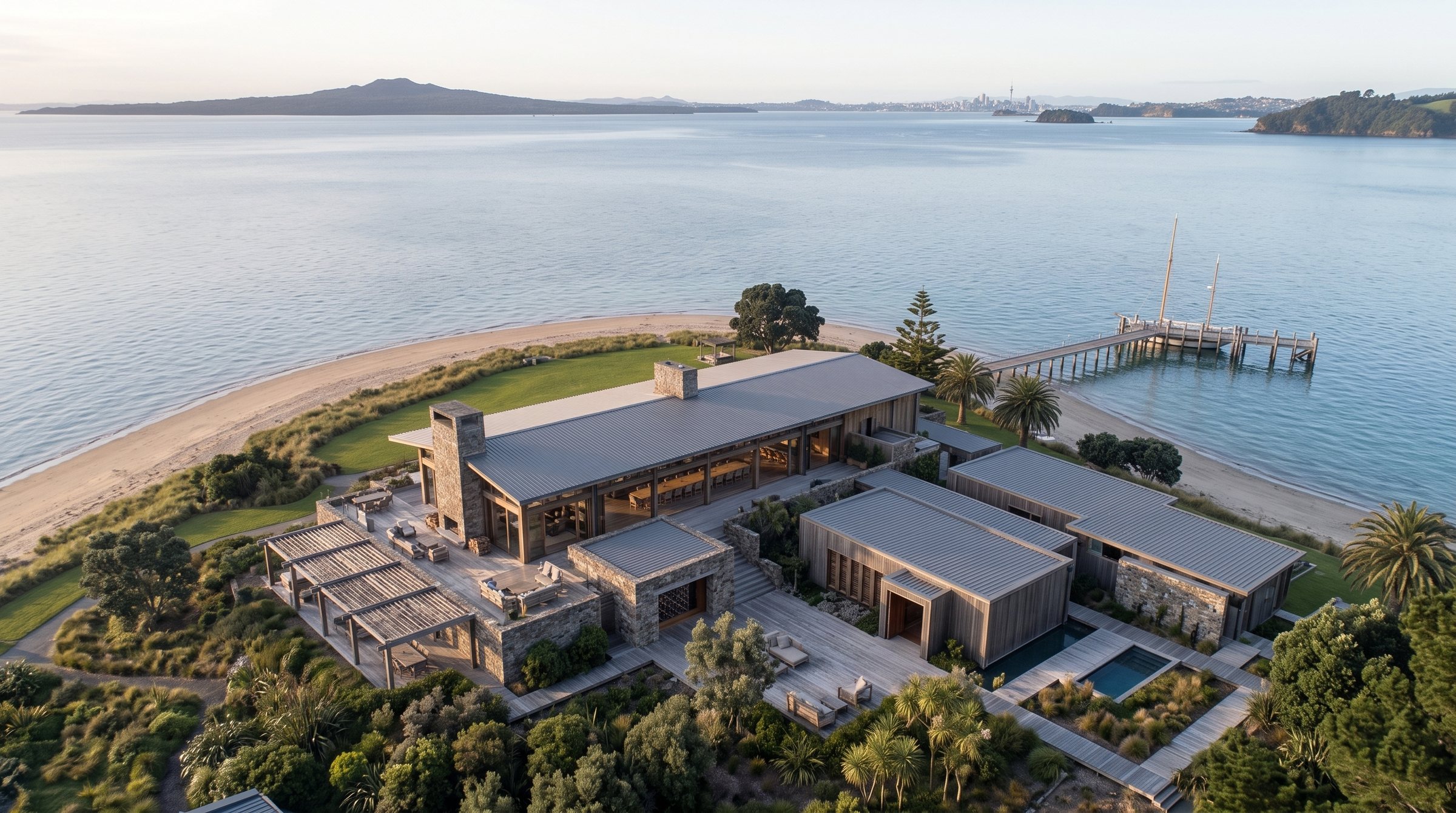
Subtraction, done well, is the most valuable work on this island.
Former-resort recovery close to a major city is the most transferable brief in the series: audit, compliance, phased reopening. The same method applies wherever a tired asset needs a second life. Pakatoa is privately owned and publicly listed; this concept is independent and unaffiliated with any owner, broker, iwi or New Zealand authority. The island is noted as OIO-sensitive land, and any redevelopment would depend on resource and building consents and mana whenua consultation.
If a project here became live, we would work as the technical partner alongside the licensed local consultants who carry statutory responsibility in the jurisdiction — the architect of record, structural checkers, MEP and utilities engineers, and the environmental, coastal and fire specialists the approvals require. Our role is design, structural engineering, MEP coordination, BIM and construction-oriented documentation.