Devil's Cay / Neptune's Nest Bluewater Hideaway
Roughly 117 freehold acres with white sand on both shores and deepwater at the door — planned as a boutique hideaway for fishing, diving and doing very little, extremely well.
DEVIL'S CAY · BERRY ISLANDS
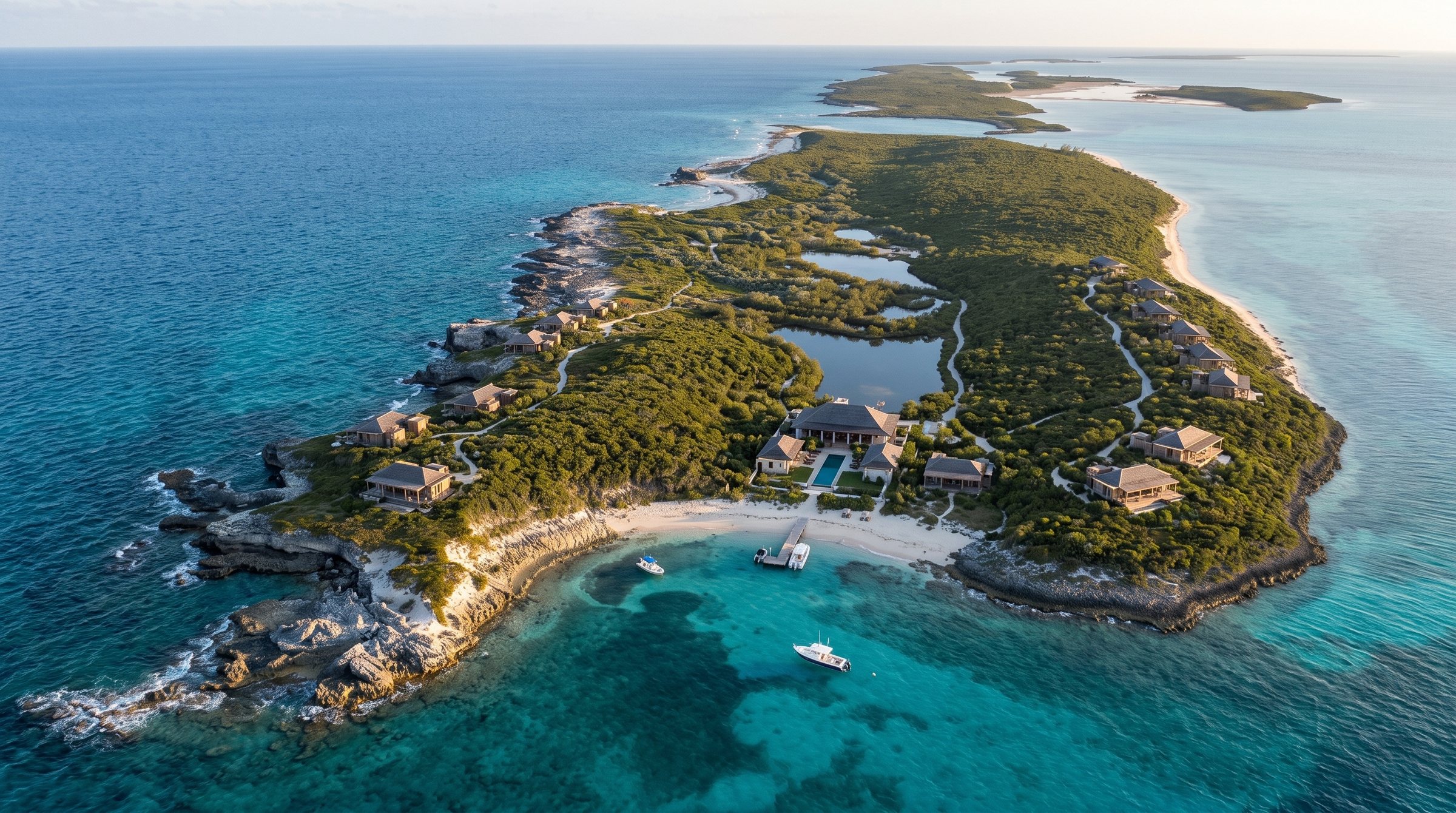
Two coastlines of white sand, deepwater access, and no reason to build anything large.
Devil's Cay — listed also as Neptune's Nest — sits in the Berry Islands: roughly 117 freehold acres, uninhabited and undeveloped, with white-sand beaches on both eastern and western shores, coves, ponds, ridges and bluffs, and deepwater access in an established fishing and yachting region. Nearby airstrips at Great Harbour Cay and Chub Cay keep it reachable. The design reads it as a bluewater hideaway at boutique scale: 20 to 35 keys, five to ten villas, no large hotel and no large marina. The central marsh, sometimes discussed as a potential inner harbour, is handled with suspicion rather than enthusiasm — an ecological basin first, a sheltered water court only if the environmental studies ever say yes.
| Location | Devil's Cay / Neptune's Nest, Berry Islands, The Bahamas |
|---|---|
| Site | Approx. 117 acres, freehold, uninhabited; beaches on both shores, coves, ponds, ridges, bluffs and deepwater access |
| Programme | 20–35 keys, 5–10 private villas, Bluewater Court pavilion, fishing and dive operations; no large hotel or marina |
| Identity | Boutique bluewater hideaway for fishing, diving and yachting |
| Status | Publicly listed as available; near Great Harbour Cay and Chub Cay airstrips. No affiliation. |
| Stage | Resort design — architecture, structure, MEP, BIM |
Small plan, deep water.
§03 — Masterplan strategyEverything is organised around one pavilion, two beaches and the discipline to leave the marsh alone.
Arrival is by boat, straight off the deepwater. The Bluewater Court anchors social life at a protected cove; beach villas sit behind the vegetation line, ridge villas take the bluffs for long views and surge protection. The central marsh is preserved as habitat, with any future water court strictly conditional on environmental and coastal engineering studies. A small but complete technical base runs it all.
Deepwater arrival
Deepwater access is the island's practical gift: boats arrive without dredging, channels or breakwaters. A low-impact dock and moorings serve guests, fishing and dive operations, keeping the marine works honest from day one.
The Bluewater Court
One pavilion faces a protected cove and concentrates the club: restaurant, bar, fishing club, dive centre, small spa, shaded courtyard and a boat deck with proper gear storage.
Beach villas
Villas along the shores sit behind the beach vegetation with conceptual setbacks of 30 to 50 metres, leaving turtle nesting beaches as no-build, low-light zones and both sand edges uninterrupted.
Ridge villas
A few premium villas take the higher bluffs, lifted clear of storm surge and aimed at long water views. Height comes from the landform, since every building stays at one or two storeys.
Inner water option
The central low marsh is treated as an ecological basin and possible controlled small-boat refuge. It stays untouched unless environmental and coastal engineering studies support a protected water court.
The Bluewater Court.
§04 — The iconic pieceA refined island club at the water's edge, built around fishing, diving and long dinners.
The Bluewater Court is the island's one significant public building: arrival lounge, restaurant and bar, fishing club, dive centre, small spa, shaded courtyard with a still pool and a boat deck with storage for serious gear. It faces a cove or protected water condition, so boats, swimmers and dinner tables share the same view. The tone is a working club with good manners — stone, timber, deep shade and marine-grade hardware.
It is a low-rise, hurricane-resistant pavilion: elevated floors where flooding threatens, roof tie-downs and wind uplift resistance engineered to Bahamian expectations, hurricane shutters or impact glazing, and corrosion-resistant fixings throughout. A building this simple can be documented completely, built by a small team and maintained by island staff.
Architecture, engineering, ecology.
§05 — The technical layersBarefoot, but disciplined
Bahamian minimalism with fishing-club restraint: low pavilions of coral stone and limestone, timber, lime plaster and metal roofs, with woven screens, shaded glass and stone paving. Barefoot luxury is the register, but every material is chosen for salt, sun and the practicalities of marine operations.
Engineered for the surge
Low-rise hurricane-resistant structures with elevated floors in flood-prone areas, engineered roof tie-downs and wind uplift resistance, corrosion-resistant fixings and a low-impact dock. An emergency shelter and stormwater management complete a scope that assumes the storm season is annual, because it is.
Autonomous by necessity
A standalone microgrid, desalination and water storage, wastewater treatment and disciplined fuel and maintenance safety make the island self-sufficient. Ponds, wetlands and habitat zones are preserved outright, turtle beaches stay dark, and a low-light night strategy protects both wildlife and the atmosphere guests pay for.
Boutique scale, full rigour
The Bahamas approvals path — building permit, DEPP clearance, CEC, and EIA/EMP where triggered — is mapped into the documentation plan from the outset. A compact federated model covers architecture, structure and MEP, keeping a boutique project cheap to coordinate and credible to regulators.
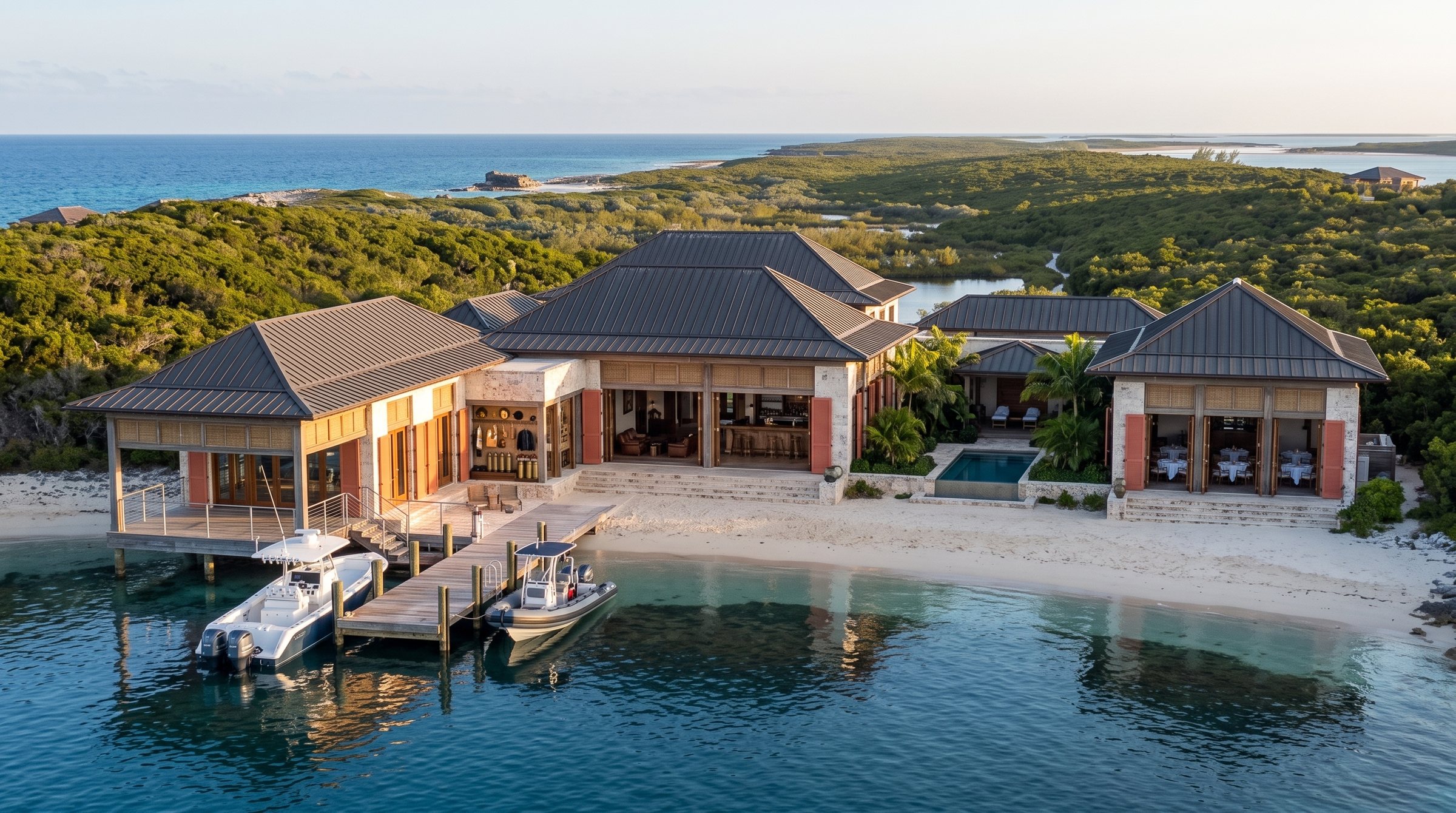
A hideaway succeeds by what it declines to build.
It is the series' most buildable brief — a test of whether the studio's documentation rigour scales down gracefully to a small island, a small team and a controlled budget. Devil's Cay / Neptune's Nest is privately owned and publicly listed; we have no affiliation with its owners, brokers or Bahamian authorities. The central marsh is treated as habitat unless studies prove otherwise, and any real project would require Bahamian permits, DEPP clearance and EIA where triggered.
If a project here became live, we would work as the technical partner alongside the licensed local consultants who carry statutory responsibility in the jurisdiction — the architect of record, structural checkers, MEP and utilities engineers, and the environmental, coastal and fire specialists the approvals require. Our role is design, structural engineering, MEP coordination, BIM and construction-oriented documentation.