Carpathian Wellness Retreat
A mountain wellness resort held low against the slope — stone, timber and concrete arranged around framed views and still water.
§C-05 · 45.3°N 24.6°E · DESIGN
Masterplan.
§02 — masterplanThree low bars stepping with the contours, not cutting across them.
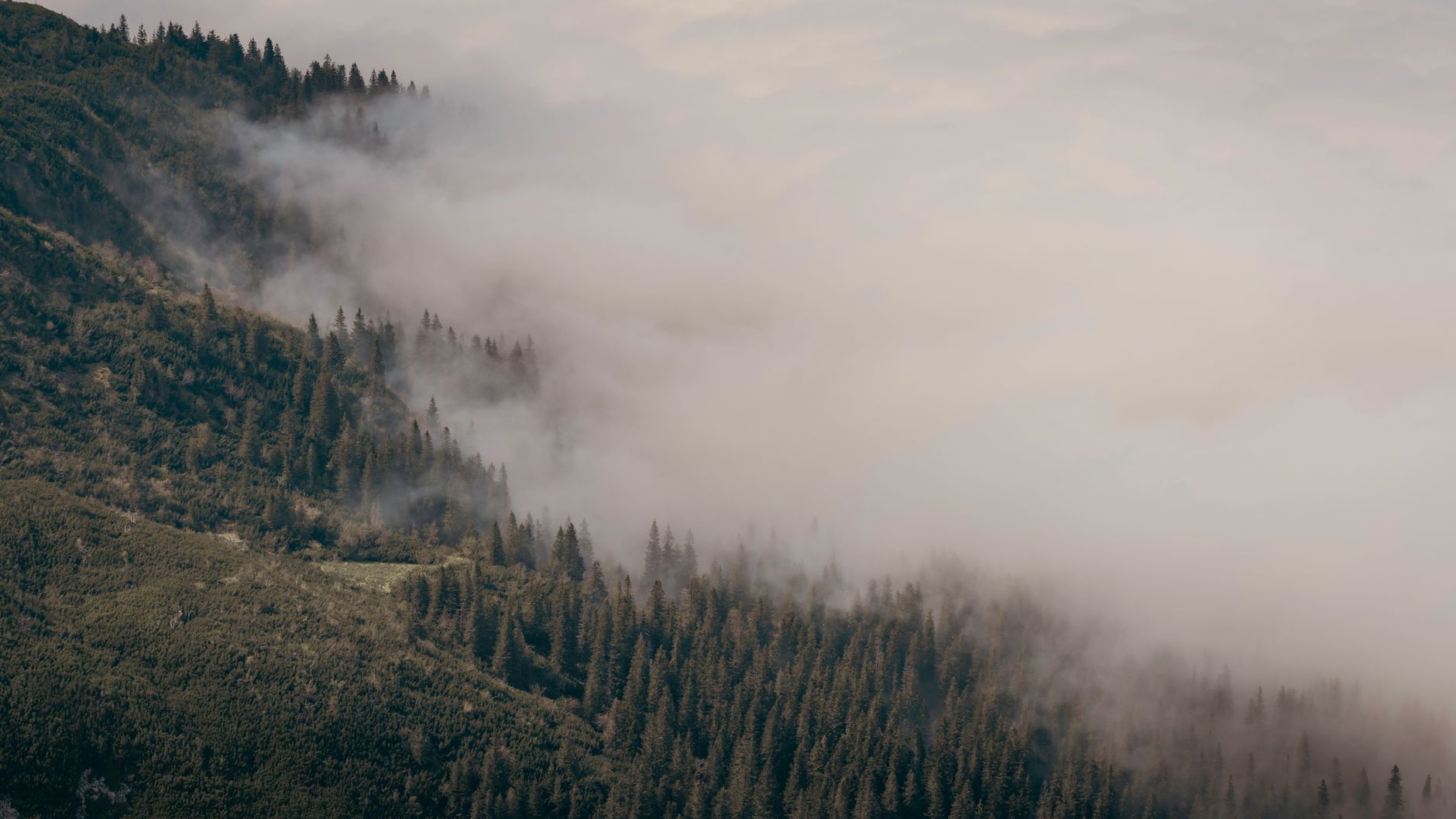
The design sets a long horizontal resort into a north-facing Carpathian slope, above the tree line of the spruce forest and below the exposed ridge. A spa and thermal pavilion holds the lowest terrace, close to a small collected lagoon of meltwater. Guest rooms occupy the middle bar, each opening to a single framed view of the valley. Arrival, kitchen and back-of-house sit uphill, screened by planting and a stone retaining line.
Movement is kept short and level. A single covered spine links the three bars, so a guest can cross the resort in a robe without meeting weather or a service route. Vehicles stop at the top of the site; the rest is walked. The masterplan is measured against snow load, prevailing wind and the low winter sun, and every long elevation is turned to earn a specific view rather than a panorama.
Architecture.
§03 — architectureCalm and horizontal — stone bases carrying timber upper floors.
Long volumes read as stone bases carrying timber upper floors, with concrete used where structure meets ground and water. The palette is mineral and warm: local stone laid in deep courses, spruce and larch left to grey, and board-marked concrete at the thermal pool. Roofs are low-pitched and broad, sized for snow to sit and shed on the studio's terms rather than the storm's.
Interiors are warm against the cold outside. Timber linings, dark stone floors with underfloor heat, and small deep windows that frame one thing each — a stand of trees, a rock face, the surface of the lagoon. Glazing is rationed and placed, not spread; the building spends its openings where the view earns them. Light is treated as a material: low and raking in winter, filtered through timber screens in summer. The result is an interior that spends nothing on effect and leaves the drama to the mountain.
Structural strategy.
§04 — structureA mixed timber, steel and concrete scheme — each material used where it is honest.
Reinforced concrete forms the plinth, the retaining systems and the wet cores at the spa, where durability against water and freeze-thaw governs. Cross-laminated and glue-laminated timber carry the guest bars and the covered spine, keeping the upper structure lightweight and warm and shortening the on-site programme through prefabrication. Steel is reserved for the long-span moments — the thermal pavilion and the arrival canopy — where a slender frame does what timber and concrete should not be asked to.
Concrete plinth & retaining
Reinforced concrete for the plinth, retaining systems and wet cores at the spa, detailed for freeze-thaw and de-icing exposure where weather and water reach it.
Timber guest bars
Cross-laminated and glue-laminated timber carry the guest bars and covered spine — lightweight, warm and prefabricated, with connections detailed for moisture and movement.
Steel long-spans
Slender steel frames at the thermal pavilion and arrival canopy, reserved for the long-span moments where timber and concrete should not be asked to reach.
Snow, wind & seismic
Roofs sized for mountain snow load including drift and sliding accumulation; lateral design for ridge-exposed wind and seismic action to the Romanian code, with stepped footings following the slope.
MEP & sustainability.
§05 — servicesThe wellness programme drives the services — coordinated early, not fitted late.
Thermal pools, saunas, treatment rooms and a commercial kitchen carry heavy loads for heating, ventilation, humidity control and water treatment. Pool plant, heat recovery and air handling are given planned space and planned routes, so the mechanical strategy and the architecture are drawn together from the first section.
Thermal efficiency leads the environmental approach. A heavy, well-insulated envelope, controlled and modest glazing, and thermal mass in the stone and concrete hold heat through cold nights. Heat recovery links the warm, humid spa air to fresh-air pre-heat; ground-source heat is studied as the primary source, with solar thermal supporting pool and domestic hot water. Water is treated, buffered and, where possible, reused. The measure of success is a building that stays warm quietly — low in energy demand, calibrated to a cold climate, and detailed so the services disappear into the architecture.
BIM & documentation.
§06 — BIMStructured to become one coordinated model — from concept to construction.
Architecture, structure and MEP are developed as disciplines in one federated BIM environment, with the structural frame modelled in Tekla Structures for the steel and timber connections and the prefabricated elements. Clash detection, coordinated sections and quantities come from the model, not from redrawn 2D, so the timber, steel and concrete interfaces are resolved before they reach site.
Documentation is construction-oriented and IFC-based, so it can be shared cleanly with a local design and construction team. For any built version, the studio would act as a technical partner alongside local consultants, issuing coordinated models and drawings into their statutory and approval processes. The aim is continuity from concept to construction — one model carrying the design from this concept through to buildable detail.
International Resorts
Resort design and engineering beyond the flagship destinations — mountain, alpine and remote sites included.
Open → CONCEPTEco Island Sanctuary
The other concept beyond the flagship destinations — a low-impact island resort weighing logistics, water and power against a light footprint.
Open → PROOFOur built and ongoing work
Transferable proof — the Spa Center at Gighera, public buildings and steel/Tekla halls.
Open →A resort that feels held by the mountain, not staged on it.
An in-house resort design by Ionescu-Lupeanu Design & Engineering. For international and cross-border projects — including Central European mountain work — local approvals, statutory submissions, code compliance and professional sign-off are handled together with local licensed architects, engineers, structural checkers, EIA consultants, fire consultants and MEP/utilities consultants. The studio is a technical partner and does not replace local consultants.